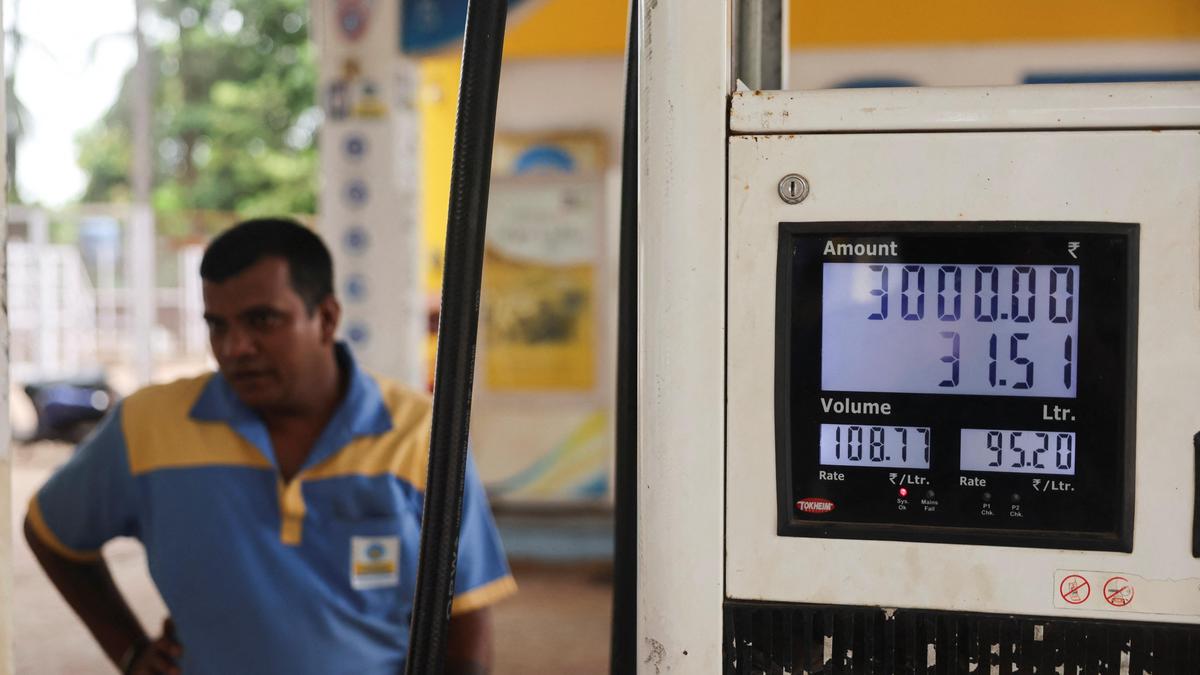
India’s state-run oil marketing companies – Indian Oil Corporation (IOC), Bharat Petroleum Corporation (BPCL), and Hindustan Petroleum Corporation (HPCL) – raised retail petrol and diesel by ₹3 per litre and compressed natural gas (CNG) by ₹2 per kg on Friday. The move shatters a domestic pump-price freeze that had been locked in place since March 2024, the longest stretch of unchanged fuel rates since pricing was formally deregulated.
The immediate market read will frame this as margin repair for OMCs that were absorbing staggering daily losses. That read is incomplete. A ₹3 bump trims the under-recovery on diesel from ₹100 per litre to roughly ₹97 per litre. The political machinery that enforced the freeze for over two years is already pushing back. Traders need to assess the sequence, not just the single hike, and decide how many more increments the Centre will tolerate before policy arithmetic collides with electoral reality.
A Rs3/Litre Hike That Ends a 26-Month Consumer-Price Freeze
The last time Indian consumers faced a fuel price increase was April 2022. In March 2024, the government trimmed petrol and diesel by ₹2 per litre ahead of the Lok Sabha elections. After that cut, pump prices stayed frozen, regardless of where global crude traded, because state-run OMCs are acutely sensitive to electoral pushback. Technically, fuel pricing is deregulated and OMCs can revise rates daily based on a fortnightly average of international crude prices. In practice, the commodity’s political weight turned that daily freedom into a two-year standstill.
Why the Freeze Held and What Changed Now
The freeze was not a policy oversight. OMCs banked healthy marketing margins when crude was subdued and retail prices stayed elevated relative to import cost. That cushion disappeared once Brent crude punched through $100. By Friday morning, July Brent futures traded at $107.04, up 1.25%, and June WTI stood at $102.50, up 1.31%. With those input costs, the OMCs were losing an estimated ₹20 per litre on petrol and ₹100 per litre on diesel – burn rates that no quarterly earnings presentation can absorb indefinitely. A state election cycle just concluded, giving the Centre a narrow window to act without immediate electoral blowback. That window opened the door for Friday’s increase.
Congress general secretary Jairam Ramesh warned the hike would push inflation toward 6% and lower growth estimates considerably. The pushback confirms the political sensitivity. The window that permitted Friday’s adjustment may remain open for weeks, not months, if state-level opposition crystallises.
Under-Recovery Math: From ₹100/L to ₹97/L on Diesel
Before the hike, the OMCs were bleeding ₹20 per litre on petrol and ₹100 per litre on diesel. A ₹3 per litre increase directly reduces that under-recovery by the same amount, assuming no offsetting change in the fortnightly crude average. The post-hike implied losses are roughly ₹17 per litre for petrol and ₹97 per litre for diesel.
- Petrol: pre-hike under-recovery ₹20/L, post-hike ₹17/L
- Diesel: pre-hike under-recovery ₹100/L, post-hike ₹97/L
- CNG: price increase of ₹2 per kg, reflecting higher domestic gas costs
- Diesel consumption accounts for roughly 40% of India’s petroleum product demand; a ₹97/L residual loss still implies a cash burn of hundreds of crores daily across the three OMCs
These numbers carry a clear message. The hike is a signal that some pass-through will be permitted. It is not a signal that full cost recovery is the destination. A full reversal of the diesel gap would require a ₹100 per litre pump-price increase – an impossibility in the current environment.
Brent at $107 and the Geopolitical Trigger
The immediate spark for Friday’s crude spike was a claim from US President Donald Trump that China wants to buy American crude. That headline piled a fresh geopolitical premium on top of the ongoing West Asia conflict. Oil Jumps 1.55% on Trump’s China Crude-Buy Claim, Hormuz Pledge detailed how such remarks inject intraday volatility into an already taut futures curve.
MCX May crude oil futures traded at ₹9,829, up 1.08% from the previous close. May natural gas futures on MCX were at ₹280.40, up 1.08%. The CNG price hike of ₹2 per kg reflects the pass-through of higher domestic gas costs. City gas distributors and commercial transport operators who had budgeted on stable CNG prices now face a direct input-cost increase.
The timing was brutal for the OMCs. The fortnightly average was already climbing toward levels that made the existing retail prices untenable. Trump’s comment ensured the crude benchmark pushed higher just as the pricing review window opened. If Brent holds above $105 through the next two weeks, the next fortnightly average will force the same arithmetic that produced Friday’s decision, only with a larger cumulative loss built up since the freeze.
Who Carries the Cost: Transport, Logistics, and Inflation
The naive sector read says higher pump prices benefit OMCs. The better read is that the ₹3 hike is too small to fix their earnings, and the real sector impact flows through transportation, logistics, and inflation-sensitive industries whose input costs are now rising with no guarantee of demand elasticity.
- Road transport and logistics firms see diesel climb ₹3/L overnight, tightening already thin margins in the trucking and fleet-operator space. If additional hikes follow, freight rates will have to rise, feeding into the cost of every shipped good.
- Consumer goods and FMCG distribution networks run on diesel. A sustained fuel-price climb directly pushes distribution costs higher, a headwind for companies already watching rural demand.
- Paint and tyre manufacturers face the double pressure of higher crude-linked raw material costs (solvents, carbon black) and elevated freight expenses.
- Commercial CNG users, especially auto-rickshaw and cab fleets, absorb the ₹2/kg increase, narrowing the operating cost advantage that compressed natural gas had over petrol.
None of these pressures show up in a single session. They become material if the fortnightly review cycle produces another two or three ₹3-style increments over the next six weeks. That scenario would shift the macro conversation from “one-off price adjustment” to “structural fuel-cost re-base.”
Equity Markets Shrug; Fortnightly Review Carries the Real Signal
Indian equity indices barely flinched. The BSE SENSEX fell 64.22 points, or 0.09%, to 75,334.50. The NSE NIFTY 50 shed 1.55 points to 23,688.05. The near-flat session with a negative bias suggests the fuel hike was widely expected after the West Asia-driven crude spike and the conclusion of state elections. The market is not yet pricing an aggressive pass-through cycle that would choke consumption.
The subdued reaction does not mean traders are complacent. Attention has already shifted to two factors: the ongoing US-China summit and the next fortnightly pricing review. An agreement that hints at stable or lower crude prices would remove immediate pressure from OMCs and curb the risk of further fuel hikes. A breakdown that sends crude above $110 would resurrect the debate about another ₹3–₹5 per litre adjustment within weeks.
IOC, BPCL, HPCL: The Stocks That Need a Clear Policy Signal
Shares of IOC, BPCL, and HPCL opened without a strong directional move on Friday, confirming that the market reads the hike as insufficient to change the earnings narrative. The real value of the move may be psychological: it establishes that the government will permit OMCs to adjust prices when crude costs become unmanageable, even if the adjustment is deliberately incomplete.
Key insight: The ₹3 hike is a political test balloon. If it sticks without a rollback, OMCs will likely press for further small increases in the next fortnightly review, rebuilding a cadence of periodic price adjustments that was abandoned two years ago.
If that cadence does not materialise, the stocks will keep pricing a government-imposed subsidy mechanism – either an excise cut or direct fiscal transfers that blunt the earnings recovery the hike seemed to promise.
What the Next Fortnightly Window Decides
The pricing formula OMCs follow is based on a fortnightly rolling average of international crude prices. The current adjustment window captured the spike toward $107 Brent. If crude holds above $105 for the next two weeks, the average will push higher, and OMCs will face the same arithmetic that forced Friday’s decision, only with a larger accumulated loss.
- Watch the MCX crude futures settlement each day. A sustained level above ₹9,500 makes another hike probable.
- Track OMC under-recovery disclosures. If the per-litre loss on diesel stays above ₹95, the pressure to act will not fade.
- Monitor state-level political statements. The Karnataka Deputy Chief Minister’s reaction is a template. If multiple states join the chorus, the Centre may revert to a fiscal-subsidy route – an excise cut or a direct transfer – rather than let pump prices rise further.
Risk to watch: A government-imposed cap on retail prices, or a surprise excise-duty reduction, would immediately erase the margin relief that OMCs just captured, while potentially tightening the fiscal position. Traders in IOC, BPCL, and HPCL need a clear signal that the Centre will allow the fortnightly formula to work before they can re-rate the stocks.
Friday’s ₹3 bump is a start. The real decision point arrives at the next pricing review, when the size and speed of further pass-through will reveal whether India is returning to market-linked fuel pricing or simply exchanging one politically managed freeze for a drip-feed of incomplete adjustments.