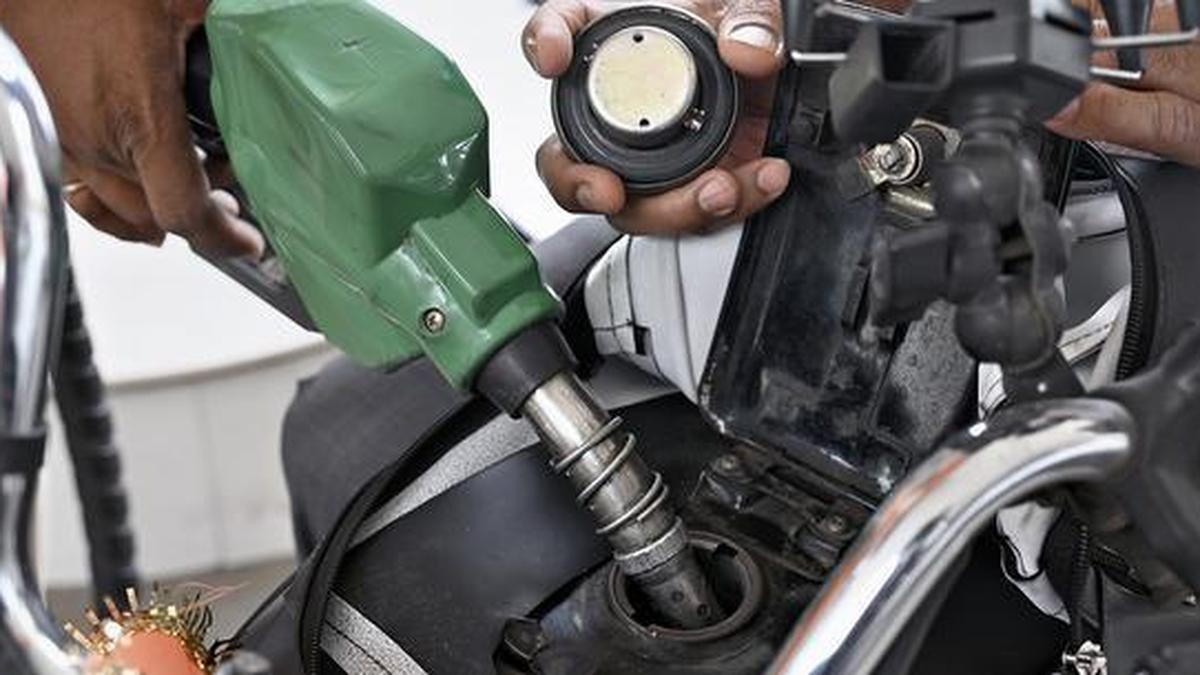
India's state-run fuel retailers raised petrol and diesel prices for the second time in under a week on Tuesday, pushing the national capital's petrol price to Rs 98.64 a litre. The combined increase since Friday, a Rs 3 a litre step followed by a hike of up to 96 paise, signals an active effort to restore the marketing margins that had been squeezed by global crude strength.
Petrol price was hiked to Rs 98.64 a litre from Rs 97.77 per litre in the national capital. Diesel now costs Rs 91.58 a litre against Rs 90.67 previously, according to industry sources.
The move effectively resets a pricing mechanism that had gone dormant in recent weeks. Indian fuel prices follow the trade parity price, which tracks the cost of importing refined products. When international benchmarks rose without corresponding domestic increases, state-run oil marketing companies (OMCs) absorbed the gap as an under-recovery against their marketing margins.
Tuesday's hike was rolled out across India's four major metro markets. Delhi petrol rose to Rs 98.64 a litre, while diesel gained to Rs 91.58. Mumbai saw the steepest petrol increase at Rs 107.59, with diesel at Rs 94.08. Kolkata recorded petrol at Rs 109.70, the highest among the cities tracked. Chennai petrol reached Rs 104.49.
The Margin Gap and the IPP Formula
The domestic pricing formula matters more than the headline number. Indian OMCs benchmark pump prices to the import parity price (IPP) and adjust daily. Over the weeks preceding the Friday hike, the gap between the IPP and the administered retail price widened as Brent crude held above $80 per barrel. The two-step correction of Rs 3.90 per litre cumulatively in Delhi partially compensates for that divergence. For a deeper look at the global crude benchmark, see our crude oil profile.
The mechanism has a specific financial impact. For state-run fuel retailers, domestic marketing margins represent the single largest driver of absolute earnings volatility. When the pass-through stalls, cash flow is diverted to absorb the crude cost increase. This week's correction starts reversing that dynamic.
Sector Readthrough: Downstream Cash and CPI Pressure
State-run downstream margin recovery
The immediate beneficiary is the downstream refining segment. State-run operators with large retail networks, the companies that administer these daily prices, receive a direct cash flow lift from each hike. The Rs 3.90 combined increase across the two rounds improves their per-litre gross margin on the roughly 4.5 million barrels per day of products India consumes, although the precise capture rate depends on volume losses from demand destruction.
CPI risk for bond and rate markets
The inflation read-through is a structural factor for rate markets. Petrol and diesel feed directly into the transport sub-index of the Consumer Price Index (CPI), which in turn affects distribution costs across the economy. For traders watching the RBI's policy path, a sustained pass-through keeps the central bank on alert against upside inflation risk.
Demand-side elasticity risk
The correction is not without risk to volume. India's price-sensitive consumer base adjusts driving and logistics patterns when pump prices breach thresholds. Private vehicle owners in Mumbai, where petrol now trades at Rs 107.59 a litre, face the highest cost among the four metro markets. A prolonged test of that level can shift demand toward public transport, diesel vehicles, or simply reduce discretionary mobility.
The net effect on refinery margins depends on elasticity. If the demand response is muted, the margin recovery is clean. If volumes contract sharply, the gross margin per barrel improves. The throughput drops, creating a trade-off for integrated refiners.
Confirmation Signal: Pace of Daily Revisions
The bull case for this pass-through hinges on continuity. Daily price revisions are transparent on the websites of state-run fuel retailers. If the Brent crude benchmark remains in the $80s, further hikes are needed to fully normalise marketing margins. A pause or a reversal, particularly if the government intervenes through an excise duty cut or a subsidy reinstatement, would weaken the margin recovery narrative immediately.
The strongest confirmation signal is a third consecutive small hike within the same week, maintaining the pace of pass-through. The risk to watch is a sharp drop in global crude that lets OMCs pause without hurting margins further, or a spike that forces them to skip revisions again and rebuild the under-recovery. For a broader view of how raw material price changes flow through to downstream assets, see our commodities analysis.
Bottom line for traders: A sustained pass-through keeps the margin recovery thesis intact. A pause or reversal rebuilds the under-recovery risk.