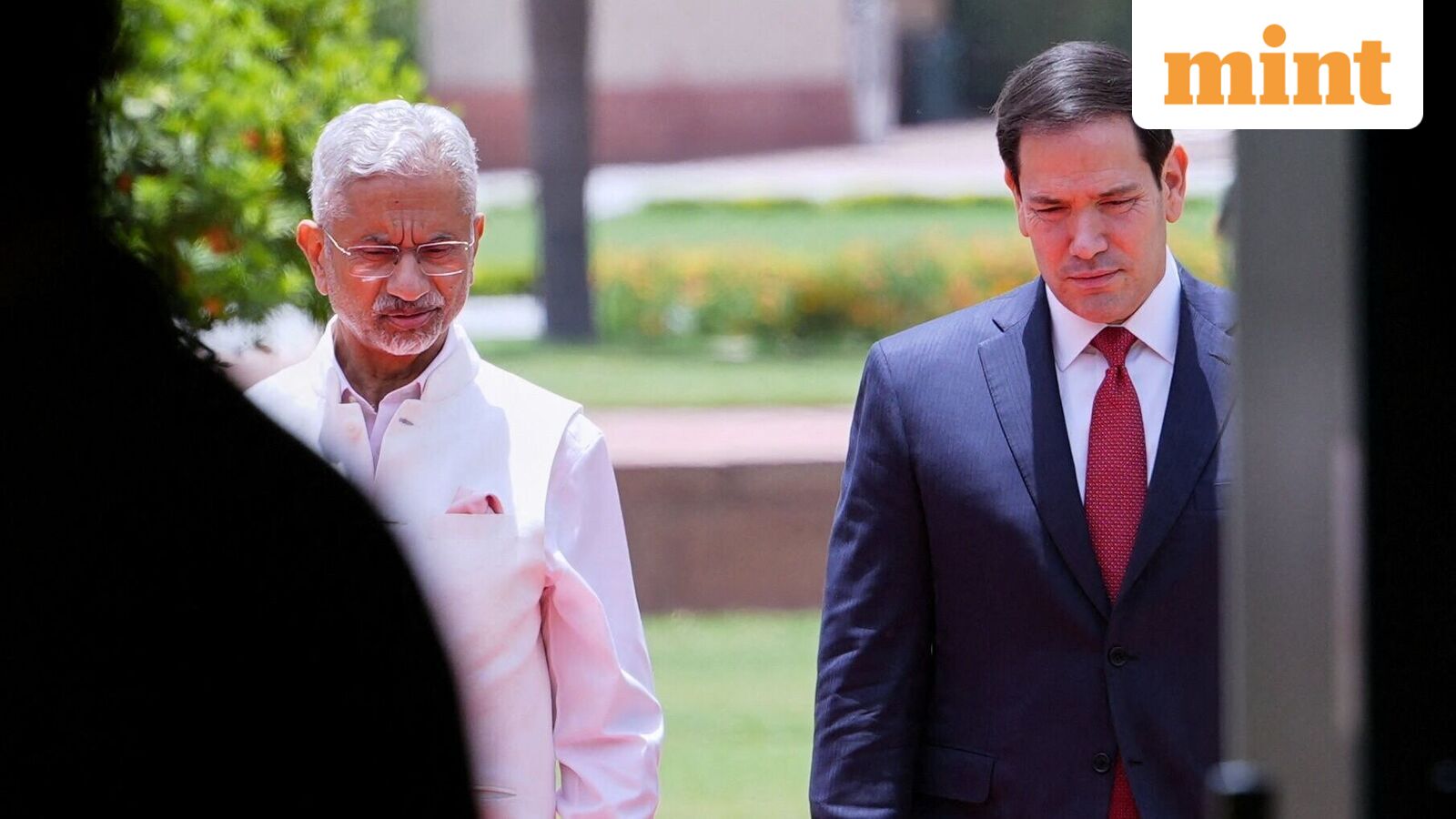
External Affairs Minister S Jaishankar and US Secretary of State Marco Rubio held delegation-level talks in New Delhi on Sunday. The discussions covered visa challenges for Indian travellers, the prospect of an early trade deal, and regional developments in West Asia. No trade deal timeline was announced, leaving the bilateral economic agenda as the key risk event for markets tracking India-US ties.
Jaishankar said challenges related to visa issues faced by Indian travellers were raised directly with the US side. He also said concluding a trade deal with the US at an early date was discussed. “We discussed situation in West Asia, Indian subcontinent and East Asia,” Jaishankar said after the meeting.
The Trade Deal Timeline: The Market Risk Event
What Changed and What Didn't
Jaishankar said an early trade deal was discussed. No deadline was set. That absence matters more than the presence of the discussion. A concrete timeline would have given a clear catalyst for India-exposed sectors. Instead, the vague “early date” language leaves the market without a hard event to price.
Rubio pushed back against any suggestion the visit was about repairing the relationship. “This is not about restoring or reinvigorating. I've seen people use that terminology. This is about continuing to build on what is already a very solid and strong strategic partnership,” he said. The framing signals continuity, not urgency. Markets expecting a sprint on trade will need to recalibrate for a marathon.
Why the Timeline Matters
The India-US trade relationship has been a source of both opportunity and friction. A deal would reduce tariff uncertainty for Indian exporters in sectors like textiles, pharmaceuticals, and engineering goods. It would also open the door for deeper US investment into India. Without a timeline, companies delay capacity decisions. The risk is that bilateral trade momentum stalls while other priorities–like the Quad and West Asia–take center stage.
Exposure: Sectors Tied to the Bilateral Agenda
IT Services and Visa Issues
Jaishankar directly raised visa challenges faced by Indian travellers. For India’s IT services sector, which relies on H-1B and L-1 visas for talent deployment to the US, this is a material issue. Any progress on visa easing would be a positive for companies like Tata Consultancy Services (TCS), Infosys, and Wipro. No progress leaves those stocks exposed to continued visa processing delays and uncertainty around US immigration policy.
Energy Sector Cooperation
Jaishankar said, “Secretary Rubio and I welcomed recent cooperation between India and US in energy sector.” Rubio had also indicated before the visit that Washington sought to expand energy collaboration with New Delhi. For India, US energy imports–especially LNG–provide a hedge against supply disruptions linked to the Strait of Hormuz, which Rubio explicitly referenced. Energy cooperation benefits US exporters like Cheniere Energy and India’s GAIL and Petronet LNG. The risk is that trade deal delays slow broader energy agreements.
Defense and Strategic Technologies
The Prime Minister's Office said Rubio briefed Modi on the upward trajectory of cooperation across defense, strategic technologies, and trade. Defense stocks in both countries–Lockheed Martin, Boeing, HAL, Bharat Electronics–have a structural tailwind from the deepening partnership. The risk is that the defense relationship remains steady, providing no incremental catalyst for near-term share prices.
The Next Catalyst: Quad Meeting on 26 May
New Delhi will host the Quad Foreign Ministers' Meeting on 26 May. Australia’s Penny Wong and Japan’s Toshimitsu Motegi will join Jaishankar and Rubio. This multilateral meeting will test whether the strategic alignment produces concrete deliverables in supply chain resilience, maritime security, and critical technologies.
Rubio's Itinerary
Rubio’s four-day visit spans Kolkata, Agra, Jaipur, and New Delhi (23–26 May). He began in Kolkata visiting the Mother House. The tour includes cultural stops, signaling soft-power engagement alongside hard diplomacy.
White House Visit as a Signal
US Ambassador Sergio Gor posted on X that Rubio extended a formal invitation on behalf of President Donald Trump for Prime Minister Modi to visit the White House in the near future. Modi requested Rubio to convey his warm greetings to Trump. A White House visit would be the strongest signal of strategic continuity. Its absence would be a negative for market sentiment on India-US relations.
What Would Reduce the Risk / What Would Make It Worse
Confirmers
- A formal announcement of a trade deal timeline, even a target date, would reduce uncertainty. Markets would price in a clear catalyst.
- Progress on visa issues for Indian travellers would boost sentiment for IT services stocks.
- The Quad meeting producing joint statements on supply chain resilience or technology transfer would reinforce the partnership narrative.
- A confirmed Modi-Trump White House meeting date would give a clear geopolitical tailwind for India-exposed equities.
Negatives
- Failure to advance the trade deal in coming months would sour the positive tone and weigh on export-oriented sectors.
- Divergence on West Asia policy–especially regarding Iran or the Strait of Hormuz–could create friction. Rubio’s reference to supply chain disruptions in that region underscores the sensitivity.
- A lackluster Quad outcome–statements without action–would weaken the strategic buildup narrative.
- Any signal that the White House invitation is not materializing would be read as a downgrade in bilateral priority.
The visit has reinforced the message that the India-US relationship is on a solid trajectory. The next concrete marker is the Quad meeting on 26 May. For traders, the absence of a trade deal timeline is the main uncertainty to watch. Until that changes, the upside for India-exposed assets from bilateral diplomacy will remain capped.
For related reading on India’s trade and energy positioning, see the India Trade Delegation to Canada Targets Critical Minerals Deal and Iran Defers Uranium Talks, Opening 60-Day Window for Oil Risk. For broader market context, visit stock market analysis.