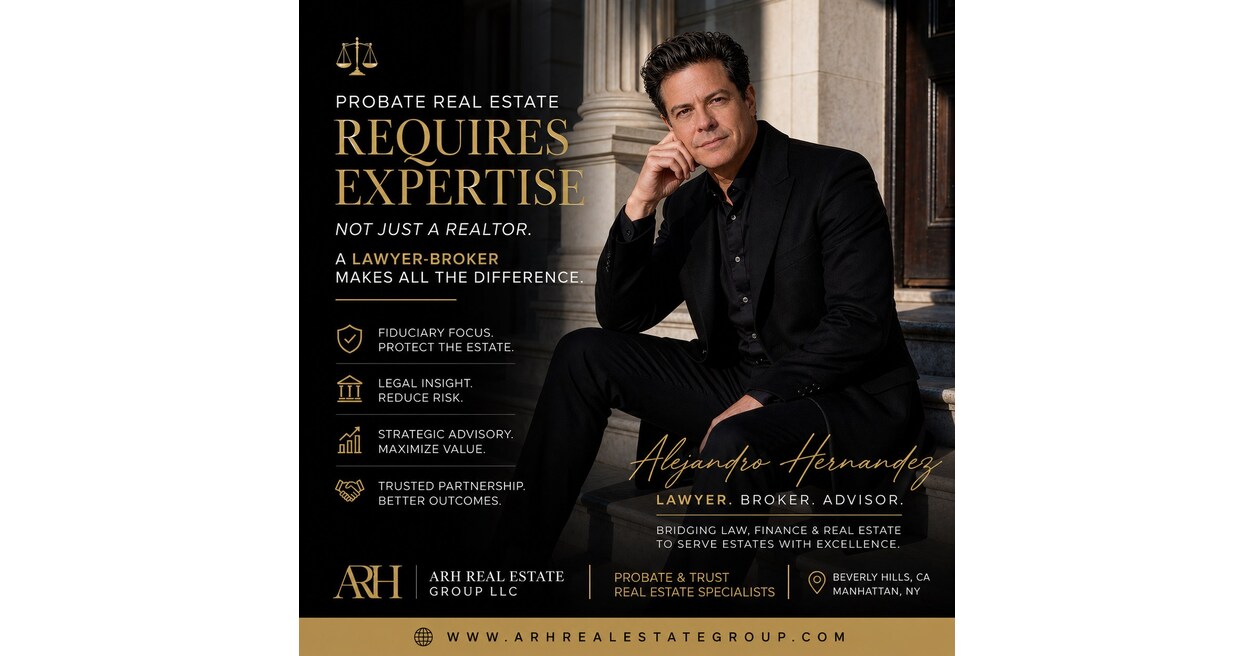
Alejandro Hernandez is standardizing probate real estate by merging legal and brokerage roles, aiming to reduce administrative friction in asset liquidation.
The rise in probate filings and inherited property transfers is forcing a change in how estate assets are managed. Alejandro Hernandez, operating through ARH Real Estate Group LLC, is formalizing a dual-role advisory model that combines legal expertise with real estate brokerage. This shift addresses the friction often found between estate attorneys and traditional property brokers.
Traditional real estate transactions involving probate often suffer from communication gaps between legal counsel and the brokerage team. By integrating these roles, the advisory model aims to mitigate risks associated with court-ordered sales and trustee obligations. The primary value proposition here is the reduction of administrative delays that typically plague the liquidation of inherited assets.
For those navigating stock market analysis or broader asset management, the professionalization of probate real estate represents a structural change in how illiquid assets are brought to market. When legal and brokerage functions are siloed, the risk of litigation or improper asset valuation increases. A unified approach allows for a more streamlined transition from probate filing to final property disposition.
Trustees and probate attorneys often face pressure to maximize asset value while adhering to strict court timelines. The integration of legal and brokerage services serves as a risk-management tool, ensuring that property listings comply with probate codes while maintaining market competitiveness. This is particularly relevant in high-volume regions where probate backlogs can lead to significant holding costs for beneficiaries.
The next decision point for stakeholders involves evaluating whether a dual-role advisor provides sufficient cost-efficiency compared to hiring separate legal and real estate counsel. As these advisory models gain traction, the standard for property disposition in probate cases will likely shift toward firms that can demonstrate both legal compliance and market-driven execution. Watch for whether this model scales beyond individual practitioners to larger institutional estate management firms, as this would signal a permanent change in how residential and commercial estate portfolios are handled during transition periods.
AI-drafted from named sources and checked against AlphaScala publishing rules before release. Direct quotes must match source text, low-information tables are removed, and thinner or higher-risk stories can be held for manual review.