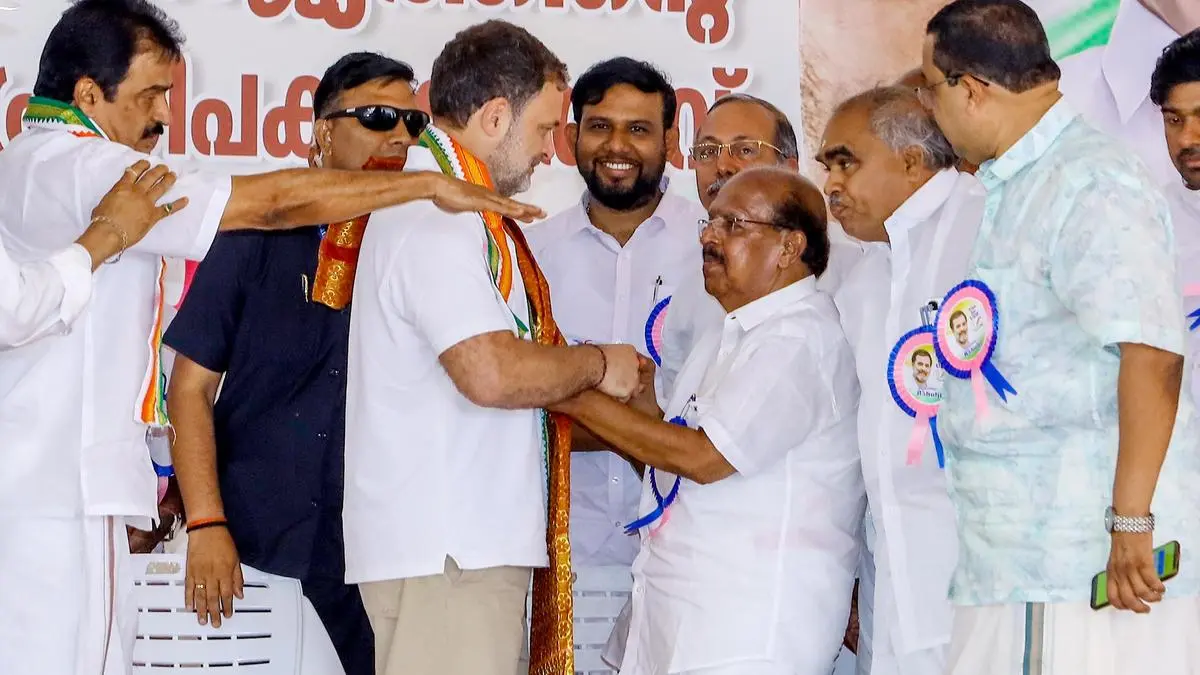
The Kerala Congress Legislative Party (CLP) has officially ceded its authority to the party high command to select the next Chief Minister, following the party's victory in the 2026 Assembly elections. By passing a unanimous resolution on Thursday, the 63 newly elected MLAs effectively bypassed a direct internal vote, centralizing the decision-making process within the All India Congress Committee (AICC). This move, orchestrated by KPCC president Sunny Joseph in the presence of AICC observers Mukul Wasnik and Ajay Maken, signals a shift toward top-down administrative control rather than grassroots consensus.
The Contenders and Institutional Friction
The leadership vacuum centers on three primary candidates: VD Satheesan, Ramesh Chennithala, and K C Venugopal. Each represents a different factional interest within the state party, and the high command's intervention suggests a desire to mitigate internal friction that could impede the formation of a stable government. For market observers, the specific choice of Chief Minister is not merely a political formality but a signal of the incoming administration's stance on fiscal policy, infrastructure development, and regulatory oversight in the state.
When a party relies on a high command to resolve leadership disputes, the resulting government often prioritizes party-line cohesion over local economic autonomy. This can lead to delays in policy implementation as the new administration aligns itself with national party directives. Investors tracking regional exposure should note that the resolution was adopted during a closed-door meeting at Indira Bhavan, indicating that the final decision will be insulated from public or legislative debate until the AICC observers submit their formal report.
Regional Governance and Market Stability
The uncertainty surrounding the leadership pick creates a temporary paralysis in the legislative agenda. While the Congress party secured 63 seats, the necessity of consulting with United Democratic Front (UDF) ally party leaders adds another layer of complexity to the selection process. The observers are scheduled to meet with these allies to ensure that the chosen candidate maintains the coalition's stability. If the high command selects a candidate who lacks broad support among the UDF allies, the risk of legislative gridlock increases, potentially stalling key economic reforms or budget approvals in the early stages of the term.
Market participants often view such transitions through the lens of continuity. A shift toward a more centralized leadership structure, as evidenced by the delegation of the CM pick to the AICC, suggests that the state's economic policy will likely mirror national party priorities more closely than in previous cycles. This is a departure from the more localized, personality-driven governance that has historically characterized Kerala's political landscape. For a deeper understanding of how political shifts impact regional asset risk, see West Bengal Political Volatility and Asset Risk Assessment.
Evaluating the Transition Risk
The mechanism of using AICC observers to conduct individual meetings with MLAs serves to identify potential dissenters before the official announcement. This process is designed to prevent a public fracture within the 63-member bloc. However, the reliance on this mechanism also highlights the fragility of the current coalition. If the high command's choice deviates significantly from the preferences of the senior leadership—specifically the bloc comprising V M Sudheeran, K Sudhakaran, Ramesh Chennithala, and V D Satheesan—the resulting government may face internal challenges that undermine its ability to execute its mandate.
Investors should monitor the speed at which the high command announces the final pick. A prolonged delay would suggest significant internal disagreement, which typically correlates with increased volatility in regional sentiment. Conversely, a swift announcement would indicate that the AICC has successfully consolidated power, likely leading to a more predictable, albeit centralized, governance model. As the state navigates this transition, the focus remains on whether the new leadership can maintain the coalition's integrity while addressing the fiscal pressures that often follow an election cycle. For broader context on how leadership changes affect corporate and regional environments, see Why the Average CEO Age Jumped to 61.