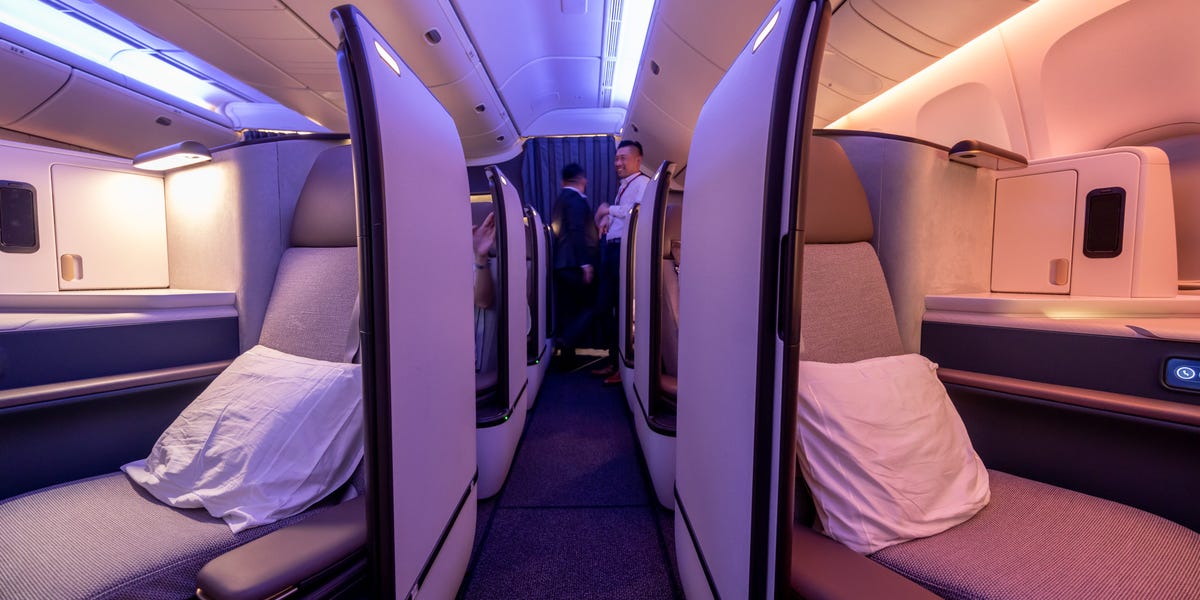
The Family-Flight Problem That Suite Pods Miss
Newer business-class suites with closing doors and staggered seats look luxurious for solo travelers. For a parent flying with a baby or toddler, they create a real problem. The privacy wall that makes a suite desirable for a solo passenger becomes a barrier when you need to reach your child during turbulence or help them settle. Older business-class cabins, typically configured in a 2-2-2 or 1-2-1 layout with open sides and lower dividers, let a parent lean over, pass a pacifier, or hold a hand without unbuckling or climbing out of their seat.
The Mechanism: Access Trumps Privacy
The core advantage of older cabins is physical access. In a reverse-herringbone suite with a closing door, the parent and child are separated by a fixed console and a door panel. Reaching across requires awkward stretching or fully standing up, which is impractical during seatbelt signs. Older cabins like the 2-2-2 configuration on many Airbus A330s or Boeing 777s place the parent and child side by side with a movable armrest. The divider drops flat, creating a shared surface for toys, snacks, or a sleeping baby. The parent can also angle their seat toward the child without fully rotating the pod.
What Changes for the Booking Decision
This shifts the calculus for family travelers who might otherwise default to the newest aircraft. The A350 or 787 with a door-closing suite looks better on paper but performs worse for a parent managing a restless toddler. The older 777 with a 2-3-2 or 2-2-2 layout becomes the better operational choice. Airlines that still fly these configurations include British Airways on some 777s, United on select 767s and 777s, and Lufthansa on A340s. The trade-off is a less modern seat, older entertainment screens, and sometimes no direct aisle access. For a parent, the access gain outweighs those downsides.
The Better Market Read: Seat Selection as Risk Management
The naive read is that newer equals better. The practical read is that seat geometry determines whether a flight with a baby is manageable or exhausting. The key variable is the divider height and seat angle. A seat with a fixed console and a door that slides up creates a wall. A seat with a drop-down armrest and a low divider creates a bridge. Parents should search for seat maps on older aircraft types and prioritize rows where the middle seats share a low divider. The bulkhead row also matters: it offers more floor space for a bassinet but often has a hard wall instead of a seat in front, which changes the access dynamic.
What Would Confirm or Weaken This Setup
This advantage holds as long as airlines keep older cabins in service. If carriers accelerate retrofits to door-closing suites across all long-haul fleets, the older-cabin option shrinks. The next decision point is the fleet renewal cycle at major carriers. United is retrofitting its 777-200s with Polaris suites that include doors. British Airways is phasing out its 777-200s with Club World seats. As these older cabins retire, the parent-friendly option becomes harder to find. For now, the strategy is simple: book the older plane, pick the side-by-side seats, and treat the suite as a solo-traveler product, not a family one.
Internal Links
For more on how travel choices affect your wallet, see our stock market analysis for airline sector trends. If you are booking through a travel portal, check our guide to the best stock brokers for earning points on purchases.