The debate over artificial general intelligence is shifting from model size to architecture. That shift has implications for how investors evaluate AI companies, including Apple, which is building agentic systems into its ecosystem.
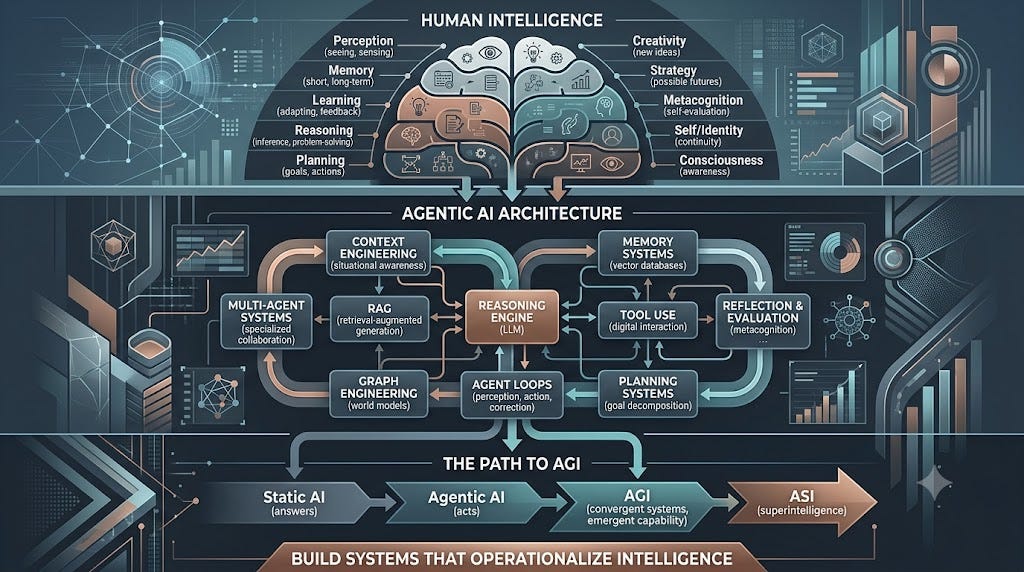
Human intelligence is a stack of interconnected functions: perception, memory, learning, reasoning, planning, creativity, intuition, strategy, metacognition, self-identity, and consciousness. Goals and values sit across all of them. Modern large language models handle perception, language, pattern recognition, and reasoning well, but only within a single prompt-response loop. What they lack is everything downstream: acting on the answer, verifying it, and adapting to what happens next.
Agentic AI closes that gap. Instead of generating a single answer, an agent can understand a goal, build context, retrieve information, use tools, plan a sequence, execute it, observe results, evaluate outcomes, correct its approach, and keep going until the objective is met. That is a different paradigm from prompt-response AI. The model becomes the reasoning engine. Everything else is engineered around it: context, retrieval-augmented generation, memory systems, tool use, agent loops, planning, graph engineering, reflection, multi-agent collaboration, goal systems, and persistent identity.
The distinction is simple. AI answers. Agentic AI acts. Sophisticated agentic systems learn from their own actions, maintain context across time, coordinate with other agents, use external tools, and pursue objectives over extended periods.
Under this lens, AGI is not a single breakthrough model. It is the convergence of multiple intelligence layers operating together: general learning, reasoning, memory, planning, adaptation, world models, creativity, metacognition, autonomous action, and goal-directed behavior. AGI is more likely to emerge from integrating many cognitive capabilities into a persistent, adaptive system. That is why intelligence architecture, not just model scale, is the thing worth watching.
Artificial superintelligence represents a further threshold: intelligence substantially exceeding human capability across most cognitive domains. AGI does not equal consciousness, and neither does ASI. A system could become extraordinarily capable without having any subjective experience. Capability and consciousness are separate questions.
A practical framework for evaluating any AI system runs through this chain: human capability, cognitive function, AI equivalent, current capability, limitation, engineering mechanism, AGI requirement. Run any current model through that chain, and the gaps become specific: persistent memory, reliable multi-step planning, genuine metacognitive self-correction, and coherent identity over time.
The trajectory is not better chatbots or larger models. It is increasingly sophisticated intelligence architectures built as systems, not single models. The progression is AI, agentic AI, AGI, ASI. The real engineering question is how to build systems that do not just generate intelligence but operationalize it.