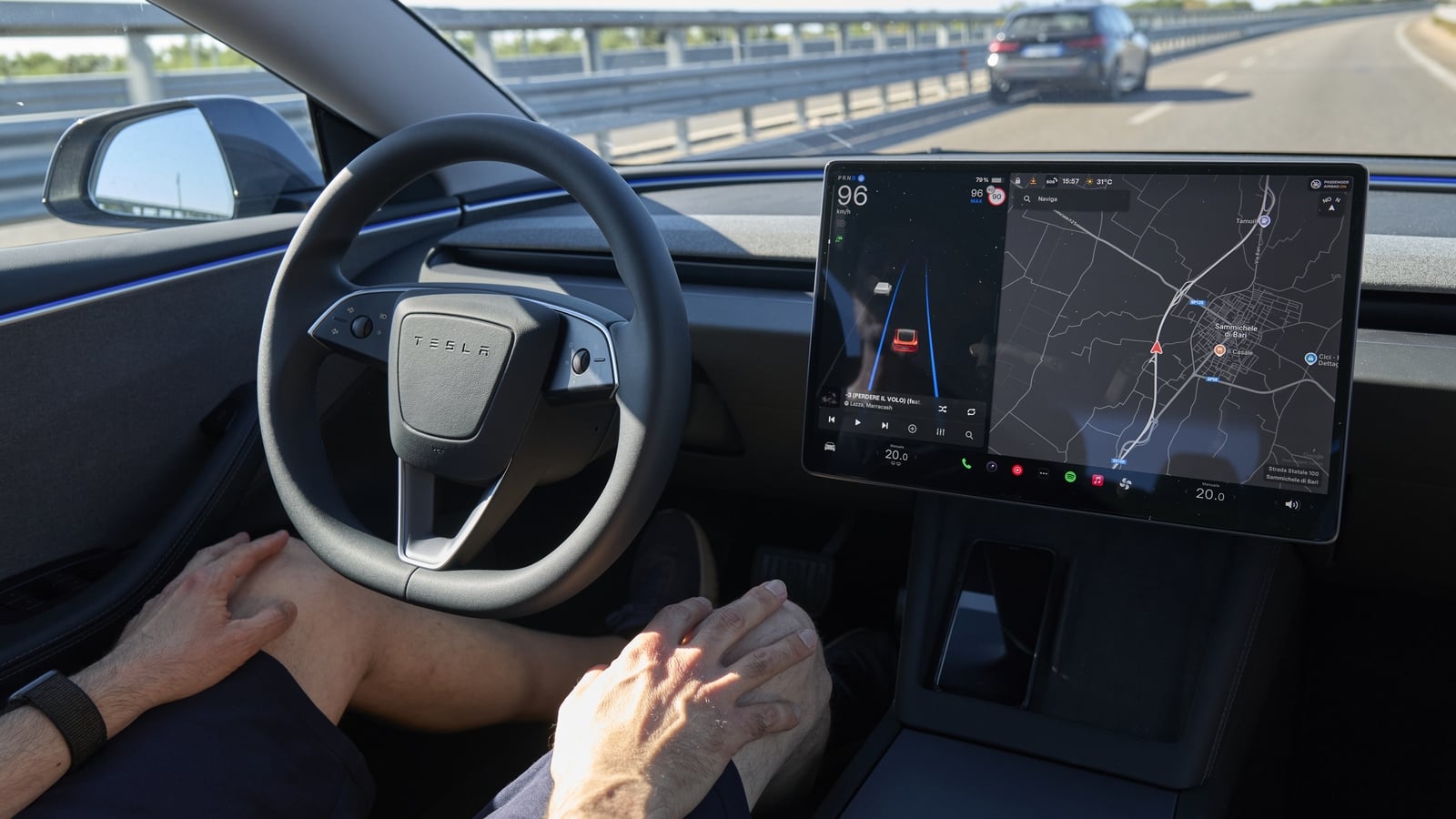
Tesla has opened formal talks with Irish authorities to gain approval for its "full self-driving" (FSD) software, a move the company sees as critical to reversing a 27% slump in European sales last year. The discussions, confirmed by Ireland's Department of Transport, are part of a broader push to bring the driver-assistance system to EU roads as early as this summer. But the path from Dublin to Brussels is littered with regulatory fragmentation, unresolved safety questions, and a US investigation into 2.9 million vehicles that could reshape the timeline.
The simple market read is that any EU green light unlocks a new revenue stream and revives Tesla's stagnant regional deliveries. The better read is that FSD approval is less a product launch than a regulatory chess match where each member state holds a veto by raising technical objections, and where the technology's classification as Level 2+ puts it in a grey zone that no European regulator has fully resolved.
The Approval Gauntlet: From Dublin to Brussels
Ireland's involvement is not a standalone national decision. The Department of Transport told RTÉ News that "Tesla are currently engaging with the Irish authorities including the Irish approval body, the NSAI, regarding their FSD system" but stressed that "at this stage it is not possible to provide timelines for any EU approval." If the technology is approved at EU level, it could then be allowed in Ireland. A national strategy for connected and autonomous vehicles has been in development since 2018, and a March 2023 amendment to the Road Traffic and Roads Act paved the way for Level 2 systems to be lawfully used, though none are currently operating on public roads.
The Dutch road authority RDW became the first EU regulator to grant preliminary approval after 18 months of testing on public roads. This week in Brussels, Dutch officials made their case to other European regulators. That endorsement is a necessary but insufficient step. EU vehicle type-approval rules mean a system must be accepted by multiple member states before it can be sold across the bloc, and objections from any national authority can stall the process.
Why FSD Matters for Tesla's European Sales Recovery
Tesla's European sales fell 27% last year, a decline the company has explicitly linked to the absence of FSD. The feature is already available for purchase in Europe as "enhanced autopilot" for €3,800, but it will become subscription-only from May 21. Current regulation bans the use of hands-off systems, so the capability sits dormant in vehicles already on the road. Paddy Comyn, Head of Automotive Content at Done Deal, noted that "there are cars on sale in Ireland that would have the capability of doing it, but the manufacturers haven't fitted it based on the legislation that exists here."
For Tesla, FSD approval is not just about software revenue. It is a demand catalyst. The company argues that the system improves road safety by over 80% by reducing human error, a claim that, if accepted by regulators, could differentiate its vehicles in a crowded European EV market where competitors like Mercedes already offer a certified Level 3 system. Without FSD, Tesla's product lineup loses a key differentiator, especially as Chinese manufacturers push into Europe with their own advanced driver-assistance suites.
The Level 2+ Grey Area and Safety Scrutiny
Despite the "full self-driving" branding, the Dutch authority stressed that the system is a driver-assistance system, not a self-driving one. It is classified as Level 2+, meaning it can control braking, acceleration, and steering, and allows the driver to remove hands from the wheel. That hands-off capability is the critical distinction from standard Level 2 systems used by other automakers.
Professor Sergio Savaresi, head of the Department of Electronics at the Polytechnic University of Milan, explained the core tension: "In a Level 2 vehicle, the driver must be able to react and take control instantaneously – not within two-three seconds. This is why all the other carmakers providing the L2 technology simply do not allow to take the hands off." He added that the reaction time needed to re-engage "is a grey area and a subject of ongoing debate."
That debate has real-world consequences. A 2023 Irish court case involved a mechanical engineer driving a Tesla "no hands" on the M50. He was acquitted of dangerous driving after testifying he was monitoring the autopilot system, but the incident illustrates the gap between legal permissibility and actual driver behaviour. Professor Savaresi noted that "in practice, you could use Tesla’s FSD at Level 3, and this is where most accidents have occurred – because users became overconfident and trusted the technology so much that they would, for example, read emails. But that is not allowed."
Meanwhile, the US National Highway Traffic Safety Administration launched an investigation last year into 2.9 million Tesla vehicles over reports of crashes involving FSD. Complaints alleged the software failed to detect parked vehicles or gave drivers too little reaction time to avoid a collision. Any adverse findings from that probe would almost certainly be cited by European regulators considering approval.
Regulatory Fragmentation and the Nordic Pushback
Even as the Netherlands advances the dossier, regulators from Sweden, Norway, and Finland have raised concerns, according to Reuters, citing the system's "tendency to speed" and questioning its performance on icy roads. These are not trivial objections. Nordic countries represent a significant EV market and have some of the highest Tesla adoption rates in Europe. Their skepticism signals that the technical case for FSD is far from settled.
Tesla's camera-only approach adds another layer of debate. Most automated systems combine cameras, radar, and lidar. Dr Martin Glavin, Professor at the School of Engineering at the University of Galway, pointed out that "with a standard camera, you might see a black road and a black tyre and you wouldn't notice a difference. But with a hyperspectral sensor, the material properties of the rubber would differ from the road." His research group tests sensors in extreme weather conditions typical of Ireland, and the findings could inform the Irish approval body's assessment.
This fragmentation means that even if a majority of EU states eventually approve FSD, individual countries could impose operational restrictions – speed limits, road-type exclusions, or weather-related limitations – that dilute the system's commercial appeal. For traders, the risk is not a binary approve/reject decision but a patchwork of conditions that makes the European rollout less valuable than the US version.
What Would Confirm or Break the Thesis
The bullish case for Tesla's European FSD rests on three assumptions: that the Dutch precedent accelerates EU-level approval by late 2025, that the US investigation does not produce a recall or mandatory restrictions, and that the hands-off feature survives the regulatory process intact. Confirmation would come from a formal EU technical service opinion endorsing the system, or from a second major member state granting preliminary approval without additional constraints.
The bear case is that the Nordic objections harden into formal blocking positions, that the US probe results in a software limitation that European regulators then adopt, or that a high-profile accident involving FSD in Europe triggers a political backlash. Any of these would push the timeline beyond 2025 and force Tesla to compete on price and brand alone in a market where it is already losing share.
For now, the Irish talks are a procedural step, not a catalyst. The next concrete marker is whether the European Commission's technical committee takes up the Dutch submission and sets a timetable for a pan-EU opinion. Until then, the 27% sales decline remains the baseline, and the FSD premium embedded in Tesla's valuation stays at risk.