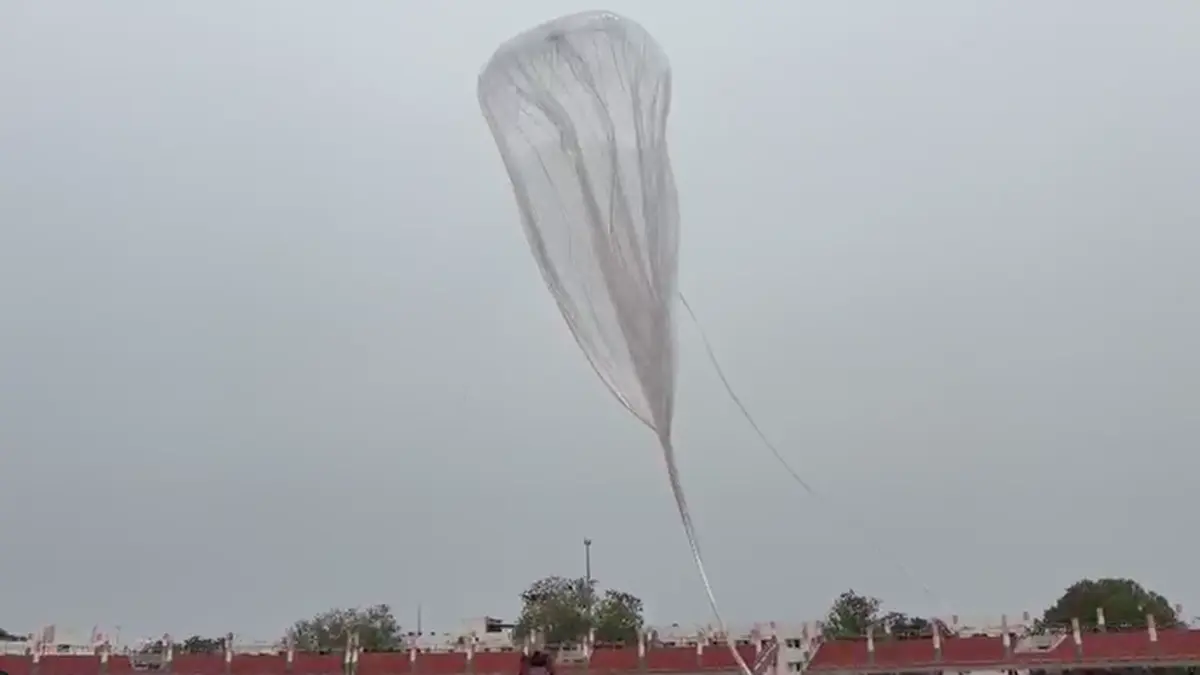
Red Balloon Aerospace launched Mission SANA, India's first private high-altitude super-pressure balloon carrying commercial payloads from seven national and international partners. The company's VISTA platform ascended to about 25 kilometres above Earth from Indira Gandhi Stadium in Vijayawada. Founded last year in Vijayawada, the near-space startup built the platform and launched its first mission in eight months.
"All payload missions were completed successfully, validating India's technical capability against international commercial standards," a company spokesperson said on Wednesday.
Mission SANA: Payload Mix and Eight-Month Build
The balloon carried payloads from organisations testing biological experiment systems, propulsion technology demonstrations, onboard computing platforms, Earth observation sensors, and navigation performance validation systems. This multi-tenant approach–one VISTA mission supporting multiple customers and experiments simultaneously–is central to the business model.
Sireesh Pallikonda, Co-Founder and COO, said: "A single VISTA mission can support multiple customers, multiple experiments, and multiple industries at the same time."
The platform's development timeline is unusual. Red Balloon Aerospace was founded last year. Moving from incorporation to a live stratospheric balloon mission in eight months suggests a team with prior expertise in the sector. The company is developing stratospheric platforms, tethered aerostats, and stratospheric airship systems for near-space applications.
VISTA Platform: Super-Pressure Technology and Persistent Altitude
The VISTA platform uses super-pressure balloon technology that maintains a stable altitude for extended periods without gas loss during day-night temperature cycles. Conventional near-space platforms rise and descend within a few hours. VISTA remains operational for weeks or even months.
C. V. S. Kiran, Co-Founder and CEO, described the platform as "a tower in the sky, enabling Non-Terrestrial Networks (NTN) connectivity and disaster management across regions that have historically lacked persistent, affordable coverage."
The technology fills a critical gap in spatial infrastructure. Aircraft operate below 10 km, satellites orbit above 160 km, and the stratosphere between 20 and 50 km has remained largely unused despite offering strategic advantages. Stratospheric platforms provide high-resolution imaging with longer dwell times than satellites, flexible deployment without orbital launch costs, and rapid response capability for disaster management and communications.
Strategic Positioning: India Joins a Five-Nation Club
Mission SANA places India among five nations globally with indigenous stratospheric hydrogen balloon capability after the United States, France, Japan, and China. For a startup that did not exist 18 months ago, this is a rapid entry into an exclusive group.
The achievement carries both technical and geopolitical weight. Stratospheric balloons have dual-use applications: they can support civilian communications, Earth observation, and disaster response, and they also serve defence and surveillance purposes. India's ability to operate its own platforms reduces reliance on foreign systems and foreign launch windows.
Public Market Read-Through: Sectors Exposed to a New Near-Space Player
Red Balloon Aerospace is a private company. No public equity trades directly on its success. The technology, however, has implications for several publicly traded sectors:
- Satellite operators face a new competitor for persistent imaging and connectivity contracts. Satellites offer global coverage, a stratospheric balloon delivers higher-resolution regional coverage with lower latency.
- Telecom infrastructure providers may see demand shift toward Non-Terrestrial Network solutions for rural and remote coverage. The VISTA platform's "tower in the sky" capability competes with both terrestrial towers and low-earth-orbit satellite constellations.
- Defence contractors could integrate stratospheric platforms for surveillance and communications. Platforms that stay aloft for weeks at 25 km reduce reliance on satellite revisit times and drone endurance limits.
Investors building watchlists should track whether Red Balloon can scale from a single successful mission to repeatable commercial service. The eight-month development cycle suggests speed, scaling requires funding, regulatory approvals, and customer contracts.
Confirmation Signals: What Proves the Thesis
The current mission is a proof of concept. Several risks must be resolved before the technology becomes a meaningful market force:
- Regulatory risk: Operating at 25 km requires airspace coordination and spectrum allocation. India's regulatory framework for stratospheric operations is still developing.
- Safety risk: Hydrogen balloons carry explosion risk. The company's safety record will be scrutinised as missions increase.
- Funding risk: As a private startup, Red Balloon needs capital to build more platforms and hire talent. The current funding environment for deep-tech ventures is tight.
- Competition: Established players like Aerostar (US) and Raven Aerostar already operate stratospheric balloons. Red Balloon's cost advantage and local market access are its differentiators.
The next concrete marker is the company's second mission and its customer list. A repeat mission with paying customers would confirm commercial traction. Partnerships with Indian defence or telecom operators would validate the use case. Any regulatory approval from India's Directorate General of Civil Aviation or Department of Telecommunications would reduce execution risk.
For a deeper look at how scale versus certainty plays out in emerging tech investments, see our analysis of Cauldron Energy's 42.7 Mlb Uranium Target. And for a framework on regulatory risk in new technology markets, read How Tencent Cloud's Sovereign Cloud Win Lowers Regulatory Risk.
Red Balloon's Mission SANA is a technical achievement that opens a new near-space market. For now, the direct investment opportunity is limited to private capital. Public market traders should watch for spillover effects: satellite operators may face pricing pressure, while defence and telecom stocks could benefit from increased interest in persistent stratospheric platforms. The second mission and its customer list will separate the proof of concept from the commercial business.