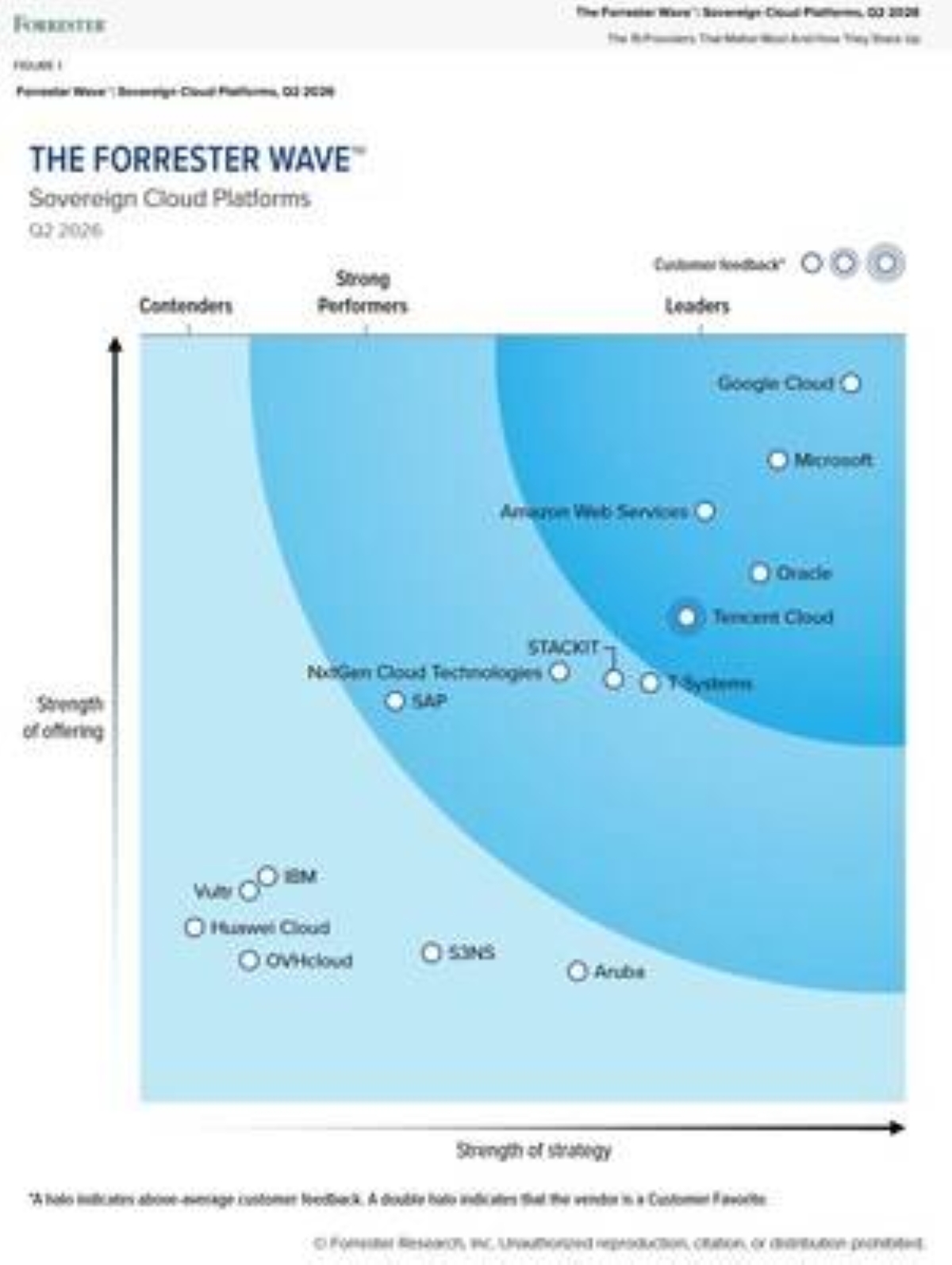
Tencent Cloud has secured a Leader position in Forrester's inaugural Sovereign Cloud Platforms report, with an additional Customer Favorite distinction. The ranking, published May 27, 2026, evaluates 15 sovereign cloud providers across strategy, current offering, and customer feedback. For Tencent Holdings (listed as TCEHY on US over-the-counter markets), this third-party validation changes the risk calculus for its cloud business in regulated industries.
Sovereign cloud has moved from optional to essential for public service, finance, and telecommunications clients as data residency, access control, and operational autonomy become regulatory requirements. Tencent Cloud Enterprise (TCE) now carries an independent endorsement that it can deliver on those demands. That endorsement reduces a key risk for TCEHY: that its cloud arm would be excluded from high-compliance procurement cycles.
Why Sovereign Cloud Recognition Matters for TCEHY
The Forrester Wave Q2 2026 report specifically noted that Tencent Cloud "has consistently formulated and executed a clear sovereign cloud strategy." The Customer Favorite label reflects direct user feedback, signaling that existing clients see the platform as reliable under real compliance constraints.
For TCEHY, the risk reduction is twofold. First, sovereign cloud competence directly addresses regulatory pressure in China and overseas markets where data localization laws are tightening. Second, the recognition provides a third-party reference that can shorten procurement cycles for large enterprises, particularly financial institutions and government agencies that require auditable compliance.
The Market Risk Shift
Before the Forrester report, Tencent Cloud faced a perception gap against vendors like Amazon Web Services and Microsoft Azure in sovereign capability. The report's Leader designation narrows that gap. For investors, this means a lower probability that TCEHY's cloud revenue stalls as regulated buyers delay decisions. The report also reduces the risk of Tencent Cloud being dismissed as a China-only provider.
How Tencent Cloud Enterprise Achieves Sovereign Compliance
Tencent Cloud Enterprise (TCE) shares the same source code as Tencent's public cloud. That architectural consistency is a practical risk mitigator: it ensures continuous product iteration without forking separate codebases. TCE provides full-stack infrastructure including computing, storage, networking, databases, and AI capabilities.
Three Dimensions of Sovereignty
TCE is built around three sovereign pillars:
- Data sovereignty: customers control data residency and access rules
- Operational sovereignty: customers or local partners manage operations
- Technical sovereignty: no forced vendor lock-in; compatibility with domestic and international hardware and software
The platform supports multiple deployment models – public, private, hybrid, and physically isolated environments – selected according to regulatory requirements. This flexibility is critical for clients operating across jurisdictions with conflicting data rules.
AI Integration Within Compliance Boundaries
TCE has integrated Large Language Model (LLM) training, inference, and Agent capabilities into its sovereign framework. That allows clients in regulated sectors to deploy AI without violating data sovereignty rules. For TCEHY, this represents a revenue expansion path: clients can upgrade from basic cloud to AI-powered services without changing vendors.
The Production-Grade Track Record: Banks, Operators, and Governments
Forrester's evaluation was not based on promises. The report drew on live customer deployments that demonstrate TCE's delivery capacity under diverse regulatory regimes.
A leading Chinese state-owned bank built a hyperscale cloud on TCE that supports 80,000 physical hosts and completed full migration of its core banking systems. That scale illustrates TCE's ability to handle mission-critical workloads.
Fusion Bank used TCE to transition to a next-generation banking core. Results included:
- 40% resource cost reduction through containerization
- Recovery Time Objective (RTO) under 30 minutes
- Migration of 150+ subsystems within 6 hours
A manufacturing customer expanded TCE usage from one region to four major regions, using a cloud-edge collaboration model to maintain operational continuity across borders.
A regional finance bureau deployed a "two-location, three-center" active-active architecture on TCE to support its smart finance platform.
A Southeast Asian operator built a commercial industry cloud on TCE, balancing internal utility needs with external commercialization.
These case studies reduce execution risk for TCEHY. New prospects can reference proven deployments rather than theoretical architectures. The breadth of industries – banking, manufacturing, government, telecom – suggests TCE's sovereign capabilities are not confined to a single vertical.
What This Means for Tencent's Risk Profile
Exposed Assets
The primary asset affected is TCEHY stock, specifically the cloud revenue segment within Tencent's broader business. Secondary exposure includes competitors in the sovereign cloud space: Alibaba Cloud, Huawei Cloud, and global hyperscalers that may lose deal flow to TCE.
Timeline
Sovereign cloud demand is accelerating as more jurisdictions pass data localization laws. The Forrester report provides a near-term catalyst for deal closures, likely within the next two quarters. Longer-term, Tencent's ability to expand AI capabilities within sovereign frameworks could sustain growth.
What Would Reduce Risk Further
- Additional named customer wins in North America or Europe, expanding geographic credibility
- Publication of compliance certifications (e.g., SOC 2, ISO 27001, local equivalents) tied to the sovereign platform
- Expansion of TCE's AI Agent features, increasing per-customer revenue
What Would Make It Worse
- Regulatory tightening that exceeds TCE's current architecture (e.g., new isolation requirements Tencent cannot meet)
- Geopolitical escalation raising barriers for Chinese-owned cloud providers in non-China markets
- Competitors achieving higher rankings in future Forrester evaluations or gaining exclusive certifications
AlphaScala Perspective: Tencent Cloud at Mixed Alpha Score 42
AlphaScala's proprietary model assigns TCEHY an Alpha Score of 42/100 with a Mixed label, in the Communication Services sector. The score reflects the tension between a strong cloud product and the broader uncertainties around Tencent's regulatory environment and growth trajectory. The Forrester recognition improves the cloud-specific picture but does not resolve the conglomerate-level risks. For full model details, see the TCEHY stock page.
Conclusion
Tencent Cloud's Leader placement in the Forrester Wave is a concrete de-risking event for TCEHY. It provides independent validation of sovereign cloud capability in the exact verticals – finance, government, telecom – that require stringent compliance. The production deployments cited in the report give the claim weight beyond marketing.
Investors should track whether this recognition translates into measurable cloud revenue acceleration, particularly from international clients. The next catalysts are new customer announcements and the upcoming quarterly earnings report, where cloud segment growth and margin data will test whether the Forrester win is driving real business outcomes. The risk remains that geopolitical headwinds or domestic regulatory shifts could offset this competitive advantage. For now, Tencent Cloud has moved from a question mark to a validated option in sovereign cloud.