China AI Companion Crackdown: Doubao, Qwen Go Dark July 15
Alibaba's Qwen and ByteDance's Doubao disabled agent features ahead of China's July 15 AI companion law. Alibaba's stock faces regulatory overhang and mixed sentiment.
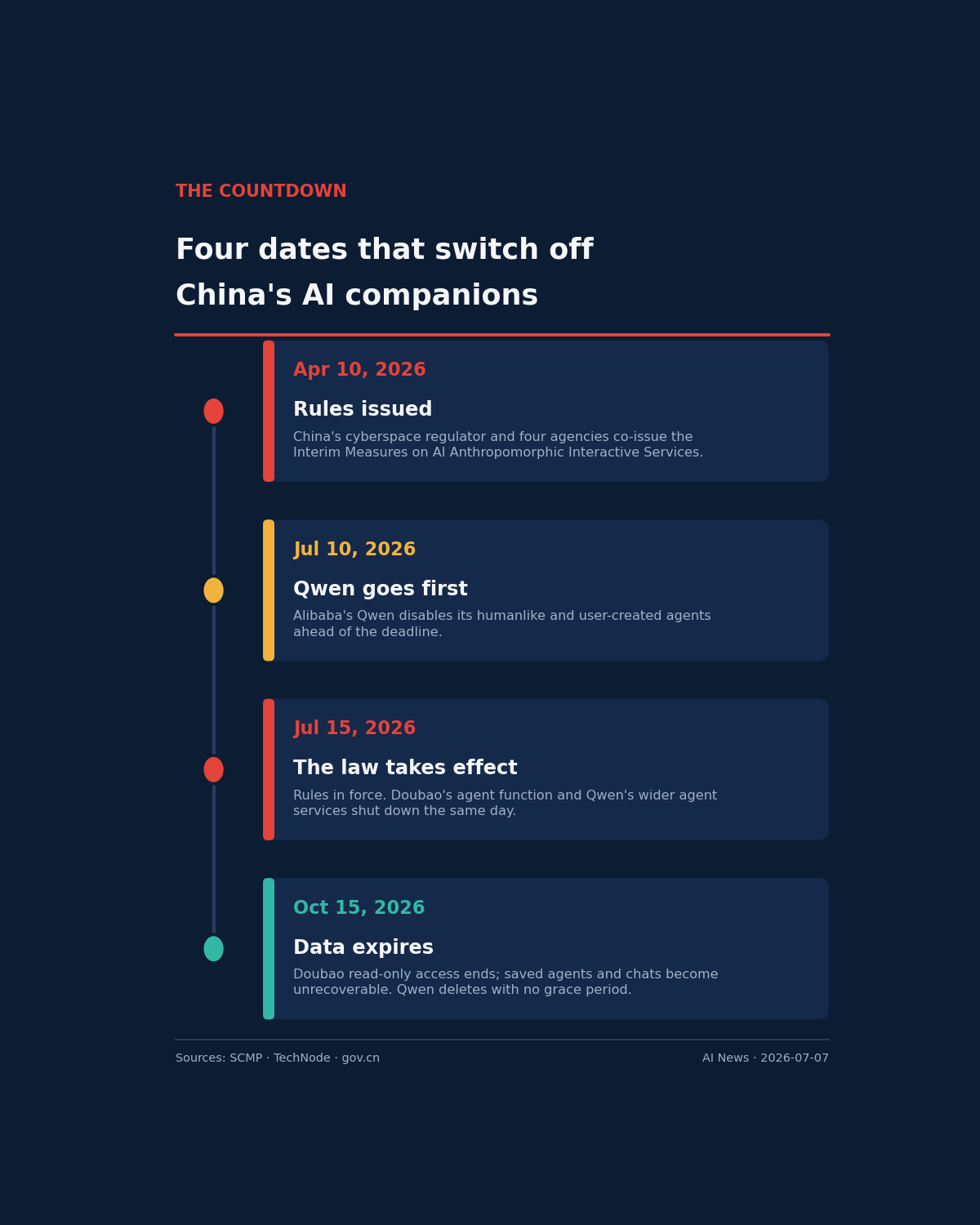
Last weekend, millions of Chinese users opened their AI apps and found a notice. ByteDance's Doubao said its agent function would stop working on July 15. Alibaba's Qwen warned that its humanlike and user-created agents would stop on July 10, with broader agent services ending five days later. Screenshots of chatbots circulated on Chinese social media as users mourned companions they had talked to for months.
The shutdowns are not product failures. They are the first visible effect of a new law. On July 15, China's Interim Measures for the Administration of AI Anthropomorphic Interactive Services take effect. The rules bar AI that simulates human behavior without clear labeling and restrict emotional attachment features. Alibaba and ByteDance are complying ahead of the deadline.
The measures were published in March and finalized in May after a public comment period. They apply to any service that simulates human appearance or behavior in interactive settings. This includes chatbots and voice assistants. Virtual avatars are also covered. Companies must label AI-generated content and prevent addiction, including blocking minors from forming emotional bonds with chatbots. Doubao and Qwen each have tens of millions of monthly active users. The shutdown of agent features will affect a significant portion of their user base. ByteDance and Alibaba have not said whether they will redesign agent features or abandon them entirely.
For Alibaba, the crackdown adds regulatory pressure to a stock that already faces a mixed outlook. The company's Alpha Score is 42 out of 100, reflecting neutral sentiment among traders. Qwen is a flagship product for Alibaba's cloud and AI unit, which competes with Baidu's Ernie Bot and Baichuan. A prolonged shutdown of agent features could slow adoption of Alibaba's AI ecosystem. BABA shares traded flat on Monday, with no major sell-off, according to market data. The muted reaction suggests investors are still assessing the impact. The BABA stock page shows the current market reaction.
The risk extends beyond Alibaba and ByteDance. Baidu and Tencent face similar compliance costs. Startups like Zhipu AI also face the same rules. The law does not ban AI agents outright. The labeling and addiction-prevention requirements may make the current free-form companion model unsustainable. Companies that rely on user engagement and emotional stickiness could see retention fall.
What would reduce the risk? Clear guidance from regulators on what constitutes permissible AI companionship. ByteDance and Alibaba could reintroduce agent features with compliance filters. A delay in enforcement or a softening of the rules would also help.
What would make it worse? A broad interpretation that bans most interactive AI. Another Chinese tech company facing a high-profile fine or shutdown. Or a regulatory spillover into other markets, as other countries watch China's experiment.
China is the first major economy to enact companion-specific AI rules. The European Union's AI Act covers general-purpose AI but does not have companion-specific provisions. The U.S. has not yet proposed similar rules. The crackdown is being watched by regulators in Europe and the U.S., according to policy analysts.
July 10 is the next date: Qwen's agent features go dark. The full law takes effect July 15.
Drafted by a large language model from the source reporting linked above, then screened by automated publishing checks. It is not read by a journalist before publication. Some articles cite our Alpha Score. Verify prices and figures against the original source. Educational coverage, not personalized advice.