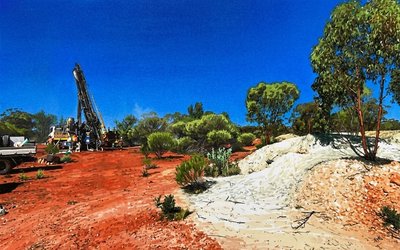
Leeuwin Metals (ASX: LM1) has started a 5,000-metre reverse circulation drilling program at the Marda gold project in Western Australia. The program targets resource extension and new discoveries, focusing on high-grade trends where rock chip sampling returned assays as high as 209 grams per tonne gold.
The company reported a maiden resource at Marda just nine months after acquiring the project from Ramelius Resources (ASX: RMS). That resource stands at 2.1 million tonnes at 1.1 g/t gold for 73,800 ounces (indicated) and 8.1 Mt at 1.03 g/t gold for 268,500 ounces (inferred), for a combined 342,300 ounces.
The Drilling Program: Three Target Categories, Three Risk Profiles
The 5,000-metre RC program is not a single-target drill-out. Leeuwin is pursuing three distinct categories of targets simultaneously, each with different risk and reward profiles.
Resource Extension at Evanston and Golden Orb
Evanston hosts 4.3 Mt at 0.98 g/t gold for 135,800 ounces above a 0.3 g/t cut-off. Within that, a higher-grade component of 2 Mt at 1.52 g/t for 96,400 ounces sits above a 0.8 g/t cut-off. Golden Orb adds an inferred 0.5 Mt at 1.56 g/t gold for 25,700 ounces.
Both deposits have downhole electromagnetic (DHEM) anomalies that have not been drill-tested. DHEM can identify conductive sulphide bodies that often host gold mineralisation below the current resource limits. If the DHEM targets correlate with extensions of the known mineralised zones, the program could add tonnes at grades similar to the existing resource.
High-Grade Discovery Targets: Atkinson Find and Allens Find
Atkinson Find returned rock chip results of more than 10 g/t gold from a historic workings sample. Allens Find, a historic state battery site, produced peak assays of 18.55 g/t and 11 g/t gold.
These are not resource targets. They are discovery targets. Rock chip sampling at surface does not guarantee continuity at depth. The grades are high enough that even narrow vein intersections could add meaningful high-grade ounces to the project economics.
The 11 North-South Trends
Leeuwin identified 11 north-to-south structural trends with limited prior drill testing. These trends are regional-scale targets. The company has not yet reported specific assays from these trends. The structural setting is analogous to other gold deposits in the Southern Cross greenstone belt.
The Common Mistake: Treating All Drilling as Equal
A naive read of this announcement is that Leeuwin is simply drilling more holes at an existing resource. The better market read separates the program into three risk tiers:
- Lowest risk: DHEM-driven extension drilling at Evanston and Golden Orb. These targets sit below known mineralisation with geophysical vectors. Success here would add ounces at grades similar to the existing resource.
- Medium risk: First-pass drilling at Atkinson Find and Allens Find. High-grade surface samples exist. Continuity is unproven. A single high-grade intersection would be a material catalyst.
- Highest risk: Regional testing of the 11 north-south trends. These are greenfield targets with no resource base. Success would require a discovery, not an extension.
Practical rule: A drilling program that mixes resource extension and discovery targets is not a single binary event. Each target category has a different probability of success and a different impact on valuation.
The Better Framework: What Confirms or Weakens the Thesis
For a watchlist decision, the relevant question is not whether Leeuwin will hit gold. It is what specific results would confirm the exploration thesis and what would weaken it.
Confirming signals
- DHEM target intersections at Evanston: If drilling hits mineralisation at the DHEM anomalies with grades above 1 g/t gold, it validates the geophysical targeting and opens the possibility of resource growth at depth.
- High-grade intersections at Atkinson Find or Allens Find: A single intersection above 5 g/t gold over a meaningful width (2 metres or more) would confirm that the surface rock chips reflect real mineralisation at depth.
- New discovery on the 11 north-south trends: Any intersection above 1 g/t gold on a previously untested trend would be a discovery event.
Weakening signals
- DHEM anomalies return barren or sub-economic intersections: This would suggest the geophysical targets do not correlate with gold mineralisation, reducing confidence in the remaining DHEM targets.
- Atkinson Find and Allens Find return only low-grade or narrow intersections: High-grade surface samples that do not extend at depth are common in Archean gold systems. This would not kill the project. It would shift focus back to the existing resource.
- No assays reported from the 11 trends: If the company drills only the higher-confidence targets and defers the regional trends, the program becomes a resource extension play rather than a discovery play.
Valuation Context: What the Resource Means
The 342,300-ounce resource at Marda is modest by ASX gold standards. Ramelius Resources sold the project after presumably determining it did not fit its production profile. Leeuwin's thesis is that Marda is an advanced exploration asset with near-term potential, not a development-stage project.
Executive chair Christopher Piggott said the company was looking forward to the drilling results. "With the Marda existing resource as a base, plus 11 under-drilled structural trends, prior rock chip anomalism at Atkinson Find and Allens Find, and newly-defined DHEM anomalies at Evanston and Golden Orb, we believe this program is well-positioned to deliver meaningful exploration outcomes," he said.
Leeuwin holds granted mining leases at Marda, which reduces permitting risk relative to pure exploration plays. The project is located near Southern Cross in Western Australia, close to existing infrastructure.
Risk to Watch: Funding and Timeline
Leeuwin stated it is well-funded for the program. The company did not disclose the exact cash position in this announcement. The 5,000-metre RC program at current drilling costs in Western Australia would likely cost between $500,000 and $750,000. Investors should watch for any capital raising announcements during or after the program.
Results are expected in due course. For a program of this size, first assays typically take 4 to 8 weeks from commencement, depending on laboratory turnaround times.
Leeuwin Metals is running a three-tier drilling program at Marda. The highest-impact outcome would be a high-grade discovery at Atkinson Find or Allens Find, which would differentiate the project from its current status as a modest resource with exploration upside. The most probable outcome is resource extension at Evanston and Golden Orb, which would add ounces. The results will determine whether Marda remains a resource extension story or becomes a discovery story.