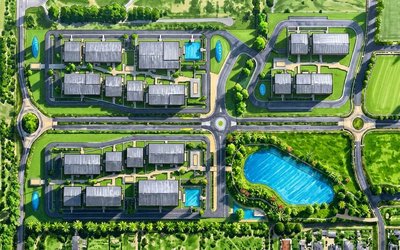
Aland Equity Group (ASX: AEG) is shifting its funds management business into property through a series of cornerstone funding model that avoids development risk. The company has executed cornerstone agreements giving it exclusive long-term rights to finance acquisition and staged development of residential, seniors living, mixed-use, and commercial projects. All projects are owned by entities associated with company chair Alex Brinkmeyer. AEG will earn investment management fees. It will not take development risk.
The move transforms AEG from its existing funds management base into a capital-light property platform. The key question for ASX small-cap watchers is whether the related-party reliance on Brinkmeyer's 50-year development track record is a safety buffer or a single-point-of-failure risk.
The Brinkmeyer Pipeline: 4,200 Lots and a Business Park
The agreements cover advanced-stage projects in high-growth corridors. The initial tranche includes:
- Yarrabilly residential development at Cowra, New South Wales.
- Chinnerys and Bungendore industrial training facility and technology hub near Canberra.
A future pipeline has been identified comprising more than 4,200 mixed residential lots and a 100,000 square metre business park. All projects are owned by entities tied to Brinkmeyer.
AEG managing director David Nolan said the platform provides the company with “exclusive rights to establish funds to finance the acquisition and development of projects with approvals already in place, rather than relying on sourcing projects from external parties.” The quote underscores the advantage: pre-approved projects shrink execution timeline and eliminate the risk of spending capital on site identification that never closes.
Execution Machinery Outside AEG
The development work itself is handled entirely by experienced project delivery entities associated with Brinkmeyer that sit outside the Aland group. AEG is explicitly prohibited from acting as property developer under the agreement terms. That separation protects AEG from construction cost overruns, regulatory delays, and subcontractor disputes – the chronic risks that have sunk many small-cap property developers.
The 30% Margin: How AEG Gets Paid
AEG's revenue will come primarily through investment management fees. The pricing methodology for property acquisition includes a 30% development margin at the fund level for residential developments. That margin underpins investor returns before AEG takes its fee slice.
Practical rule: A 30% margin is high by residential development standards – most large-scale builders target 15–20% gross margin on project costs. The 30% figure suggests either aggressive pricing assumptions or a genuine structural advantage in Brinkmeyer's supply chain and land bank. If the margin is achieved, AEG's fee pool becomes material even on moderate fund sizes. If not, investor sentiment toward subsequent funds could sour.
A Capital-Light Fee Machine?
AEG does not put its own balance sheet at risk. It structures funds, manages capital calls, and collects fees. The model resembles a private equity real estate fund manager structure rather than a traditional ASX-listed developer. That is a different risk profile and demands a different valuation multiple from the market.
For context, ASX-listed fee-based asset managers such as Charter Hall or Centuria Capital trade at earnings multiples significantly higher than pure-play developers. If AEG can build a credible, scalable pipeline, a re-rating is possible. Scale is not yet proven.
Execution Risk: One Developer, One Track Record
The agreements tie AEG's property future almost entirely to one person – Alex Brinkmeyer. His development career spans more than 50 years across Australia, England, and the US, and includes delivery of more than 10,000 residential lots across NSW and the ACT. Notable projects include the award-winning Jerrabomberra Estate, major Canberra suburbs Gordon and Condor, pioneering development in Canberra's Gungahlin satellite city, and the Southern Tablelands' largest rural residential subdivision at Royalla Station.
Proven Track Record, Concentration Risk
Key insight: Brinkmeyer's track record is the platform's strongest asset. It is also a concentration risk. If Brinkmeyer's entities face project delays, funding gaps, or succession issues, AEG's entire pipeline could stall. The agreements do not appear to include a diversified set of independent developers.
AEG's exclusivity rights are valuable only as long as the Brinkmeyer entities continue to deliver on time and on budget. Investors should monitor the completion rate of Yarrabilly and Chinnerys/Bungendore as lead indicators. Any material slippage would weaken the narrative before the full 4,200-lot pipeline even begins.
Board and Related-Party Governance
Because Brinkmeyer is both the chair of AEG and the counter-party behind the projects, governance scrutiny is unavoidable. The agreements were presumably negotiated by independent directors. The company has disclosed the arrangement publicly, which is standard ASX practice. The structure still sits in a grey zone. Institutional investors typically demand a separate independent board committee to review such deals. If AEG lacks that, the discount on its stock may persist.
What Confirms or Weakens the Thesis
What this means: AEG is trading a near-term development risk for a long-duration fee stream backed by a single, well-documented developer. That fee stream will be valued by the market only if the first two or three funds show the promised 30% fund-level margins and meet their timelines.
Risk to watch: The largest risk is that the 4,200-lot pipeline never fully converts to funded projects. AEG has identified the pipeline. Conversion depends on capital raising success with external investors. If institutional appetite for residential development funds wanes – for example, due to rising interest rates or falling property prices – AEG may struggle to launch funds even with exclusive rights.
Confirming signals: Successful capital raise for the first fund within the next two quarters. Positive updates on Yarrabilly or Chinnerys/Bungendore reaching construction milestones. An independent board committee announcement. Any third-party development partner added to diversify the pipeline.
Weakening signals: Delays in fund launches. Missing the 30% margin in fund financials. Related-party transactions without independent review. Brinkmeyer's entities experiencing liquidity stress.
AEG's stock currently carries an Alpha Score of N/A (data not available for this ticker in the proprietary feed). For traders scanning ASX small-caps, the stock becomes more interesting if the first fund raise closes above A$20 million and institutional names appear in the investor register.
Get the latest ASX small-cap news, exclusive interviews, and market insights delivered to your inbox weekly. Join 100,000+ investors. Unsubscribe anytime.