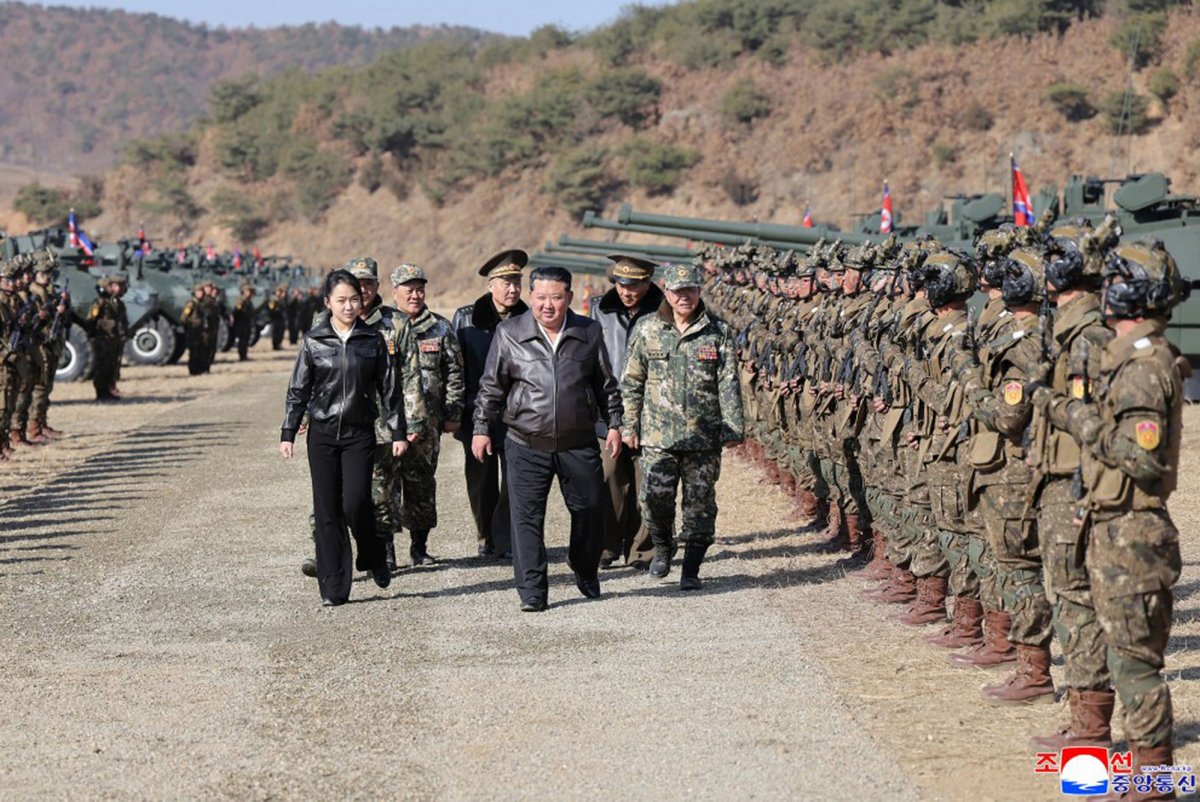
Kim Jong Un convened the first known gathering of all division and brigade commanders since he took power in 2011 and ordered them to turn the southern border into an "impregnable fortress," the Korean Central News Agency reported Monday. The meeting on Sunday at the Workers' Party Central Committee headquarters marks a hardening of military posture that puts new pressure on South Korean equities, the won, and regional defense spending narratives.
The directive goes beyond rhetoric. Pyongyang earlier this month announced plans to deploy new 155 mm self-propelled howitzers to three battalions of long-range artillery units along the southern border this year. That hardware upgrade, combined with the constitutional revision that removed all references to reunification, redefines inter-Korean relations as those between two separate states and creates a sustained geopolitical risk premium for investors watching the peninsula.
The Howitzer Deployment Timetable
Kim delivered the order at a meeting that included all division and brigade commanders – the first assembly of that scale since 2011. The stated agenda was the "rapid modernization of the military and technical equipment of our army" and adapting training to modern warfare, according to KCNA.
A shift from ideology to hardware
Previous South Korean assessments characterized North Korean military gatherings as largely ideological exercises. This one had a concrete procurement and deployment angle. KCNA quoted Kim calling for reorganizing the military structure and reinforcing frontline units with upgraded weapons and technology to strengthen deterrence. The specific reference to turning border defenses into an impregnable fortress signals that Pyongyang is moving from general threats to specific positional improvements.
The artillery expansion schedule
The earlier announcement of 155 mm self-propelled howitzers for three long-range artillery battalions gives the order a tangible timeline. These systems have a range that covers major South Korean population centers and U.S. military bases near the DMZ. The deployment is scheduled for this year, which puts a calendar-based risk marker on any South Korea-exposed portfolio.
Seoul's Two-State Reality
Kim’s meeting and his language are not isolated events. They follow a formal constitutional change that eliminates decades of unification language and codifies the two-state stance that South Korea’s Unification Ministry confirmed Monday.
A new policy baseline
"North Korea has adopted a two-state stance, and there appear to be trends in that regard," Unification Ministry spokesman Yoon Min-ho said at a regular briefing on Monday. That acknowledgement from Seoul is rare. It means the South Korean government now treats the North’s shift as an operational reality rather than mere propaganda.
The gap between engagement and fortification
President Lee Jae Myung, who took office in June, has pursued a "Korean Peninsula peaceful coexistence policy" that explicitly rejects unification by absorption and respects North Korea’s system. Lee has dismantled border propaganda loudspeakers and called for dialogue. Pyongyang has largely ignored those overtures while continuing to expand its military capabilities. The gap between Seoul’s engagement posture and the North’s fortress-building creates an asymmetric risk: market reactions tend to price the negative catalyst immediately but only slowly discount the absence of reciprocal de-escalation.
What the meeting does not say
Kim did not announce a change to the armistice or a specific military threat. The meeting appeared aimed at encouraging the military while reinforcing ideological discipline and modernization efforts, according to the Unification Ministry’s initial assessment. The absence of an explicit attack warning matters because it implies the posture is defensive in intent aggressive in positioning – exactly the kind of ambiguity that keeps the geopolitical risk premium sticky.
KOSPI and Won Exposure
Geopolitical escalations from the Korean peninsula have historically hit risk assets through three channels: the KOSPI and its components, the Korean won (KRW) versus the dollar, and the defense sector globally.
Direct exposure: South Korean equities
South Korea’s benchmark KOSPI tends to sell off on border threats, especially when they involve new artillery deployment near the DMZ. The presence of U.S. military assets in the region means any escalation also affects shares of companies with significant exposure to Korea-related defense contracts. Defense contractors like Hanwha Aerospace (South Korea’s largest defense firm) and LIG Nex1 could see a short-term bid as the security premium rises. The broader market reaction is typically negative for risk-on flows.
Indirect exposure: Safe-haven rotation
When North Korea hardens its military posture, institutional investors often rotate into safe havens: gold, the U.S. dollar, Japanese yen, and Treasuries. The flight is rarely sustained beyond a few sessions unless the North follows through with a missile test or a border incursion. The initial move is consistent. Traders watching the KRW/USD pair should note that a 1-2% intraday drop in the won has been a typical response to similar meetings in the past.
The defense sector read-through
Globally, North Korean military activity tends to support the thesis for increased defense spending among allies. South Korea itself is a major buyer of U.S. and European defense systems. Any perceived inadequacy in current defensive capabilities could accelerate procurement cycles. President Lee’s policy of peaceful coexistence does not preclude military modernization. The North’s howitzer deployment gives Seoul a specific threat to cite in budget requests.
Confirmation Points for Traders
Traders needing to calibrate position sizing around this catalyst should watch three concrete markers in the weeks ahead.
- Howitzer deployment timetable: If the three battalions receive the 155 mm self-propelled howitzers on schedule this year, the risk premium persists. Any delays due to logistics or sanctions enforcement would weaken the narrative.
- South Korea’s response posture: The Unification Ministry said it will "continue to closely monitor related trends." If Seoul escalates its military readiness or suspends elements of Lee’s engagement policy, the market will reprice accordingly. A calm response keeps the premium contained.
- Missile tests or border incidents: Kim’s meeting did not include a launch announcement. North Korean military gatherings have historically preceded missile tests. A long-range missile launch or a drone incursion would mark a step up from the fortress-building rhetoric and trigger a sharper risk-off move.
For broader context on how geopolitical events affect equity markets, see AlphaScala's stock market analysis.