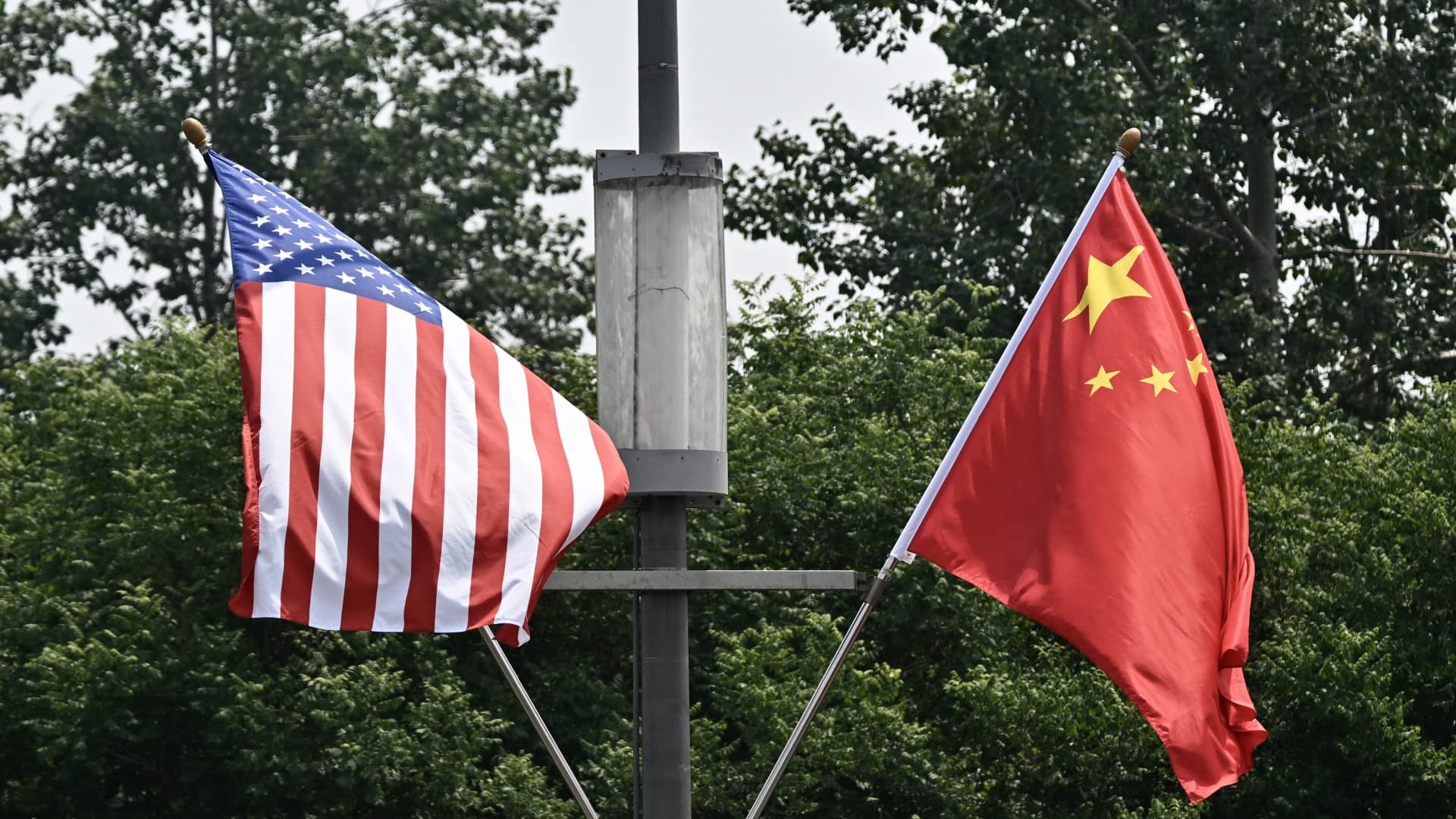
The technology shift that Washington has tried to contain is quietly reshaping the supply chains of some of the world's largest companies. Apple has turned to Alibaba and Baidu for artificial intelligence services in China. Ford is building a $3.5 billion battery plant in Michigan using CATL technology. Volkswagen has teamed up with Xpeng on smart electric vehicles. Stellantis is expanding its partnership with Leapmotor on EV production and joint purchasing.
Those partnerships reflect a broader move by global companies to source technology from Chinese firms, not just sell into the country. "Five years ago, China was primarily where global companies went to sell. Today, in certain sectors, it is where they go to source capability," Kitty Fok, managing director at IDC China, told CNBC.
The trend is unfolding even as the U.S. expands curbs on Chinese semiconductors, AI, and quantum computing. Since blacklisting Huawei in 2019, Washington has restricted exports of advanced chips and chipmaking equipment, blocked certain U.S. investments, and proscribed firms including Semiconductor Manufacturing International Corporation. Those measures have not stopped Chinese companies from building formidable positions in electric vehicle batteries, AI, and automotive software. The restrictions have forced Chinese firms to develop alternatives to U.S. chips and software, speeding up domestic innovation, said Lian Jye Su, chief analyst at Omdia.
Chinese automakers including BYD, Changan, Chery, and others accounted for nearly 63% of the global EV market in 2025. Chinese battery makers including CATL, BYD, CALB, and Gotion held close to 70%, according to Soumen Mandal, principal analyst at Counterpoint Research. Mandal cited cost, scale, manufacturing depth, supply-chain integration, and speed of innovation as reasons global companies continue to engage with Chinese firms. "China's technological rise is shifting from low-cost manufacturing to scale, supply-chain depth, and speed of innovation," he said. Global companies are balancing geopolitical risk and commercial realities, he added.
That balance is most advanced in EV batteries. CATL's lithium-iron phosphate technology is at the center of Ford's Michigan plant. Fok said the integration is difficult to reverse. "Switching suppliers is not a procurement decision you make in a quarter. It takes years of engineering, testing, and recertification," she said.
For some companies, the partnerships are driven by access to the Chinese market. Multinationals that need AI or cloud services for their China operations must work with local providers due to restrictions on foreign firms, Fok said. "Inside China, a lot of this isn't a choice," she said, pointing to Apple's work with Alibaba and Baidu.
Su said access to the Chinese market remains the primary driver for many partnerships. He also described a "slow yet persistent structural shift" in supply chains and innovation flows in batteries, EVs, energy storage, and applied AI.
The shift is beginning to play out in artificial intelligence. An IDC survey of European companies this year found security and compliance requirements, along with superior performance, were the top two reasons for adopting Chinese AI models. "The popular narrative that Western companies are rushing to Chinese AI because it's cheap gets this backwards," Fok said. "The decision is performance-led and compliance-gated." That challenges the assumption that Chinese AI competes mainly on price.
Chinese firms including Alibaba and DeepSeek have focused on open-source models, making them more accessible globally than U.S. rivals Anthropic and OpenAI. The U.S. restrictions on advanced semiconductors have accelerated domestic innovation, Su said. "The key impact of the U.S. restriction is that it has become a catalyst for Chinese domestic innovation and efficiency," he added.
Geopolitical considerations will continue to shape adoption. Su expects resistance to be strongest in advanced semiconductors, cybersecurity, defense, and national security. Companies deepening ties with Chinese tech firms risk exposure to future trade disputes or sanctions, analysts said. Counterpoint's Mandal expects Chinese technology to expand globally across EVs, batteries, consumer electronics, robotics, drones, and selected AI and semiconductor areas, leading to what he called "a more fragmented but pragmatic global technology ecosystem."
Fok said the shift is already structural in batteries and electronics manufacturing. AI is in transition. Automotive software remains at an early stage.
Alibaba and Stellantis, both deepening ties with global automakers, carry Alpha Scores of 54 and 46 at AlphaScala, reflecting mixed market sentiment.