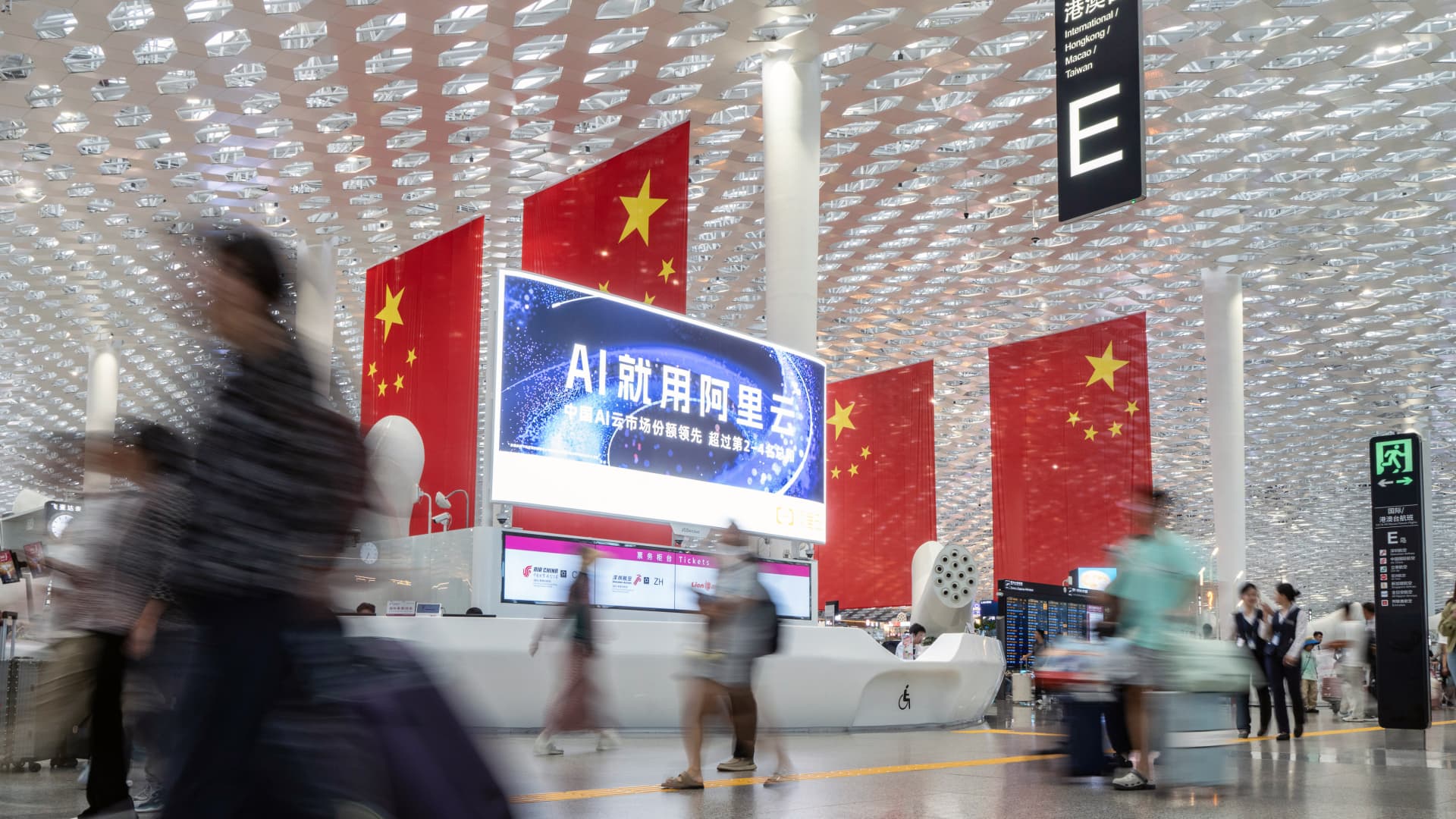
For years, the debate over artificial intelligence revolved around two questions: could American companies keep innovating at the frontier, and could Washington develop a strategy to preserve the technology lead over China. Those questions have been overtaken by events, according to Dewardric McNeal, managing director and senior policy analyst at Longview Global.
The defining question is no longer whether China can compete at the frontier. It is whether the U.S. can adapt fast enough to compete against a Chinese innovation ecosystem advancing on model performance, cost, deployment, customization, financing, standards, developer adoption, and global reach. Washington increasingly responds to successive Chinese breakthroughs rather than shaping the environment in which AI develops, McNeal wrote in an op-ed.
Headlines around DeepSeek, Moonshot AI's Kimi K3, Alibaba's Qwen family, Tencent's Hunyuan, Zhipu AI and MiniMax are often treated as separate stories. They are anything but. Viewed collectively, they show that China has cultivated a frontier AI ecosystem capable of repeatedly producing world-class capabilities across multiple firms, McNeal argued. Whether those advances come through original innovation, engineering optimization, open-weight collaboration, or distillation of U.S. models is increasingly beside the point.
The U.S. has consistently underestimated China's commitment to long-term technological advancement and its ability to translate domestic industrial strategy into global competitive advantage, McNeal wrote. Whether the issue was rare earths, electric vehicles, robotics, semiconductors, or AI, Washington evaluated China's progress company by company and product by product, often dismissing each advance as exceptional or unsustainable. Beijing pursued a patient strategy designed to cultivate conditions under which an entire ecosystem could innovate and deploy simultaneously.
China's plans toward becoming a technology superpower were established years before the Biden administration's technology restrictions, McNeal noted. Those measures may have influenced the direction and pace of Chinese innovation, but they did not create the underlying trajectory. DeepSeek's January 2025 announcement compelled many observers to acknowledge a trajectory Beijing had been articulating through industrial policies, Five-Year Plans, and national technology strategies for more than a decade.
McNeal described China's broader approach as "ecosystem statecraft" – a form of strategic competition that seeks to shape the environment within which technologies are developed, financed, standardized, deployed, and promoted. It integrates industrial policy, finance, innovation, global standards, university curriculum direction, state-supported developer ecosystems, diplomacy, and commercial expansion into a coherent national strategy. Rather than competing company by company, ecosystem statecraft seeks to shape the conditions under which technologies succeed.
AI happens to be the clearest manifestation of this broader strategy today. The same logic existed across China's approach to semiconductors, electric vehicles, batteries, robotics, telecommunications, renewable energy, critical minerals, digital infrastructure, and advanced manufacturing, McNeal wrote.
American policy has emphasized preserving technological leadership through frontier innovation while slowing China's progress through export controls, investment screening, and restrictions on advanced computing. Those remain important tools, McNeal said. But Beijing increasingly appears focused on shaping the ecosystem within which global technology competition occurs. Chinese AI firms are making their technologies easier to deploy, customize, integrate across multiple computing environments, and build upon. Reducing friction throughout the technology stack may prove as important as improving benchmark performance.
President Xi Jinping's recent address to the World Artificial Intelligence Conference reflected this broader vision. By emphasizing international AI cooperation, governance, open-source development, and greater participation by developing countries, Beijing positioned itself not simply as a producer of advanced AI but as the architect of an alternative global technology ecosystem, McNeal wrote.
That strategy also helps explain why persuading countries to avoid Chinese AI will likely prove more difficult than Washington's earlier campaign against Huawei and ZTE, McNeal argued. Governments can regulate telecommunications infrastructure, but they have far less ability to determine which AI models, software libraries, and developer tools are adopted by millions of developers and integrated into commercial applications around the world.
Many governments now evaluate both Washington and Beijing through a pragmatic lens, balancing and hedging both countries, making decisions based on security concerns as well as comparative affordability, financing, technological capability, local capacity building, and long-term economic opportunity, McNeal wrote.
America retains extraordinary advantages. Its universities remain unparalleled, its venture capital ecosystem unmatched, its semiconductor industry underpins the global AI economy, and its frontier laboratories produce extraordinary breakthroughs, McNeal acknowledged. Yet technological leadership is rarely determined solely by who invents it first. It is determined by who builds the ecosystem that everyone else ultimately chooses to join.
The question is not simply whether American companies can continue building the world's most capable AI models, McNeal concluded. It is whether the United States can develop an equally coherent national strategy – one capable of surviving changes in administrations while combining technological innovation with trusted alliances, standards-setting, research, talent development, commercial partnerships, financing, and international credibility. Once the competition becomes ecosystem versus ecosystem, success depends on whose ecosystem the world's developers, researchers, entrepreneurs, universities, businesses, governments, and investors choose to trust, adopt, and build upon.