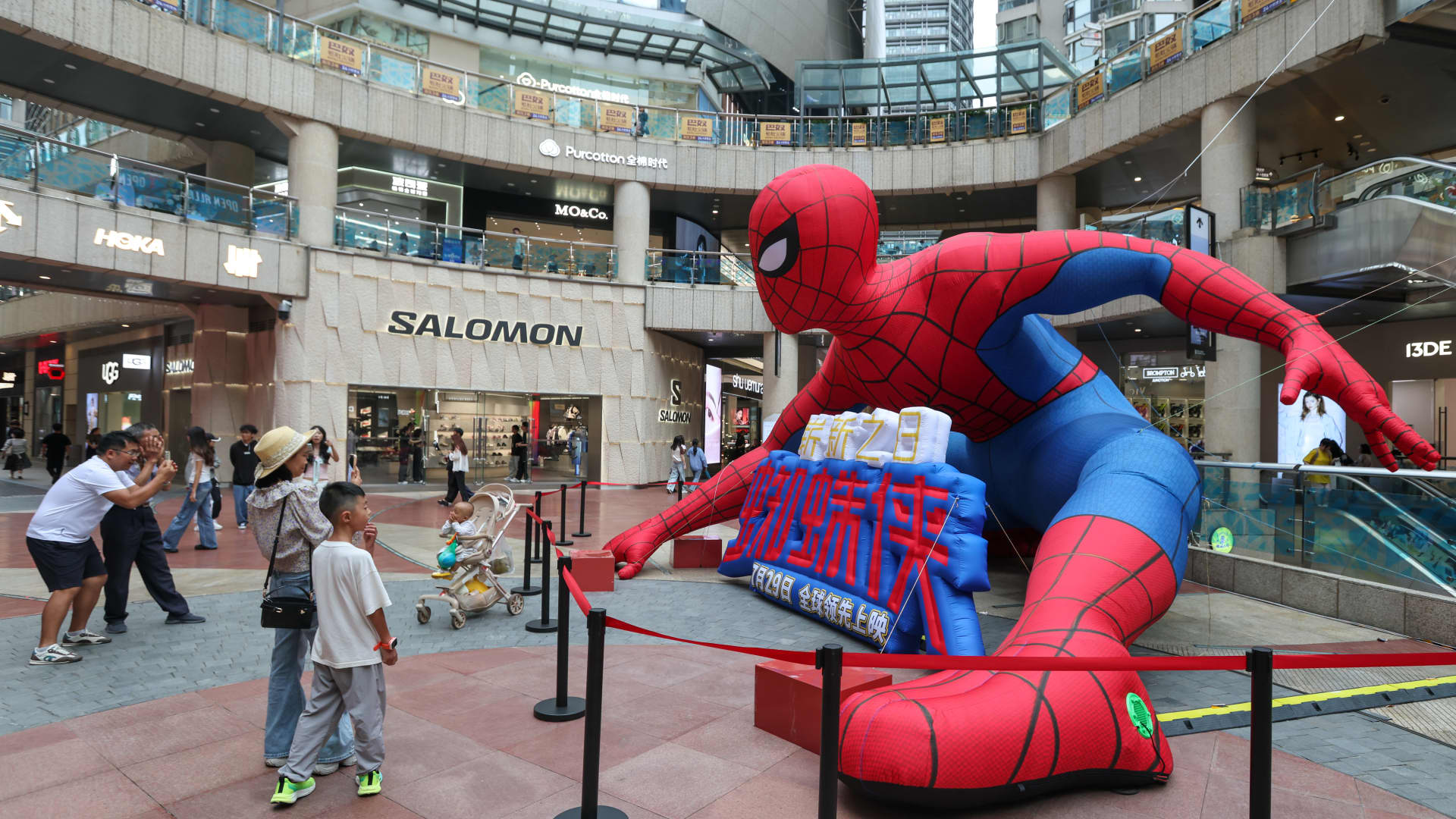
Hollywood is putting more stars and money into China, and the box office is starting to respond. Timothee Chalamet sold tofu in Chengdu. Tom Holland and Zendaya posed with sheep-themed matcha in Shanghai. The strategy is showing up in ticket sales.
"Spider-Man: Brand New Day" has cracked the ten highest-grossing films in China this year, according to ticketing platform Maoyan. Christopher Nolan's "The Odyssey" has earned more than $7 million in just two weekends of limited screenings, ahead of its Aug. 14 release. At a Beijing theater I visited Sunday, there was a rare line to get into premium screenings. Several showings were nearly sold out.
Imax is benefiting directly. The company screened 14 Hollywood films in mainland China in the first half of the year, up from just two in the same period last year, filing data showed. "The box office has picked up dramatically in China in recent weeks," Imax CEO Richard Gelfond said on an earnings call in late July, according to a FactSet transcript. He expects further improvement with upcoming titles like "Dune: Part Three" and "Avengers: Doomsday."
Nolan helped drive buzz with an unconventional interview. He spoke with Yiyang Zhuge, a Boston College doctoral candidate who hosts a podcast. Their philosophical conversation has racked up more than 1 million views on Bilibili and millions more on X. Zhuge said Universal reached out weeks earlier to set up the post-premiere interview in Beijing. The studio declined to comment.
Not every Hollywood bet is paying off. "Marty Supreme" and "Devil Wears Prada 2" both sent their leads to China but struggled at the box office. "Toy Story 5" managed only modest returns. The broader market is still contracting. Industry figures show China's box office plunged 40% in the first half of the year.
Consumer habits are shifting. The content flow is no longer one-way. Two of China's three highest-grossing domestic films this year have rolled out to other parts of Asia and abroad, helped by Alibaba's Damai Entertainment. (Alibaba Group Holding Limited carries an Alpha Score of 57/100, a moderate rating in the Consumer Discretionary sector.) Last year, Chinese animated film "Ne Zha 2" beat Pixar's "Inside Out 2" as the top-grossing animated film worldwide, though the bulk of its revenue came from home.
Some Chinese companies are pushing into new formats. Micro-dramas aimed at mobile have overtaken Netflix in the U.S. by time spent, according to Omdia. Virtual reality is another frontier. Ethan Tang, CEO of Metavision International, said his company uses Pico or HTC headsets at venues in China and other countries to immerse audiences in 40-minute stories set in ancient Egypt or the age of dinosaurs. Across four venues, Metavision generated $14.82 million in ticket sales over three years, Tang said. The company is already profitable.
"Immersive entertainment commercializes fastest when one operator controls the hardware, the environment, and the narrative all together as a single integrated experience," said Jialu Shan, an associate research director at the Center for Future Readiness at IMD Business School. She noted that state policy support for large-format VR venues is unique to China and, combined with tourism, makes the trend more investable.
Hollywood hasn't moved into VR yet. Tang said it's "just a matter of time" before U.S. studios license characters to VR producers. He claimed Apple Vision Pro engineers tried Metavision's experience in Shanghai last year. Apple did not respond to a request for comment.
Even as U.S. giants eye China's entertainment market, the landscape is shifting faster than they can adapt. The country's crude oil imports hit a three-month high in July as Strait of Hormuz tensions eased, and AI-related demand drove export growth of nearly 24% year-on-year. The broader geopolitical climate remains tense. China retaliated against recent U.S. restrictions on foreign-made humanoid robots with export controls on drone sales, and banned Chinese companies from working with U.S. entities on factory inspections required for electronics sales. Wealthy Chinese are also scrambling for tax advice as Beijing targets offshore trusts with a 20% levy on assets transferred since 2023, with back taxes due by Oct. 22.
For Hollywood, the immediate opportunity is in theaters. Imax's Gelfond expects the momentum to continue with the next wave of blockbusters. The competition from Chinese content and new formats like VR suggests the window for U.S. studios to capture the market may be narrowing.