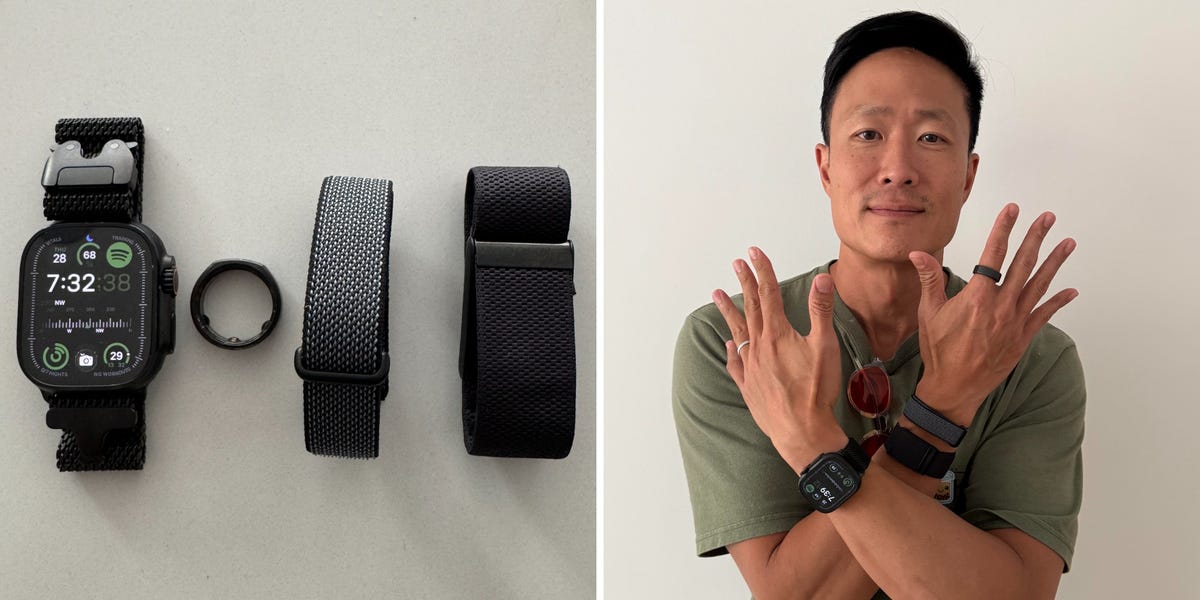
Apple Watch beat dedicated fitness bands from Whoop and Oura in a two-week test by a Toronto health coach. Alphabet's Fitbit was also in the running. The result shows the advantage of a hardware ecosystem over a subscription model.
Why Apple Watch Won
Dan Go, a performance coach who has worked with entrepreneurs for over a decade, wore all four devices simultaneously for two weeks. He picked the Apple Watch as the winner for accuracy and overall value. "Apple Watch was the most accurate in terms of comparing how I felt to the metrics I was getting," Go told Business Insider, which published the experiment.
The Apple Watch tracked steps closely with a standalone pedometer. It matched Go's subjective sense of being rested or not. Go said its lack of an ongoing subscription fee was a key advantage over the Oura Ring and Whoop band, both of which require monthly payments to unlock full data.
Go said he expected some variability between devices. The actual differences were larger than he anticipated. "One of the most surprising things to me was that the Whoop was over-exaggerating the amount of steps I was taking," he said.
Whoop's Data Gap
For sleep, Go did not test the devices in a sleep lab. He used his Apple Watch score as a benchmark, based on a Journal study that found it to be the most accurate. Compared to the Apple Watch, he found the Whoop sleep score exaggerated how poorly he slept.
Emily Capodilupo, senior vice president of research at Whoop, told Business Insider that the company is working to improve its algorithms and hardware. "Our sleep algorithms have been evaluated against the clinical gold standard of polysomnography, and we're proud of the accuracy we've achieved across sleep and other key health metrics," Capodilupo said.
Oura's Trade-off
The Oura Ring generated strong sleep data that previously helped Go overhaul his habits. "I improved my sleep, going from someone who had trouble going to sleep to someone who went straight to sleep and was able to stay asleep throughout the entire night," he said.
He does not recommend it, though, because he found himself taking the ring off too often. The subscription requirement was an additional strike.
The test pits Apple's premium pricing against the subscription model underpinning Whoop and Oura. For the "weekend warrior" consumer Go described, an integrated device like the Apple Watch offers comparable health data without a recurring cost. Fitbit, owned by Google, was the fourth device. It did not win any category Go evaluated.
When Data Becomes Counterproductive
Go said he was not concerned with the devices' recovery scores, which estimate how well the body is handling stress. They rarely matched how he actually felt. Unless the devices showed a drastic change, he finished a planned workout even if a device recommended he rest.
"Something that we have to realize about the human body is that it is so resilient," he said.
The constant stream of data from wearables can become counterproductive, Go said. He plans to stop wearing devices for now. "I'm going back to using no wearable because the constant attack of being told…, 'This is how you should feel. This is how you should perform.' It actually does have an outsize impact on my psychology," Go said.
His advice for clients: try whichever wearable fits your priorities. Use it for four to eight months to notice patterns. Then ditch the device and focus on listening to your body. "I am not anti-wearable," he said. "But at some point, you have to be able to let go of the training wheels. Once you have the data and you have a good handle on it, then you will want to evolve toward how you feel."