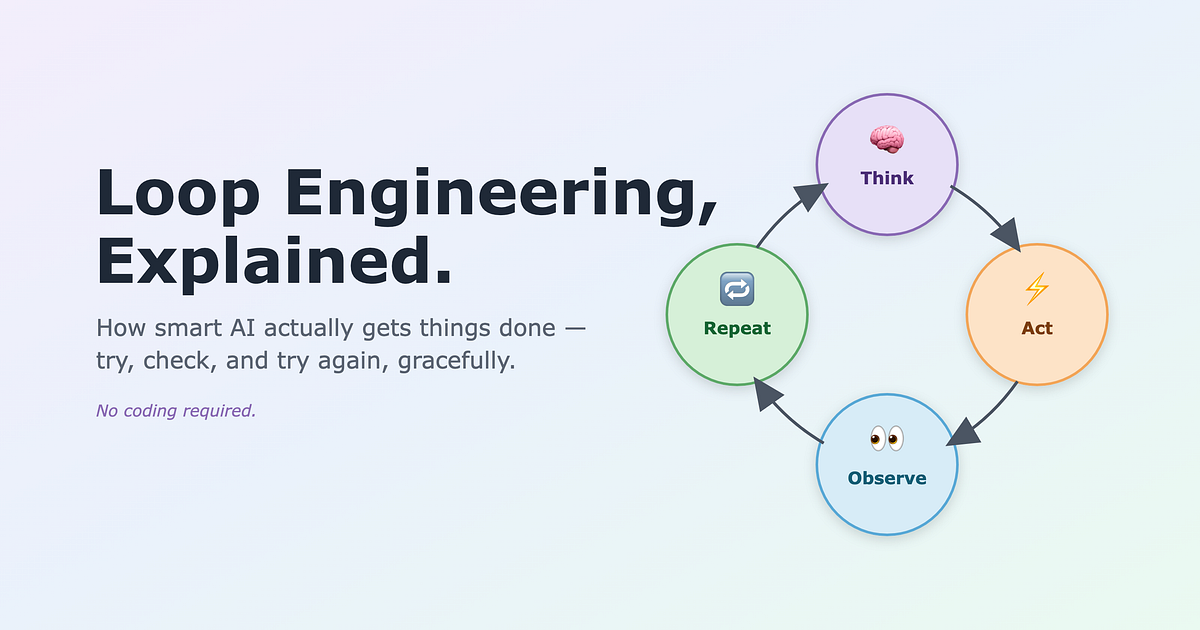
The same principle that makes a selfie session produce one good shot – try, check, adjust, repeat – is the missing piece in half the algorithmic trading setups pitched on X right now. Loop engineering describes how an AI agent decides what to do next based on what just happened. In markets, that loop is the difference between a strategy that adapts and one that blows up on the first regime shift.
A simple loop: scan for a signal, enter a position, check the P&L, decide to hold or exit. That works in a textbook. In real markets, the loop needs guardrails. A badly engineered loop re-enters the same losing trade because it does not remember what it already rejected. A well‑engineered loop logs each rejection and skips that path.
Consider an algorithm that buys Apple (AAPL) when the 50‑day moving average crosses above the 200‑day. That is a single pass, not a loop. Add a loop: after the first entry, the algorithm checks the next bar’s volume. If volume is below the 20‑day median, it tightens the stop. If the cross happens during a Fed blackout window, it reduces position size by half. Those are loop decisions tied to observable conditions.
The difference shows up in drawdowns. A fixed‑rule system takes the same trade every time. A loop‑engineered system adjusts the trade size, the stop distance, and the exit trigger based on what the market just did. It does not need a new model. It just needs the iteration logic.
Loop engineering applies to execution too. A broker’s API fails mid‑fill. A brittle loop aborts the whole order. A well‑engineered loop retries with a smaller slice, or switches to a different venue, or logs the failure and moves to the next symbol. The market does not wait for a human to restart a script.
One practical rule: every algorithm should have a stop condition that is not a price level. Stop after three consecutive losing trades. Stop after the VIX crosses above 30. Stop if the position sat unfilled for more than 10 seconds. That stop is what separates a loop from a runaway process.
Traders who build their own scripts already do this intuitively. They add a max_retries parameter or a timeout flag. Loop engineering just formalizes what works. The best systematic strategies are not the ones with the smartest entry signal. They are the ones that know when to stop trying and when to try a different angle.