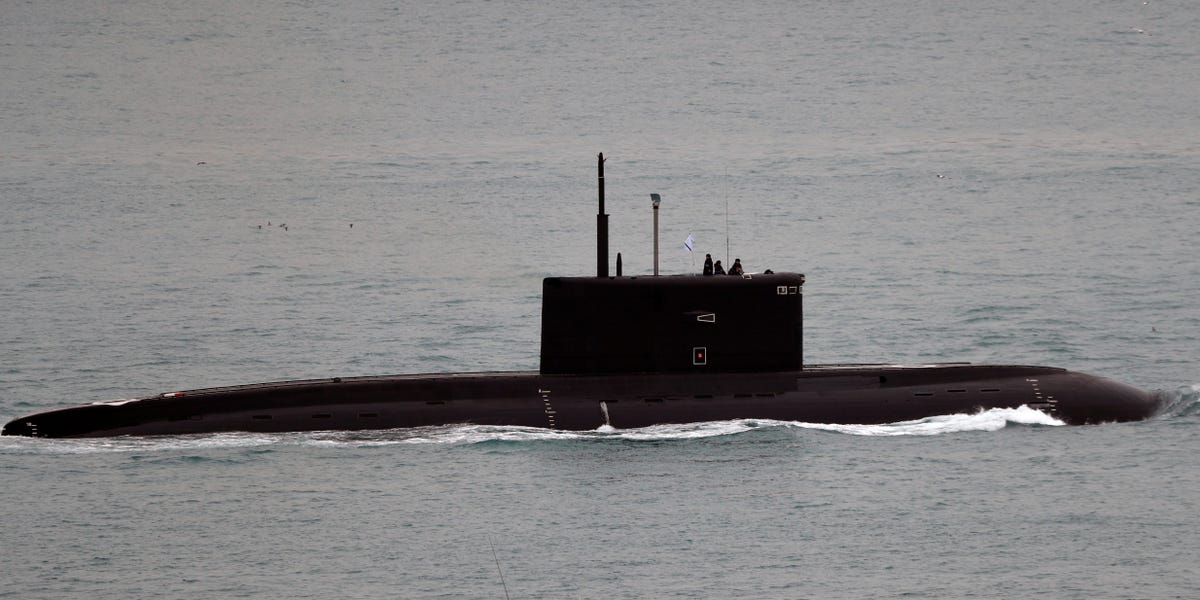
Russia has fitted submarines at a major Black Sea naval base with anti-drone cages, according to Western intelligence officials. The move is the latest attempt by Moscow to protect its naval assets from Ukrainian deep strikes that have already crippled parts of the Black Sea Fleet.
The cages, which have become a common sight on tanks and armored vehicles on the battlefield, are now being bolted to submarine hulls at the Novorossiysk base. The intent is to defeat first-person-view (FPV) drones and loitering munitions that Ukraine has used to target high-value Russian naval assets hundreds of miles from the front line.
Western officials, speaking on condition of anonymity, said the adaptation signals that Russia views the submarine fleet as increasingly vulnerable to Ukrainian attacks far beyond the immediate combat zone. Previous Ukrainian drone and missile strikes have damaged or destroyed several Russian warships, including the landing ship Caesar Kunikov and the submarine Rostov-on-Don, both hit while pierside in Crimea.
After those losses, Russia moved many of its surviving vessels from Sevastopol to Novorossiysk in an effort to put them out of range of Ukrainian missiles. The new cage installations suggest that even that relocation is not considered sufficient protection.
The cages are a crude but functional countermeasure. They create a physical barrier between the drone's warhead and the hull, detonating the munition before it can penetrate the pressure hull of a submarine. The same approach has been widely used on Russian tanks in Ukraine, though effectiveness against top-attack munitions has been mixed.
The intelligence assessment did not specify how many submarines have been fitted or whether the cages affect the vessels' operational capabilities. Submarines rely on hydrodynamic efficiency for stealth and speed; external fixtures could increase noise and reduce performance. One official said the trade-off is likely seen as acceptable given the threat.
For Ukraine, the development confirms that its deep-strike campaign is forcing Russia to divert resources to passive defense measures. It also creates a target set: any submarine leaving port with an obvious cage structure is broadcasting its location and the direction of travel.
The conflict has already disrupted supply chains and increased geopolitical risk premiums across global markets. Technology companies with exposure to Europe and the Middle East, including Apple (AAPL), have cited the war's impact on component sourcing and demand uncertainty. For investors, the widening of the defensive perimeter around Russian naval bases is another data point in the long-running reassessment of military risk in the Black Sea region.
INTC stock page
stock market analysis