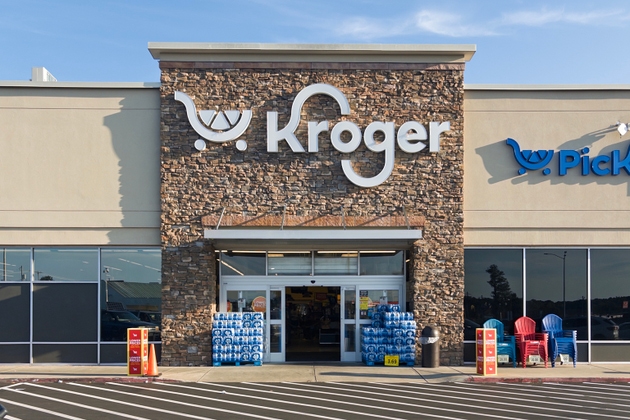
Kroger (KR) is planning storewide price cuts, ramping AI-driven supply chain efficiency, and opening 80 new stores to challenge Walmart and Costco. The initiative, reported ahead of the company’s first-quarter earnings release, marks a strategic departure from Kroger’s recent ‘midfi’ positioning and signals a bet that volume growth can offset thinner per-unit margins.
The Price-Cut Pivot
Kroger’s new CEO is steering the grocer toward direct price competition with the two largest U.S. retailers. The move is a recognition that Kroger’s historical positioning – quality above discount but price above premium – has lost traction as inflation-conscious shoppers migrate to Walmart and Costco. Price cuts across the store aim to reclaim trip frequency, with the store count expansion providing incremental shelf space to capture trade-down traffic.
The investment case hinges on whether Kroger can fund those cuts through cost savings rather than margin compression. That brings the second pillar of the strategy into focus.
Supply Chain as Margin Levee
AI-driven supply chain improvements are Kroger’s primary lever to protect gross margin while lowering shelf prices. The company has been piloting machine-learning models for inventory replenishment, labor scheduling, and demand forecasting. If these tools reduce waste and spoilage – historically a 3–4% drag in grocery – Kroger can absorb price cuts without a collapse in EBITDA margins.
Investors should watch the Q1 earnings call for any quantified targets on cost savings. Without explicit margin guardrails, the price-cut narrative risks reading as a race to the bottom. Walmart’s scale and Costco’s membership-model economics are formidable moats; Kroger must show its operating efficiency is narrowing the gap, not just lowering revenue per square foot.
What Q1 Earnings Will Reveal
Kroger reports fiscal first-quarter results in the weeks ahead. The print will be the first market test of this strategic shift. Analysts will look for:
- Same-store sales growth trends, particularly in fresh and center-store categories. A volume lift from price cuts should begin showing in transaction counts, not just dollar sales.
- Gross margin trajectory – any material compression would undermine the investment thesis before the supply chain savings materialize.
- Capital allocation clarity – the 80 new stores require capital that could otherwise go to buybacks or debt reduction. The balance between growth spending and shareholder returns matters.
If Kroger delivers same-store sales acceleration alongside stable or improving gross margins, the price-cut strategy gains credibility. If margins contract with no offsetting store traffic improvement, the stock will face pressure as the market reprices the risk of a profit-sacrificing volume chase.
The Next Decision Point
Beyond Q1, Kroger’s new CEO must articulate how the price cuts integrate with the broader loyalty program and digital initiatives. Walmart’s omnichannel advantage and Costco’s membership stickiness are not replicated by price alone. Kroger’s ability to defend its retail market share will depend on execution of the supply chain and store rollout timelines.
The Q1 conference call will be the first chance to hear management’s margin guardrails. Without them, the market will treat the price-cut plan as a high-risk gamble rather than a disciplined repositioning. For more context on current market dynamics, see our stock market analysis and broker comparison guide for best stock brokers.