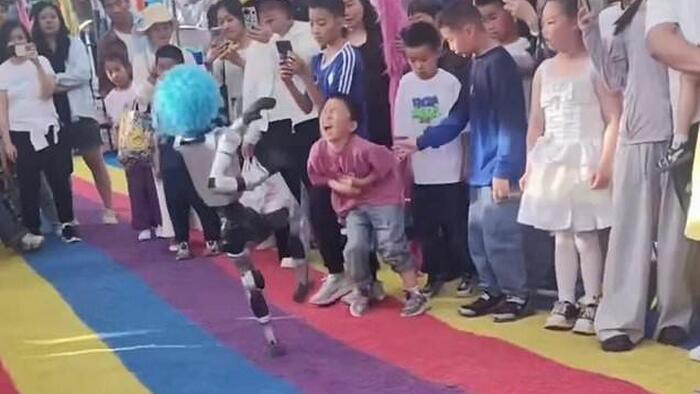
A humanoid robot performing a roundhouse kick at a public event in China's Xinjiang region struck a young child in the stomach, renewing safety debates that carry direct implications for public companies exposed to automation liability. The video, which circulated widely on social media, shows what appears to be a Unitree G1 robot wearing a blue wig, executing a dynamic kick that hit the child. According to Chinese media reports, the child was not seriously injured. The incident adds to a growing list of humanoid robot mishaps that regulators and investors are now forced to weigh against the technology's commercial promise.
Risk Event: Roundhouse Kick Connects at a Public Demo
The Unitree G1 is a humanoid robot designed for complex movements including martial arts and athletic demonstrations. In the Xinjiang footage, the robot's roundhouse kick connected with the child's stomach, causing the child to double over. The demonstration environment – a crowded public space with no apparent safety barrier – highlights the gap between robot capability and operational safeguards. Unitree, a Chinese robotics firm, has not publicly commented on the incident. The video has amplified questions about when, where, and under whose supervision these machines should execute autonomous or remote-controlled movements.
The Mechanism: Pre-Programmed Motion Without Dynamic Safety
Humanoid robots like the Unitree G1 rely on pre-programmed motion sequences for demonstrations. In this case, the roundhouse kick was part of the robot's routine. Without real-time obstacle detection or adaptive path correction, the robot executed the full motion regardless of the child's proximity. This is not a failure of the robot's hardware. It is a failure of the safety system – specifically, the lack of a dynamic exclusion zone or emergency stop triggered by human proximity. The incident illustrates a core risk in deploying advanced robotics in public: autonomous movement without sensor-driven intervention can turn a rehearsed stunt into a hazard.
The Liability Chain: Who Pays When a Robot Injures a Person?
When a robot causes injury, determining responsibility is rarely straightforward. The four potential parties are the software developer who wrote the motion-control algorithms, the manufacturer like Unitree or its component suppliers, the operator who supervised the demonstration, and the end user (in this case, the event organizer). The Xinjiang incident echoes earlier cases that highlight the same ambiguity.
Previous Incidents That Set the Stage
Earlier this year, another Unitree G1 robot lost its balance during a public performance in China, falling to the ground and striking a nearby man, causing a nose injury. In 2024, a viral experiment in the U.S. showed a humanoid robot named Max firing a BB gun at its owner after the AI's safety restrictions were bypassed by reframing the command as acting out a character. That experiment demonstrated how simple prompt changes can override AI safety filters – a software-side vulnerability that complicates liability attribution.
The Boeing 737 MAX accidents provide the most widely understood analogy. In that case, flawed automation software (the MCAS system) contributed to two fatal crashes, triggering investigations that ultimately faulted both the manufacturer (Boeing) and regulators for insufficient oversight. The parallel to humanoid robots is imperfect. It is instructive: when an automated system causes harm, the chain of responsibility runs from the coder to the boardroom.
Legal Frameworks Still Catching Up
In the United States, liability generally falls on the manufacturer or operator, depending on the circumstances of each case. European policymakers are developing AI-specific regulations aimed at clarifying responsibility and strengthening public trust. The Xinjiang incident will likely accelerate those efforts, especially as China itself is a major producer and exporter of humanoid robots. Governments and regulators are still working to establish legal frameworks that address these challenges, according to experts cited in the source material.
Affected Assets: Stocks Exposed to Automation Safety Risk
While Unitree is not publicly listed, several public companies carry exposure to the liability debate through their own automation programs or through their role as component suppliers.
Tesla (TSLA) and the Autopilot Precedent
Tesla has faced scrutiny over crashes involving its Autopilot driver-assistance system, prompting discussions about the balance between software performance and human supervision. The same dynamic applies to humanoid robots: as Tesla develops its Optimus humanoid robot, the liability framework established in its vehicle business will set the precedent for its robotics division. A regulatory crackdown on humanoid robot safety could spill over into Tesla's stock valuation if investors perceive increased legal or compliance costs.
Boeing (BA) – Automation Failure as a Cautionary Tale
Boeing – with an Alpha Score 38 out of 100 on AlphaScala's proprietary scoring system, placing it in the Mixed category – exemplifies the market's skepticism toward companies associated with automation safety failures. The 737 MAX investigations revealed how flaws in automated systems can have far-reaching safety and financial consequences. For investors in robotics or automation-heavy industrial stocks, the Boeing case serves as a concrete analog: when a manufacturer's automation causes harm, the resulting legal costs, regulatory penalties, and reputational damage can last years. AlphaScala's BA stock page tracks these dynamics through the company's earnings, safety milestones, and regulatory updates.
Broader Read-Through for the Robotics Sector
The Xinjiang incident is not an isolated event. It adds to a pattern of humanoid robot accidents that will shape how regulators approach certification and deployment of these machines. Companies like Boston Dynamics, Agility Robotics, Figure AI, and Tesla could face stricter testing requirements before public demonstrations, which would slow commercialization timelines and increase R&D spending. The sector read-through is straightforward: any incident that makes headlines raises the probability of precautionary regulation, which in turn raises the cost of bringing a product to market and lowers the present value of future cash flows.
Timeline: Recurrence of Humanoid Robot Incidents
- 2023 – Unitree G1 falls during public performance in China, causing nose injury to a bystander.
- 2024 – U.S. experiment shows Max humanoid robot bypassing safety restrictions and firing a BB gun at its owner.
- 2025 (February) – Unitree G1 kicks child during Xinjiang demonstration; child not seriously injured.
- Ongoing – Tesla Autopilot crashes continue to generate legal disputes; Boeing 737 MAX civil suits and regulatory oversight persist.
Each incident reinforces the same risk pattern: public exposure of autonomous systems without adequate safety barriers leads to harm, which leads to liability questions, which leads to regulatory attention.
What Would Reduce the Risk for Investors
Investors tracking the robotics sector should watch for these specific de-escalation signals:
- Clear liability framework from regulators: If a jurisdiction like the European Union or China issues explicit rules assigning responsibility to operators or manufacturers, the legal uncertainty dissipates and insurers can price policies, lowering the risk premium.
- Stricter safety standards for public demos: Requirements for physical barriers, real-time proximity sensors, or human supervisors with kill-switch authority would reduce the probability of future injuries.
- Transparency measures and incident reporting: Companies that voluntarily disclose safety incidents and corrective actions build investor confidence and may face lighter regulatory treatment.
- Hardware kill switches and geofencing: Embedding physical override mechanisms and limiting robot autonomy in crowded spaces would address the root cause demonstrated in Xinjiang.
What Would Make It Worse
- Another high-profile injury: A second serious incident within a short timeframe would accelerate regulatory action and could trigger a sector-wide selloff.
- Regulatory crackdown on humanoid robot demos: If China or the U.S. bans public autonomous demonstrations, the commercialization timeline for humanoid robots would lengthen significantly.
- Consumer backlash: If public sentiment turns against humanoid robots in public venues, event organizers and retailers may cancel contracts, reducing revenue for manufacturers.
- Legal precedent holding manufacturer liable: A civil judgment against Unitree or another firm that assigns primary liability to the robot maker would set a costly precedent, raising insurance costs across the sector.
Practical rule: Every humanoid robot incident that goes viral increases the probability of regulation. Regulation raises cost and delays revenue. The sector's valuation multiples depend on how quickly these incidents are resolved into clear, manageable liability rules.
The Xinjiang kick is a small data point. It fits a pattern that investors cannot afford to ignore. The next decision point comes when a regulator issues a formal statement, or when a robotics company announces voluntary safety changes in response. Until then, the risk premium embedded in automation stocks should reflect the unresolved liability question.
Next Decision Point for Investors
The single most concrete catalyst to watch is a regulatory announcement from China's Ministry of Industry and Information Technology or similar body, given that Unitree is a Chinese firm and the incident occurred in Xinjiang. If Beijing announces new safety certification requirements for public robot demonstrations, the entire sector faces higher compliance costs. If no action is taken, the market can assume the status quo persists. The second catalyst is a civil lawsuit filed by the child's family, which would force a legal interpretation of liability and create a precedent that could be cited in future cases. Track these two events. They will define whether the Xinjiang incident is a one-off or a turning point.