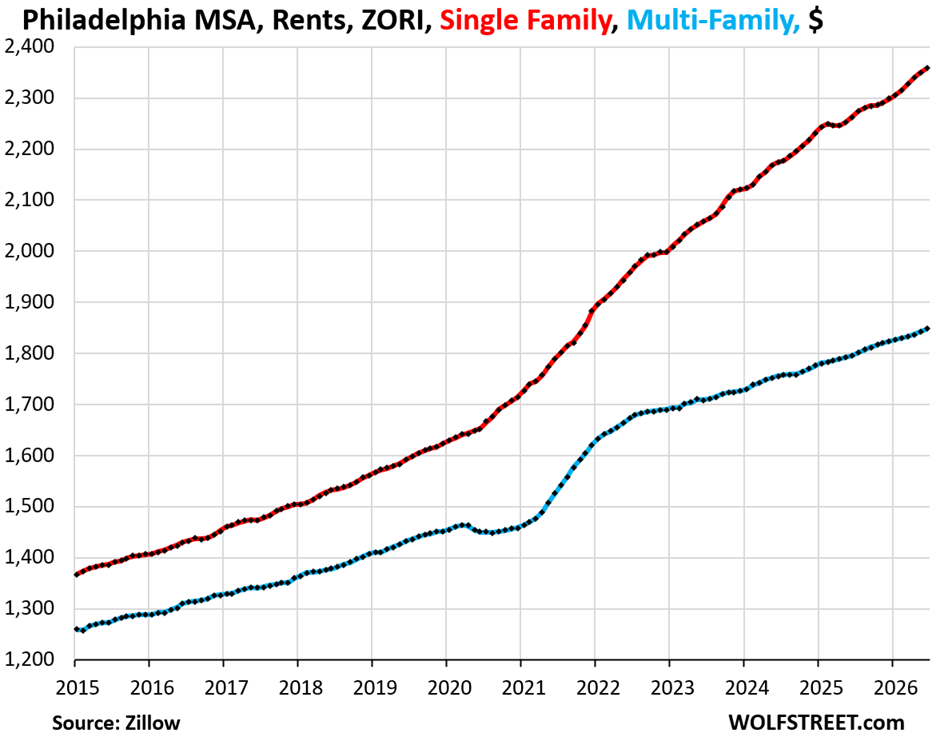
The US rental market is no longer moving as one. Multifamily rents are sliding in most major cities as a record wave of new apartment towers hits the market. Single-family rents, by contrast, keep grinding higher. The gap between the two is now 29.7%, more than double the pre-pandemic spread of 12% to 14%, according to Zillow data analyzed by Wolf Street.
The rent spikes of 2021 and 2022 fired up the construction machinery. Builders started towers. Corporate money poured into build-to-rent subdivisions. A supply wave is now cresting just as demand softens.
The year-over-year growth rate for mid-tier rents ticked up in June. Multifamily hit 1.4%. Single-family hit 2.8%. That pace is well below the 4% annual growth that was normal before the pandemic. It is stacking on top of rents that already surged 33% and 52%.
Mid-tier multifamily asking rents across the US surged 33% from January 2020 to June 2026. Single-family asking rents rose 52% over the same period. Most of the gains came in 2021 and 2022. Since then, rent growth flattened or reversed in many markets.
Denver multifamily rents are up 69% since 2020, Wolf Street data show. Seattle and Salt Lake City are up 67%. Many of these markets are now seeing declines from their 2022 peaks. Multifamily rents in Dallas are down 8% since spring 2022.
Single-family rents tell a different story. Knoxville is up 74%. Providence is up 71%. Miami and Charleston are up 70%. Tampa is up 65%. Multifamily rents dropped from their peaks in many cities. Single-family rents continued to rise from record to record.
The population slowdown is tightening the tenant pool just as the biggest multifamily construction wave in decades hits the market. The crackdown on illegal immigration and the tightening of legal immigration are reducing the pool of potential renters.
The single-family rental market is dominated by mom-and-pop landlords. They own 82% of the 15 million SFR units. The remaining 18% are owned by larger landlords, including a handful of giant publicly traded landlords. The multifamily market, by contrast, is dominated by big institutional players. Since 2022, many of those institutions have defaulted on their debts. Lenders seized properties or sold the loans to investors who then seized them.
The divergence is not limited to a few cities. In Houston, multifamily rents dropped 16% from their mid-2022 peak. Single-family rents there eased only slightly and have started ticking up again in recent months. In Dallas, the same pattern holds.
San Francisco is the outlier. Multifamily rents there, after years of stability, started surging in late 2024. The AI boom is the catalyst, as discussed in our coverage of Enterprise AI. Apple (AAPL) and other tech firms are expanding headcount. The hiring is driving demand for high-end multifamily units in the city, pushing rents up 13% since late 2024. June showed the biggest monthly spike yet at 1.3%.
The build-to-rent sector is a growing part of the single-family market. Big landlords are partnering with homebuilders or creating their own homebuilding divisions. They build entire subdivisions of rental homes. The units target higher-income renters of choice, people who could afford to buy and prefer the flexibility of renting. The new supply adds to the top of the single-family market. The impact on rents has been more moderate than in the multifamily sector.
The supply wave includes condos. Retail investors bought condos to rent them out. As condo prices plunged in many markets, those investors are losing their shirts. The units still add to the rental supply.
The new construction is almost entirely higher-end. Developers build luxury towers and high-end subdivisions because that is the only place construction pencils out. This puts pressure on the entire market below.
For REITs and homebuilders, the divergence creates a split. Multifamily REITs face a supply glut and rising delinquencies. Single-family rental REITs face a different dynamic. Their rents are still rising, the build-to-rent pipeline is growing. Homebuilders benefit from the build-to-rent demand. They face a slowing single-family for-sale market. Rents are rising and affordability is worsening.
The CMBS delinquency rate for multifamily stands above 7%, according to Trepp data.