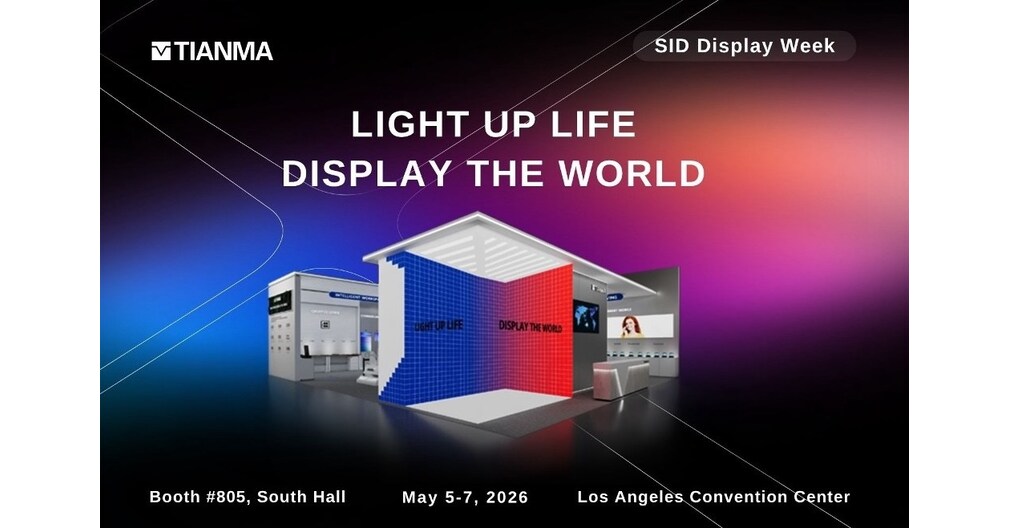
Tianma is set to showcase a series of high-performance display technologies at SID Display Week 2026, held May 5–7 at the Los Angeles Convention Center. The manufacturer is positioning its latest hardware to address specific technical bottlenecks in automotive head-up displays (HUDs), mobile refresh rates, and professional medical imaging. These demonstrations, centered at Booth 805, serve as a technical roadmap for the company’s push into high-margin, specialized display segments.
The Micro-LED HUD Mechanism
The most prominent automotive offering is the 12-inch Micro-LED IRIS HUD. The primary engineering challenge in HUD design is maintaining visibility under high ambient light without increasing the physical footprint of the optical engine. Tianma’s solution utilizes a Micro-LED architecture that achieves peak brightness exceeding 120,000 nits.
By eliminating the need for traditional black masking layers, the display achieves a transparent front-window design. This allows for an optical engine thickness of approximately 2 mm, which is critical for integration into modern, space-constrained vehicle cockpits. This shift toward thinner, brighter, and more transparent HUDs suggests a move away from bulky projection systems toward integrated, high-density display surfaces that do not obstruct the driver’s field of view.
Dual-Track Pixel Driving in Mobile AMOLED
In the mobile sector, Tianma is introducing a 6.32-inch AMOLED display featuring a 240Hz refresh rate. The technical hurdle for high-refresh-rate OLEDs is maintaining image accuracy and preventing motion artifacts when the data-writing speed increases.
Tianma’s approach employs a dual-track pixel driving architecture. By separating data writing from threshold compensation, the display maintains stable pixel control even at 240Hz. This separation is intended to preserve low-gray detail, which is often lost in high-speed displays where the time available for pixel charging is compressed. For mobile manufacturers, this mechanism offers a path to higher frame rates without the typical degradation in color depth or image stability.
Multi-Region 2D/3D Switching for Medical Imaging
Professional medical displays require high precision and the ability to handle complex data sets. Tianma’s 27-inch 4K glasses-free 3D medical display introduces multi-region 2D/3D switching. Unlike legacy systems that require the entire screen to operate in a single mode, this display allows for the simultaneous presentation of 2D and 3D content.
This capability is supported by low-latency eye tracking and real-time rendering. The ability to switch modes in real-time allows surgeons or radiologists to view 3D volumetric data alongside 2D diagnostic information on a single panel. This integration is designed to reduce the need for multiple monitors in sterile environments, where space and equipment complexity are significant operational constraints.
Sector Read-Through and Market Positioning
Beyond these headline technologies, Tianma is signaling a broader expansion into high-frame-rate and adaptive display architectures. The company is demonstrating a 27-inch QHD Oxide TFT LCD with a native 610Hz refresh rate, which pushes the current industry ceiling for frame rates. Additionally, an adaptive refresh Oxide display (20–144Hz) highlights a focus on power efficiency for industrial and professional applications where battery life or heat dissipation is a factor.
These developments reflect a broader industry trend where display manufacturers are moving away from commoditized panel production toward specialized, application-specific hardware. For investors tracking the display supply chain, the focus is shifting from simple resolution upgrades to architectural improvements like dual-track driving and transparent Micro-LED tiling.
While Tianma’s innovations are technically robust, the commercial success of these products depends on their integration into the product cycles of major automotive OEMs and medical device manufacturers. The company’s participation in the Automotive Forum at the SID Business Conference on May 4 underscores its intent to influence the design standards of next-generation cockpits.
For those evaluating the broader landscape, it is useful to compare these developments against other players in the sector, such as those analyzed in our stock market analysis. While Tianma remains a private-facing entity in many of its operations, its technological output provides a clear window into the competitive pressures facing public firms in the display space. For instance, companies like WELL (Welltower Inc.) operate in sectors where such medical display advancements could eventually influence diagnostic workflows, though the direct correlation remains distant. Monitoring the adoption rate of these specific HUD and medical display architectures will be the primary indicator of whether these innovations move from the trade-show floor to mass-market commercialization.