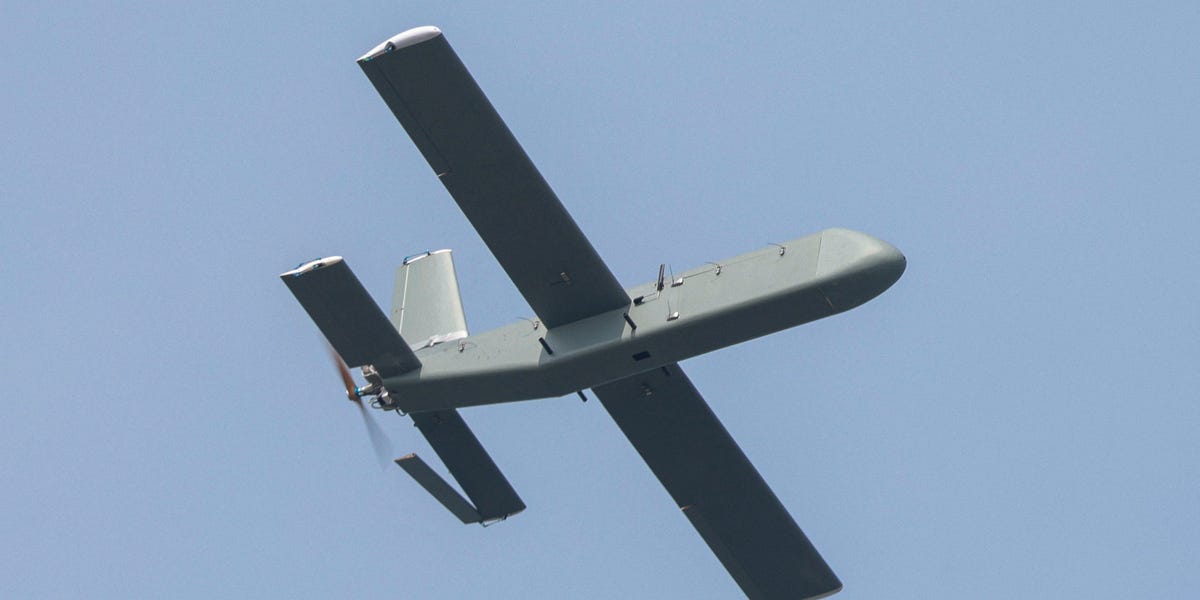
Taiwan's navy deployed two medium-class strike drones during the island's largest annual military exercise, the Han Kuang drills. The fixed-wing, propeller-driven aircraft appeared over Zuoying, Taiwan's southwest coast, during a littoral combat simulation that lasted about 30 minutes. Taiwanese military officials described them as "medium-size suicide drones" and said they were locally built by the National Chung-Shan Institute of Science and Technology. A navy spokesperson told reporters the drones were provided by the Armament Bureau for testing. Officials declined to give specifications or say whether the design was influenced by wars in Ukraine or the Middle East.
The deployment is part of a broader push to scale up Taiwan's drone arsenal. The government has said it plans to produce 100,000 drones a month by 2030. In June, the defense ministry proposed a $6.6 billion budget to buy more than 210,000 domestically produced attack and reconnaissance drones. Sea drones are also part of the plan. The strategy, often called a "hellscape," aims to flood the Taiwan Strait with thousands of aerial and surface drones to make it difficult for Chinese forces to cross. Underwater drones are also part of the plan. The "hellscape" concept, first outlined by Taiwan's defense minister in 2024, envisions using drones, mines, and other assets to make a cross-strait invasion prohibitively costly. President Lai Ching-te attended the Saturday drills.
The drones resemble loitering munitions that Ukraine has used this year to strike Russian supply lines 30 to 300 km behind the front lines. Zuoying, where Taiwan hosts its largest naval base, is about 295 km from mainland China. Bryce Barros, a visiting fellow at the Institute for National Defense and Security Research in Taipei, said the desire to employ more medium-range drones fits with lessons Taiwan has learned from Ukraine. Mid-range drones fill a gap in Taiwan's littoral defense, providing a cheaper way to strike Chinese forces from over the horizon, he said. Unlike Ukraine's plains and forests, Taiwan's defense covers a strait with bad winds and volatile sea states, so Taipei wants drones built to withstand poor weather, Barros added. Taiwan's drones are likely to target slow-moving vessels transporting troops or weapons, he said. A range of 40 to 60 km could be useful for a variety of platforms, anything to make it harder for the People's Liberation Army to enter Taiwan's territorial waters, he added.
The littoral drills also featured naval special forces deploying in Taiwan's homegrown M109 Skyship rigid-hull inflatable boats. Taiwan's navy and coast guard launched rapid sorties with four of its older 170-ton Kuang Hua-6 missile boats and at least one Anping-class patrol vessel, a newer 600-ton catamaran that can be fitted with anti-ship missiles during wartime. The Han Kuang exercise, which lasts 10 days and 9 nights, simulates how Taiwanese forces and civilian institutions would respond to Chinese gray-zone tactics and an invasion. The exercise includes civilian response drills, simulating power outages and cyberattacks that China might use in a gray-zone campaign. China has condemned Taiwan's military exercises and has increased its own military drills around the island. The US has been selling weapons to Taiwan and conducting naval transits through the Taiwan Strait.
For Apple, the geopolitical risk is direct and material. Apple relies on TSMC for its processors, and TSMC's fabs are concentrated in Taiwan. Any disruption to the island's stability could halt chip production, delaying product launches and hurting revenue. The next catalyst is the iPhone launch cycle. Apple typically unveils new iPhones in September, with production ramping up in August. TSMC's advanced nodes are critical for the A19 and M5 chips expected in those devices. A two-week shutdown at TSMC could cost Apple billions in lost sales, analysts have estimated. The drone tests, part of a military buildup that includes a proposed $6.6 billion budget for drones and other weapons, highlight the escalating posture. Investors tracking Apple (AAPL) should monitor cross-strait tensions as a risk factor. Apple has been working to diversify its supply chain to India and Vietnam. Advanced chip manufacturing, however, remains in Taiwan. The drone tests highlight the fragility of that concentration.
Beyond Apple, TSMC's ADR and semiconductor ETFs with heavy Taiwan exposure, such as the iShares PHLX Semiconductor Index ETF, are sensitive to any escalation. The broader stock market analysis shows that geopolitical risk premiums in tech stocks have been rising this year. Any sudden increase in tensions could lead to a sector-wide selloff. The risk is not just hypothetical. In 2023, a fire at a TSMC plant in Taiwan briefly disrupted chip supply, though it was quickly contained. A broader conflict would have far more severe consequences. The geopolitical risk is priced into some assets, but the drone tests represent a new escalation. Taiwan's defense spending has been rising, and the drone program is a key part of that.
A diplomatic resolution or a de-escalation in rhetoric would lower the risk premium. An accidental engagement or a Chinese military response to the drone tests could trigger a selloff. Taiwan's drone buildup is part of a long-term strategy to deter invasion. The $6.6 billion budget proposal awaits legislative approval in the fall. No further drone tests have been announced. The exercise concludes later this month. Investors should watch for any Chinese military response to the drills.
China has repeatedly said it will not rule out force to unify Taiwan. The drone tests, while defensive, could be seen as provocative. Any miscalculation could lead to a crisis. The US has warned China against unilateral action. For now, the situation remains tense but stable.