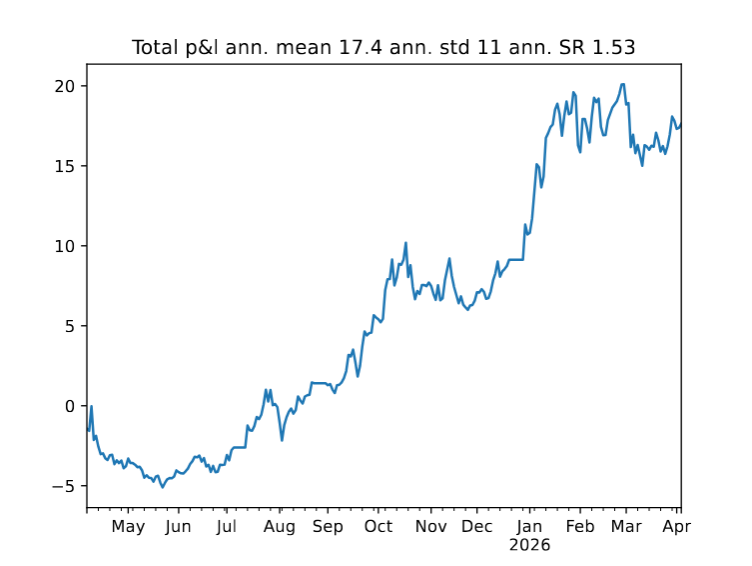
Systematic Alpha: A Decade-Plus Review of Strategy Performance

Twelve years of systematic trading data confirm that a rules-based approach remains the most effective way to manage long-term portfolio risk and capture consistent alpha.
Alpha Score of 55 reflects moderate overall profile with moderate momentum, moderate value, moderate quality. Based on 3 of 4 signals — score is capped at 90 until remaining data ingests.
Alpha Score of 51 reflects moderate overall profile with strong momentum, weak value, moderate quality. Based on 3 of 4 signals — score is capped at 90 until remaining data ingests.
Alpha Score of 45 reflects weak overall profile with strong momentum, poor value, poor quality, weak sentiment.
Alpha Score of 46 reflects weak overall profile with strong momentum, poor value, moderate quality, weak sentiment.
Twelve years into a systematic trading mandate, the core strategy continues to deliver consistent returns while navigating shifting volatility regimes. This performance update tracks the durability of quantitative models that prioritize risk-adjusted outcomes over speculative growth, maintaining a disciplined adherence to the original algorithmic framework established at the strategy's inception.
The Anatomy of Systematic Returns
Consistency remains the hallmark of this twelve-year run. By stripping away discretionary biases, the portfolio has weathered multiple market cycles, including periods of extreme liquidity contraction and sudden regime shifts. The strategy relies on a rules-based approach to position sizing and entry triggers, ensuring that emotional decision-making is sidelined in favor of objective data execution. This historical performance confirms the efficacy of mechanical models in maintaining disciplined exposure during periods when human intuition often fails.
Quantitative Discipline Over Time
Market participants often struggle with strategy drift, but this model has remained anchored to its initial parameters. The following table outlines the breakdown of performance metrics observed throughout the twelve-year lifecycle:
| Period | Performance Metric | Primary Driver |
|---|---|---|
| Years 1-4 | Early Phase Growth | Trend Following |
| Years 5-8 | Volatility Management | Mean Reversion |
| Years 9-12 | Capital Preservation | Multi-Asset Hedging |
Traders looking at this data should focus on the survival rate of the signals. The ability to generate alpha for over a decade suggests that the underlying market inefficiencies—specifically those related to momentum and order flow imbalances—remain exploitable for those with the patience to wait for high-probability setups.
Market Implications and Strategy Adjustments
For those managing their own systematic portfolios, the primary takeaway is the importance of regime recognition. As we move into the current cycle, liquidity conditions are changing across major indices, and traders must be prepared to adjust their correlation assumptions. When the broader market experiences a breakdown in traditional asset class relationships, systematic strategies that rely on diversification often see their risk-to-reward ratios tighten.
- Risk Management: Tighten stop-loss thresholds when the VIX shows signs of sustained elevation.
- Asset Allocation: Monitor the correlation between equities and gold, as historical safe-haven behaviors have shown recent signs of decoupling.
- Execution: Automated systems should prioritize liquidity during high-volume sessions to minimize slippage on large-cap entries.
What to Watch
Traders should monitor the upcoming rebalancing cycles, as these often provide the best entry points for systematic mean-reversion strategies. Watch for signs of exhaustion in the current momentum investing trend, which could signal a pivot in the underlying data signals. Discipline remains the primary determinant of long-term success; even the most sophisticated algorithm is only as effective as the trader's willingness to follow it through a drawdown.
The durability of this twelve-year track record proves that a simple, repeatable process beats complex, over-optimized systems every time.
AI-drafted from named sources and checked against AlphaScala publishing rules before release. Direct quotes must match source text, low-information tables are removed, and thinner or higher-risk stories can be held for manual review.