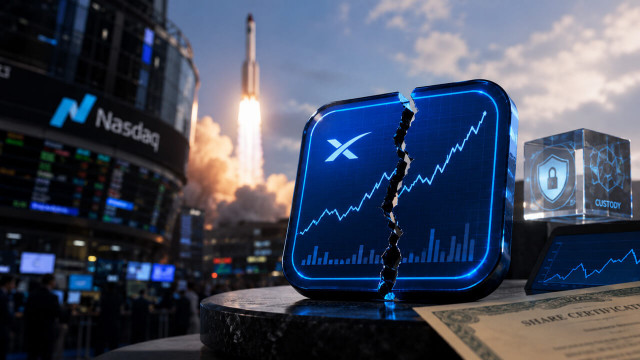
SpaceX priced its IPO at $135 per share on June 11, raised $75 billion in the largest public offering in history, and opened on Nasdaq at $150 Friday morning.
By the time the stock reached $164, retail investors had gained "SpaceX exposure" through actual Nasdaq shares, Backpack Securities' redeemable token on Solana, xStocks tracker certificates on Kraken and Bybit, Binance Wallet's subscription campaign, and Hyperliquid's perpetual futures.
The convergence on a single name reflects a structural ambiguity in how crypto exchanges and tokenization platforms label equity-linked instruments. The most anticipated IPO in years put that ambiguity under the brightest possible light.
An actual Nasdaq share of SPCX conveys shareholder ownership routed through a traditional broker. Binance Stocks offers whole-share limit orders for SPCX executed through an introducing broker and cleared through Alpaca Securities. That means real shares and real settlement, subject to Nasdaq's standard trading rules and halts.
Backpack Securities' SPCX token on Solana is backed 1:1 by a real SpaceX share purchased and held in custody by Backpack, a regulated US broker-dealer. Eligible holders can redeem those tokens for the underlying equity and transfer shares to any traditional brokerage via ACATS/DTCC rails.
Backpack CEO Armani Ferrante described the goal as making underlying securities "portable across financial systems."
The Solana launch was timed to coincide with the Nasdaq debut, making it the first time a newly listed equity had a simultaneous on-chain market from day one. This model sits closest to direct share ownership because the redemption pathway runs through regulated brokerage infrastructure.
xStocks tokens are a distinct legal instrument. They act as tracker certificates where bearer debt instruments provide economic exposure to SpaceX's price without conferring shareholder rights, voting rights, or any legal claim to the underlying shares.
Kraken's own FAQ states xStocks "do not carry shareholder rights, voting rights, or any legal claim to the underlying company shares."
Bybit's product terms state that the collateral backing xStocks "may not always consist of the underlying shares," with cash or other assets potentially substituted. Bybit acknowledges it does not independently verify the collateral. Both platforms exclude users from the United States, the United Kingdom, Canada, and Australia.
Hyperliquid's SPCX contracts are cash-settled derivatives that transition into equity-linked perpetual futures using the live Nasdaq price as an oracle once the stock lists. The position carries no claim on the underlying company.
Hyperliquid's SPCX contracts do not represent SpaceX stock and do not become stock once it lists. They transition into equity-linked perpetual futures using the live Nasdaq price as an oracle.
The friction event that drew the most attention originated in the xStocks infrastructure, not in Backpack's custody model or Hyperliquid's derivatives engine.
Binance Wallet's SPCXx subscription campaign raised $557 million from 27,689 wallet addresses, making it one of the largest tokenized IPO campaigns ever. Bybit launched a parallel subscription through its new IPO Express platform.
Both ran on xStocks, priced tokens at 135 USDC, and carried explicit fine print stating that allocations were not guaranteed. Applicants could receive full, partial, or no tokens, with unallocated USDC automatically refunded.
According to Kraken's growth team, the xStocks provider received a smaller pre-IPO allocation of SpaceX shares than expected. Demand from users across Kraken, Bybit, Binance, and Bitget far exceeded the available supply.
Each allocated user received 4.2786 SPCX shares, a uniform figure that points to a pro rata cut across a fixed pool.
Binance's FAQ states the campaign "could be delayed, suspended, or canceled due to market, regulatory, or underwriting factors." Bybit's announcement stated that listings "may also be adjusted, delayed, or canceled."
Users who read "tokenized SpaceX IPO access" as a guarantee of ownership with a partial-fill outcome encountered exactly the ceiling described in the documentation.
The supply of the trackers is bound by what the issuer can source at the offering price. When demand outstrips available shares, allocation gets cut, and users get refunds.
Backpack's model avoids that ceiling because it purchases shares through its own brokerage infrastructure and issues tokens against custodied equity. The token count corresponds directly to shares actually held.
Hyperliquid's SPCX contract, launched by Trade.xyz on May 18, generated $33 million in volume in its first 24 hours and peaked above $220 before settling near $203. That implied a SpaceX valuation above $2.5 trillion before the company had priced a single share.
By IPO day, the perp had pulled back to around $176, still 30% above the $135 offering price, with over $322 million in 24-hour volume and $293 million in open interest.
The perp ran $12 to $26 above Nasdaq's actual first-day range of $150 to $168. That spread illustrates what happens when a cash-settled derivative lacks a redemption mechanism to anchor it to spot.
Hyperliquid's order book set the price entirely by supply and demand until Nasdaq established a live feed. A three-week run from $220 down to $176, then back toward $183 on the morning of listing, shows how far that process can drift before equity markets open for real settlement.
Traders using the contract as a leveraged directional bet on IPO pricing got the product they subscribed to.
Traders who read the SPCX ticker and assumed it implied proximity to the underlying stock held a perpetual futures contract whose price converged with Nasdaq only through market mechanics. No custody mechanism enforces alignment.
SpaceX disclosed 18,712 BTC on its balance sheet, acquired in 2021 at a cost basis of approximately $661 million. An actual SPCX share gives indirect exposure to that treasury. An xStocks certificate or a Hyperliquid perp tracks SpaceX's price action, not its balance sheet composition.
SpaceX pre-IPO perp volume reached $3.2 billion and $390 million in open interest across eight exchanges between May 17 and June 11. RWA.xyz shows tokenized stocks at $1.68 billion in distributed value, up 39% over 30 days, with $3.63 billion in monthly transfer volume.
Citi projects that tokenized real-world assets will climb from $17 billion today to $5.5 trillion by 2030. As that volume scales, more capital is at risk within structures whose rights differ sharply from their names.
SpaceX was the first mainstream test of multiple tokenized equity structures operating simultaneously on the same underlying asset.
Tracker certificates proved contingent on IPO allocation pipelines that retail demand can overwhelm. Perpetuals proved capable of sustained premiums because no arbitrage mechanism forces convergence with equity markets that close at 4 PM.
Redeemable tokens backed by brokerage custody proved the model that most closely replicates share ownership. Redemption eligibility, jurisdictional restrictions, and stress-scenario mechanics are unresolved for any issuer.
OpenAI, Anthropic, xAI, Stripe, and Databricks are all candidates for the next wave of blockbuster IPOs. Each will arrive with the same menu of exposure products under similar tickers.
Before subscribing to any of them, traders must determine the risk profile by assessing the type of tokenized stock they are acquiring and the bucket it belongs to.