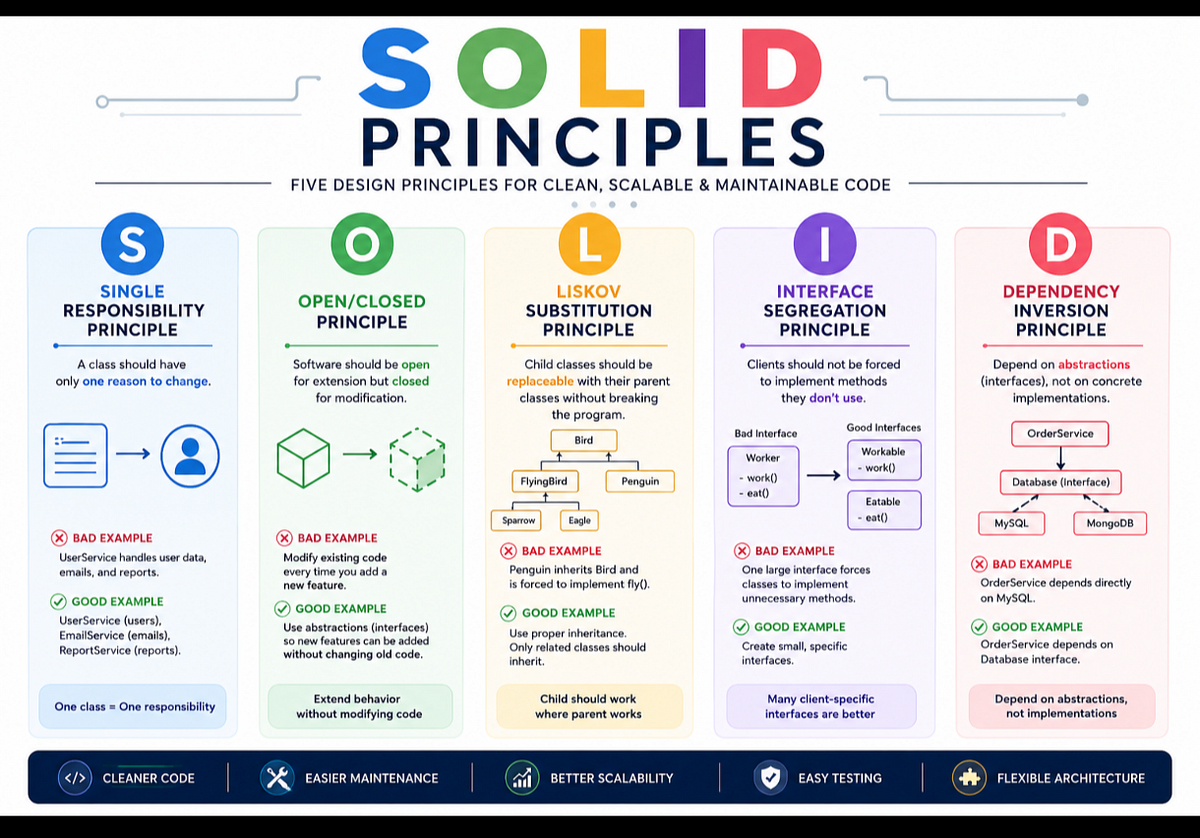
In large projects, a single class that handles user creation, email sending, and report generation is a sign of trouble. That class will change for three different reasons, and each change risks breaking the other two features. This is the problem the Single Responsibility Principle solves: a class should have one reason to change. Split that class into UserService, EmailService, and ReportService. Now each piece can evolve independently.
The Open/Closed Principle gets misread as a rule to abstract everything. The better read is that you should only abstract the parts that actually change. Payment methods change often. Database drivers do not. So build an interface around payment processing, not around the database. That way you can add a new payment provider without touching existing code.
Liskov Substitution trips up teams when a subclass alters the contract silently. A Square extending Rectangle works until someone sets width and height independently. The compiler does not catch it. Tests might not catch it. The fix is to prefer composition over inheritance unless the is-a relationship is truly complete. A Penguin does not inherit from a Bird with a fly() method.
Interface Segregation is the easiest principle to apply and the most often ignored. One large interface with ten methods forces every implementer to stub out methods they do not need. Split the interface by client need. A Robot implements Workable. A Human implements Workable and Eatable. The compiler enforces the separation, and changes to one interface do not cascade to unrelated classes.
Dependency Inversion scales best. High-level modules should depend on abstractions, not concrete implementations. Your OrderService should talk to a DatabaseInterface, not to MySQL directly. Switching from MySQL to MongoDB becomes a configuration change, not a rewrite. At a company like Apple (AAPL), with millions of lines of code, this principle lets teams swap infrastructure without touching business logic.
The common mistake is applying all five principles everywhere. A small script with three classes does not need an interface layer. A microservice with one database does not need a repository abstraction. SOLID is for systems that will live for years and be maintained by multiple teams.
The better framework is to ask one question per principle: Does this change hurt? If adding a new payment method requires editing five files, you need Open/Closed. If a subclass breaks in place of its parent, you need Liskov. If a change to one feature forces changes in unrelated features, you need Single Responsibility. Apply the principle that solves the pain you actually have.
What would confirm you are on the right track? A new feature that requires no changes to existing classes. A subclass that passes the parent's test suite without modification. A dependency swap that takes one config line. What would break the approach? A class that grows beyond 200 lines with multiple responsibilities. An interface with methods that half the implementers leave empty. A change in one module that cascades through five others.
SOLID is not a checklist. It is a diagnostic kit. Use it when the code hurts. Ignore it when it does not.