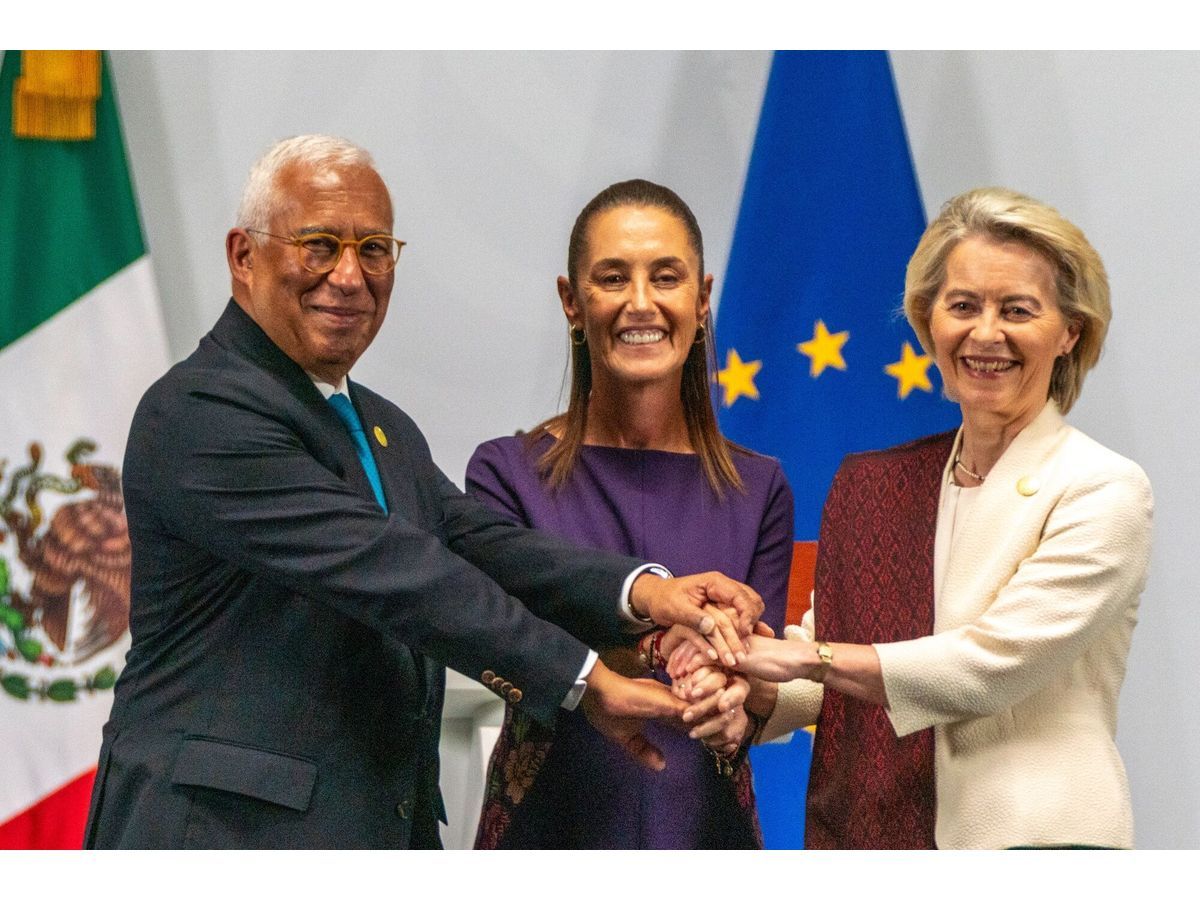
President Claudia Sheinbaum has abandoned the measured diplomacy that defined her early dealings with the Trump administration. In a fiery speech before tens of thousands of supporters in Mexico City, she declared: “Mexico does not accept interference! We are a free, independent and sovereign nation!” The shift, developed with her inner circle over recent days, is a preemptive move to counter what her government sees as a US-led narrative that her administration is subservient to drug cartels, according to three people familiar with the matter.
The risk for traders is immediate and structural. A crucial US-Mexico trade deal – likely the USMCA review – hangs in the balance. Mexico’s slowing economy depends on tariff-free access to its largest export market. Sheinbaum’s tougher tone, while calculated to shore up domestic political support, introduces a new layer of geopolitical uncertainty that markets must price.
The Risk Event: From Cool-Headed to Combative
Sheinbaum had earned praise for her pragmatic approach to Donald Trump, defusing tariff threats and managing migration flows without escalating rhetoric. That changed after US prosecutors indicted Sinaloa Governor Rubén Rocha Moya about a month ago, charging him and nine other current and former state officials with working with a major cartel to traffic narcotics into US cities. The governor denies the allegations.
Why the Indictment Triggered the Shift
The indictment hit close to home. Rocha Moya is a member of Sheinbaum’s Morena party. The US legal action, in her view, was not a routine prosecution but a political weapon aimed at destabilizing her government. After consulting with advisors, she decided to sharpen her message at a rally marking the second anniversary of her landslide election victory.
The Speech as a Signal
Standing before tens of thousands near Mexico City’s Monument to the Revolution, Sheinbaum raised her voice and gestured forcefully. The speech marked her strongest criticism yet of what she calls US meddling. One person familiar with her thinking said the shift is also intended to show US right-wing groups that their efforts to support likeminded factions in Mexico “aren’t working and won’t work.”
Exposure: Trade Deal and Economic Growth
The USMCA (United States-Mexico-Canada Agreement) is the single most important economic framework for Mexico. Trump has repeatedly threatened tariffs on Mexican goods, demanding that Sheinbaum do more to stop migrants and fentanyl. He has also floated unilateral military action against cartels inside Mexico – a proposal Sheinbaum has vehemently rejected as a sovereignty violation.
The Mechanism That Moves Markets
Political rhetoric alone rarely moves asset prices. The mechanism here is different: Sheinbaum’s shift signals that her government is willing to escalate a public confrontation with the US, which reduces the probability of a smooth trade negotiation. If Trump responds with new tariff threats or actual tariffs, Mexican exports – roughly 80% of which go to the US – face immediate cost increases. That hits corporate earnings, GDP growth, and the Mexican peso.
Positioning and Liquidity
Foreign investors hold significant positions in Mexican government bonds (Bonos) and the peso. A deterioration in US-Mexico relations typically triggers capital outflows, peso depreciation, and higher bond yields. The Banxico (central bank) may face pressure to hike rates to defend the currency, which would further slow an already weakening economy.
Timeline: Tariff Threats and Indictments
What Would Accelerate the Timeline
- Another US indictment against a Morena-linked official.
- Trump announcing new tariffs or a “cartel designation” for Mexican criminal groups.
- Sheinbaum retaliating with trade barriers or expropriation threats.
Affected Assets: Peso, Bonds, and Trade-Exposed Equities
Mexican Peso (MXN)
The peso has been sensitive to US-Mexico political headlines. A sustained escalation could push USD/MXN above the 20.00 level, a key psychological resistance. Traders should watch for Banxico intervention or rate signals.
Mexican Equities (EWW ETF, IPC Index)
Mexican stocks with high US revenue exposure – such as Cemex, Femsa, and America Movil – would face earnings headwinds from a weaker peso and potential tariffs. The IPC Index could test its 200-day moving average if rhetoric escalates.
US Companies with Mexico Exposure
Auto manufacturers (GM, Ford, Stellantis), industrial firms (Caterpillar), and retailers (Walmart) rely on Mexican supply chains. Tariffs or trade disruption would raise input costs and squeeze margins. The S&P 500 may see sector-specific pressure.
Mexican Government Bonds (Bonos)
Foreign holdings of Mexican local-currency debt have been a source of carry trade inflows. A risk-off shift could trigger capital flight, pushing yields higher. The 10-year Bono yield above 10% would signal stress.
What Would Reduce the Risk
- Sheinbaum and Trump resuming direct, pragmatic dialogue without public attacks.
- A US-Mexico agreement on migration or security cooperation that defuses tariff threats.
- No further US indictments against Morena officials for at least 90 days.
- Banxico signaling readiness to support the peso if needed.
What Would Make It Worse
- Trump ordering a unilateral strike on cartel targets inside Mexico.
- Sheinbaum expelling US DEA agents or closing the border to US goods.
- A credit rating downgrade for Mexico (Moody’s, S&P, Fitch) citing political risk.
- Mass protests in Mexico that destabilize the government.
Second-Order Effects to Track
- Remittances: Mexico receives over $60 billion annually from the US. Any disruption to cross-border flows would hit consumption.
- Nearshoring flows: Companies relocating supply chains to Mexico may pause decisions, hurting FDI.
- Energy sector: Mexico’s state oil company Pemex is already under financial strain. Trade tensions could delay US investment in Mexican energy.
The Next Decision Point for Traders
Sheinbaum’s rhetorical shift is a calculated risk – it may consolidate domestic support but it raises the stakes with the US. The next concrete catalyst is any official US response. If Trump dismisses the speech as political theater, the risk premium may fade. If he matches the tone with new tariff threats, the peso and Mexican equities will reprice lower.
For traders building a watchlist, the key variables are:
- USD/MXN above 20.50 on a closing basis would signal sustained risk.
- IPC Index below 50,000 would confirm institutional selling.
- 10-year Bono yield above 10.5% would indicate foreign outflows.
This is not a binary event. The risk is a slow bleed of confidence in the bilateral relationship, which erodes the Mexico premium that has supported asset prices since the USMCA was signed. Sheinbaum’s tone matters because it changes the negotiation dynamics. Markets that ignore political rhetoric often get caught flat-footed when the rhetoric becomes policy.
For context on how geopolitical risk events affect broader stock market analysis, see AlphaScala’s framework for pricing political uncertainty. The Sheinbaum shift is a textbook case of a risk event watch: the catalyst is identified, the exposure is measurable, and the timeline is uncertain but bounded by the next US-Mexico interaction.