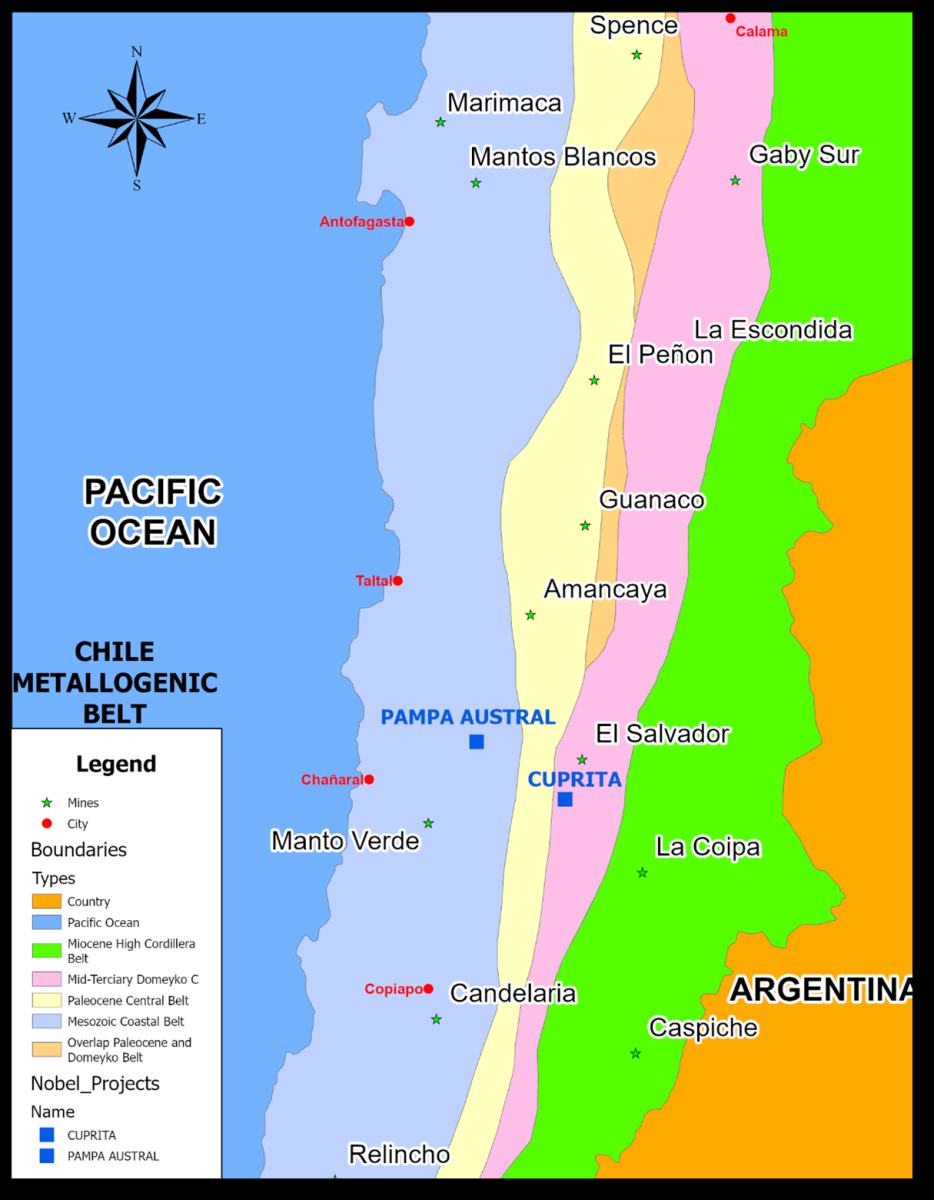
Nobel Resources Corp. (TSX-V: NBLC; OTCPK: NBTRF) has started diamond drilling at its Pampa Austral property in Chile. The two-hole program is the first drill test of a copper target that has been dormant since Farwest Mining reported a 70-meter intercept grading 0.70% copper in 2004, including 14 meters at 2.1% copper and 0.1 g/t gold. For a junior explorer with no compliant resource, the drill bit now carries a binary payoff: confirm the grade and continuity, or see the exploration thesis weaken materially. The same update confirms that an induced polarization survey at the Cuprita project is 75% complete and mapping a growing chargeability anomaly. Both projects sit in a copper-rich belt, yet the market will reprice the stock on Nobel’s own drill results, not on proximity to known deposits. As is common with Canadian junior mining press releases, the reaction hinges on whether the drill results validate the historical data.
Pampa Austral Drilling Tests the 0.70% Copper Intercept First Reported in 2004
What the Headline Says
The simple read is that Nobel is drilling a high-priority copper target with a headline grade of 0.70% copper over 70 meters. The intercept sits adjacent to an Induced Polarization (IP) chargeability anomaly identified by the optionor after the Farwest drilling, adding geophysical support. The two-hole program may be seen as de-risking: the company is finally testing a prospect that has been waiting two decades. A positive outcome could re-rate a micro-cap explorer that currently has no defined resource.
What the Market Needs to See
The better read is that the historical intercept is not NI 43-101 compliant. It comes from a 2004 news release by a different operator, using reverse circulation drilling, and has not been verified by Nobel. The IP anomaly provides a vector; chargeability highs can be generated by disseminated sulphides carrying sub-economic grades. The first two holes must deliver visual mineralization and, eventually, assay results that confirm both grade and continuity. A narrow intersection or a drop in grade would challenge the entire target concept. The market often prices junior explorers on the expectation of discovery. A miss would force a sharp revaluation.
Cuprita IP Survey 75% Complete, Anomaly Expands Under Lithocap
At the Cuprita project, Quantec Geophysics is conducting an extensive induced polarization survey, now about 75% complete according to the company. Preliminary results show a chargeability anomaly extending to the south and west under the lithocap that was the focus of the initial drill program (see Nobel’s April 23, 2026, news release). This expansion suggests the porphyry target may be larger than previously mapped. The lithocap is a near-surface zone of advanced argillic alteration that can overlie a porphyry copper system. The IP survey detects disseminated sulphides at depth, which often form a halo around the higher-grade potassic core.
Satellite Data Adds Alteration Evidence
The recently completed Photosat high-resolution satellite imagery survey confirms that alteration mineral assemblages characteristic of mineralized porphyry systems occur in association with the extensive lithocap at Cuprita. Satellite data alone cannot define grade or continuity. It improves drill targeting and will be integrated with the completed IP survey and detailed geological mapping before a future drill campaign.
Financing and Dilution: The Silent Exposure for a Pre-Resource Explorer
Nobel Resources is a junior explorer with no current mineral resource. The company has not disclosed its cash position in this release, yet the forward-looking statement cautions that the ability to obtain adequate financing is a risk. Drilling, IP surveys, and satellite imagery consume capital. If the initial holes at Pampa Austral do not deliver encouraging visual results, the market may reprice the equity lower. Future financings would then become more dilutive. The TSX Venture Exchange listing (NBLC) and the OTC Pink listing (NBTRF) both carry liquidity constraints common to micro-cap explorers. Traders should track not just the assay results but also the company’s working capital and any upcoming private placements. A financing announced at a discount to the current share price would be a negative signal, regardless of the geological potential.
Sampling and Chain of Custody Underpin the Assays to Come
The company has outlined its sampling and analytical procedures, which are standard for a NI 43-101 compliant program. Key points:
- Drill core is geologically logged, photographed, split with an electric rock saw; half sent for assay, half retained.
- Certified reference standards inserted every 20 samples; coarse blanks, fine blanks, and duplicates every 50 samples.
- Samples sealed in rice bags with numbered security tags, transported by company personnel to Andes Analytical Assays, an independent certified lab.
- The scientific and technical information is approved by David Gower, P.Geo., a consultant to Nobel (not independent).
This level of detail provides some assurance that assay results, when released, will have been generated under controlled conditions. The market will ultimately judge the grades, not the process.
Binary Catalysts: Assays from Pampa Austral and Future Drill Decisions
The next concrete catalysts are:
- Completion of the two-hole drill program at Pampa Austral, with visual logging updates possible within weeks, and assay results likely in 4–8 weeks after completion.
- Completion of the IP survey at Cuprita (25% remaining), followed by integration with satellite data and mapping to define drill targets for a future campaign.
- Any announcement of a follow-up drill program at Cuprita, which would signal that the company sees enough merit to commit more capital.
The market will probably react to the first assay batch from Pampa Austral. A failure to intersect significant copper mineralization would be a sharp negative. A confirmation of the historical grade, or better, would re-rate the stock. The gap between a historical target and a compliant resource is wide, and the binary nature of the catalyst leaves little room for a middle ground.
What Confirms the Porphyry Model – and What Breaks It
Confirmation thresholds:
- Drill hole assays from Pampa Austral that replicate or exceed the historical 0.70% copper over meaningful widths (tens of meters).
- Visual evidence of chalcopyrite or other copper sulphides in the core.
- A completed IP survey at Cuprita that defines a coherent, drill-ready chargeability target.
Failure modes:
- Barren or weakly mineralized holes at Pampa Austral, indicating the historical intercept was a narrow high-grade pod or a sampling artifact.
- IP results at Cuprita that show a discontinuous or deep anomaly that cannot be tested with the current budget.
- A financing announcement at a discount to market, diluting existing shareholders before any resource is defined.
For a junior explorer in the copper space, the drill bit carries binary risk. Nobel’s drilling at Pampa Austral is the first step across the gap from historical target to potential resource. The market will price the outcome quickly, and the next few months will determine whether the company can advance both projects or face a reset in expectations. For broader context on how junior resource equities trade around exploration catalysts, see AlphaScala’s commodities analysis.