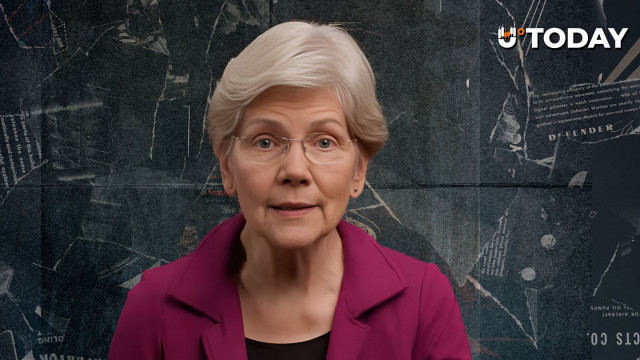
Senator Elizabeth Warren called the CLARITY Act a threat that would "blow up the economy" and demanded a complete reversal of the legislation, escalating a debate that had been advancing on a bipartisan track. The remark, made during a Senate Banking Committee session, abruptly transforms a technical effort to define digital assets into a high-profile political fight. For crypto markets, the immediate consequence is a repricing of regulatory risk, directly affecting tokens that lack clear commodity or security status and the exchanges that list them.
Warren’s long-running anti-crypto campaign is well suited to the outburst. The statement also underscores a deeper problem with how a vocal minority of U.S. politicians approaches the sector: regulation is treated as a danger, not a solution. The CLARITY Act aims to separate digital assets into commodities and securities under a coherent statutory framework. This distinction is essential because the current U.S. regime is fragmented, inconsistent, and enforced through litigation rather than clear rules. Crypto firms have operated in legal limbo for years, with regulators threatening enforcement while refusing to provide explicit guidance.
Warren presents institutional adoption of crypto as intrinsically risky, arguing that deeper economic integration eliminates investor protections and elevates systemic risk. That argument misses the mechanism. Instability stems from the absence of regulation. Scams thrive in unregulated zones, capital migrates offshore, and investors lose access to the legal safeguards that structured oversight could provide when legitimate businesses cannot operate under transparent standards.
Risk to watch: Warren’s opposition turns a bipartisan effort into a prolonged legislative struggle, threatening months of delay that keep the current enforcement-first regime intact.
The Classification Vacuum That Drives Regulatory Chaos
Without the CLARITY Act, the Securities and Exchange Commission and the Commodity Futures Trading Commission pursue overlapping and contradictory claims. Token issuers cannot determine their compliance obligations. Exchanges face constant risk of having listed assets retroactively designated as unregistered securities. Institutional capital stays on the sidelines.
This vacuum has real liquidity consequences. Prime brokers and custodians decline to hold assets that could later trigger regulatory penalties. The resulting shallow order books raise the cost of capital for blockchain projects and push activity toward offshore venues where rules, however imperfect, at least offer predictability. The CLARITY Act would for the first time delineate decentralized infrastructure tokens from speculative investment contracts, allowing market participants to price assets more precisely and giving exchanges a legal safe harbor for commodities.
Assets and Platforms Caught in the Ambiguity
Tokens that fall in the ambiguous middle are the most directly exposed. Without statutory definitions, the SEC’s case-by-case enforcement continues, forcing companies to settle or litigate without a reliable rulebook.
Ether and Layer-1 Tokens
The SEC has indicated that Ether may be a security under certain conditions, while the CFTC has permitted ETH futures trading. This regulatory contradiction keeps ETH in a legal fog. A clear commodity designation under the CLARITY Act would end that tension and unlock broader institutional custody and product development. (See our Ethereum profile for network fundamentals.)
Exchange Tokens and Governance Assets
Tokens from platforms like Uniswap, Aave, and Compound grant voting rights, raising the question of whether they constitute investment contracts. Under current practice, they remain unlegislated. The CLARITY Act’s framework would provide a path to commodity status for tokens that power decentralized governance without representing a profit-sharing arrangement.
Stablecoin Issuers and Centralized Exchanges
Circle’s USDC and other dollar-pegged tokens face uncertainty about whether reserve models trigger securities classification. A statutory carve-out could enable bank-like integration. Without it, large financial institutions steer clear.
Centralized venues are equally at risk. Coinbase, Kraken, and Binance.US have received Wells notices or enforcement actions centered on whether the tokens they list are securities. The CLARITY Act would offer a legal safe harbor for listed assets that meet commodity criteria, reducing the threat of sudden delistings that can disrupt markets.
For a broader assessment of the sector, see our crypto market analysis.
Bipartisan Momentum Pushes Back Against Anti-Crypto Opposition
Warren’s position is increasingly isolated. Bipartisan support for regulatory clarity has grown as lawmakers recognize the cost of inaction: capital flight, strategic disadvantage, and a vacuum that benefits offshore rivals. Several Senate bills, including the Lummis-Gillibrand Responsible Financial Innovation Act, have advanced similar commodity-versus-security definitions. This signals that a durable majority is forming behind the principle of establishing clear rules rather than banning the asset class.
This political dynamic matters for risk assessment. When anti-crypto rhetoric comes from a single faction without the votes to block legislation, it generates short-term volatility, not a structural roadblock. Traders who monitor committee markups and co-sponsor counts can separate headlines that create noise from those that actually shift a bill’s probability of passage. Current evidence suggests the CLARITY Act retains sufficient committee support to advance, though Warren’s opposition will likely extend the timeline and force amendments.
What Would Reduce the Regulatory Uncertainty Premium
The clearest risk reducer is a strong committee vote advancing the bill with unambiguous definitional language. If the House Financial Services Committee or the Senate Banking Committee reports the CLARITY Act with a broad bipartisan margin, markets can begin to discount a future where Bitcoin and Ether receive explicit commodity status. This outcome would immediately compress the risk premium embedded in exchange tokens and DeFi assets, encourage U.S.-based custodians to widen services, and trigger institutional product filings that have been held back pending clarity.
A second catalyst is a concrete timeline for floor debate. Once a bill reaches the calendar, even with amendments, the probability of ultimate passage rises because delay becomes more costly for opponents who lose the cover of procedural maneuvering. Market participants should watch for statements from Chairman Patrick McHenry or Senator Tim Scott setting a schedule. Such signals often precede a re-rating of sector-specific risk.
What Would Make the Stalemate Worse
If Warren rallies enough Senate Democrats to delay or block the bill, the current vacuum persists and likely deepens. The SEC would continue its enforcement-first posture, potentially filing actions against major exchange tokens and imposing costly settlements. No court ruling can provide the industry-wide certainty that a statute provides, leaving every token vulnerable to jurisdictional whipsaw.
Second-order effects would be severe. Capital formation for U.S.-based blockchain projects would stall, pushing talent and liquidity toward jurisdictions like the European Union, which has already enacted the Markets in Crypto-Assets (MiCA) framework. (See MiCA’s impact on exchange regulation.) Institutional allocators who require clear asset classification to satisfy fiduciary duties would remain sidelined, capping upside for tokens that exhibit strong network adoption. The gap between U.S. and offshore regulatory environments would widen, reducing American influence over digital financial infrastructure design.
A final amplifier is the interplay with stablecoin legislation. The CLARITY Act and proposed stablecoin bills are linked in the legislative calendar. A significant delay on one often stalls the other. If the commodity-security definitions stall, the parallel effort to regulate dollar-pegged tokens loses momentum, keeping the entire crypto asset ecosystem in a state of unresolved legal status.
Key insight: Warren’s opposition is a delay mechanism, not a veto. The legislative risk premium will rise or fall on whether committee leadership can advance the bill through a markup that preserves clear definitions.