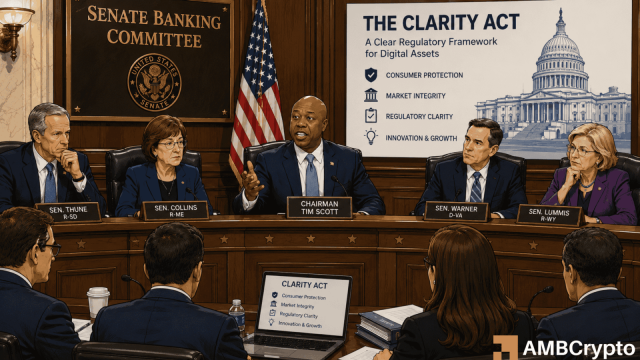
The Senate Banking Committee voted 15–9 on May 14 to advance the CLARITY Act out of markup, moving the crypto market-structure bill one step closer to a full Senate floor debate. The approved amended version now faces a sharper test: the 60-vote cloture threshold that will determine whether the bill reaches a final vote. Markup approval is a necessary checkpoint, not a guarantee of enactment. The unresolved ethics provisions that failed in committee could resurface on the floor and reshape the final product–or stall it entirely.
The 15–9 Markup Vote and the Road to Floor Consideration
The markup session is where lawmakers review legislation line by line, propose changes, and vote on amendments before deciding whether the bill should move forward. The committee debated dozens of proposed changes, including amendments related to decentralized finance (DeFi), anti-money laundering (AML), and ethics. Ultimately, the panel approved an amended version of the legislation, preserving the momentum behind one of the most closely watched crypto regulatory efforts in Washington.
What Markup Approval Actually Changes
The vote moves the bill out of committee and toward potential Senate floor consideration. Only after Senate approval would the legislation move further through the congressional process–meaning it must still pass the full Senate, the House, and be signed by the president. The timeline is uncertain. Each subsequent stage introduces new political risks. For traders, the key shift is that the legislative overhang narrowed slightly; the bill survived committee, which reduces the immediate risk of a crypto regulatory vacuum. The larger risk is now the floor vote schedule and the 60-vote hurdle.
Bipartisan Support Without a Blank Check
Lawmakers backing the bill argued that it would establish clearer rules for digital asset markets and provide greater clarity on which activities fall under existing regulatory frameworks. Supporters also defended the legislation against arguments that it would weaken AML safeguards. The markup featured sharp exchanges over ethics and AML provisions, yet bipartisan support for the bill largely held. Several lawmakers, however, signaled that committee support should not automatically translate into support for a final Senate vote. That stance leaves open the possibility that additional negotiations and amendments could still reshape parts of the bill. The risk is that the final product looks meaningfully different from the version that cleared committee, altering the regulatory impact on exchanges, DeFi protocols, and token issuers.
Amendments That Failed–and the Fight That Is Not Over
During the session, lawmakers debated dozens of proposed changes. Critics introduced amendments aimed at tightening safeguards around financial crime and conflicts of interest. Those amendments failed; however, the debates exposed fault lines that senators will likely revisit on the floor.
Warren’s Illicit-Finance Objections Signal Future Floor Battles
Elizabeth Warren repeatedly raised concerns about whether certain provisions could create unintended gaps in oversight or complicate efforts to combat illicit finance. Her amendments did not gain sufficient support in committee, yet the persistence of her objections matters. Warren is a prominent voice, and her criticisms signal that the illicit-finance debate will resurface during floor deliberation. If similar amendments gain traction there, they could add compliance burdens that alter the bill’s impact on crypto businesses. For exchanges and DeFi platforms, stricter AML provisions could raise operational costs and limit some of the anonymity features that users value. The fact that Warren’s amendments failed in committee does not remove the risk; it merely postpones the fight to a venue where more senators weigh in.
Ethics Rules Remain the Unresolved Fault Line
Ethics provisions emerged as one of the clearest areas of disagreement during the hearing. Several amendments tied to ethics rules, banking exposure, and regulatory oversight failed to pass, and the topic could remain a sticking point as negotiations move forward. The specific nature of the ethics fight is not detailed in committee statements. Any provision that restricts the revolving door between regulators and industry, or imposes new conflict-of-interest rules, would affect how crypto firms engage with Washington. An unresolved ethics conflict could delay the floor vote or force compromises that weaken industry support. If the debate escalates, it might push the timeline out further and introduce uncertainty about the bill’s final shape. For traders, the ethics question is a wildcard that could determine whether the bill maintains its current industry-friendly trajectory or acquires provisions that make compliance costlier.
Where the Exposure Sits: Exchanges, DeFi, and Token Markets
The CLARITY Act is one of several major digital asset policy efforts currently under discussion in Washington, alongside stablecoin-focused legislation such as the GENIUS Act. For crypto markets, the bill represents a potential regulatory framework that could reduce the legal ambiguity that has kept some institutional capital on the sidelines. The markup vote therefore matters. The real exposure for specific assets depends on what the final bill looks like and when it passes. For a broader view of how regulatory developments fit into the crypto market landscape, see our crypto market analysis.
Binance’s Case for a ‘Coherent Framework’
Steven McWhirter, Global Policy Lead at Binance, described the legislation as reflecting growing recognition that the United States needs
a coherent, durable and globally competitive framework for digital asset markets.
He added that policymakers are working toward a structure that supports innovation while maintaining consumer protection, market integrity, transparency, and financial crime compliance. That statement is the industry’s bull case: clear rules attract institutional capital and allow exchanges to operate with greater certainty. The risk, however, is that the final bill does not deliver the level of clarity the industry hopes for, or that it imposes disproportionate costs on smaller participants. If the eventual framework is less coherent than advertised, the competitive advantage that U.S.-based exchanges seek could diminish. The outcome directly affects the equities of publicly traded crypto exchanges and the trading volumes of major tokens such as Bitcoin (BTC) and Ethereum (ETH).
DeFi’s Unanswered Questions Are a Persistent Wildcard
The markup debate included amendments related to DeFi; however, the source does not specify their fate. DeFi remains one of the most contentious areas in crypto regulation. Any bill that imposes strict know-your-customer or anti-money laundering requirements on DeFi protocols could be bearish for tokens and platforms that rely on permissionless access. The risk is that the final legislation includes provisions that stifle DeFi innovation or force protocols to choose between compliance and decentralization. Traders should monitor whether DeFi-specific amendments resurface on the floor, as they could directly affect the valuation of DeFi tokens and the viability of decentralized exchanges. A bill that largely sidesteps DeFi would be less disruptive; a bill that targets it aggressively would raise costs and potentially depress token prices.
Timeline, Cloture, and the 60-Vote Filter
The bill now moves toward potential Senate floor consideration. No date has been set. The legislative process remains ongoing, and the next concrete catalyst is the scheduling of a floor vote. A swift vote would signal political momentum; a prolonged delay would suggest that headwinds are building.
The Cloture Vote as the Real Gatekeeper
As detailed in our earlier coverage of the Senate CLARITY Act advance, most legislation in the Senate requires 60 votes to overcome a filibuster. The 15–9 committee vote indicates a degree of bipartisan support. It does not guarantee 60 votes on the floor. The 15–9 margin includes 15 yes votes from the 24-member committee; extrapolating that to the full 100-seat Senate suggests roughly 63 yea votes–a razor-thin margin. Any defection from moderate Democrats or Republicans could push the tally below the magic 60, stalling the bill indefinitely or forcing substantial revisions to attract holdouts. The cloture vote is therefore the genuine gatekeeper, and its outcome is far from certain.
Bullish Setup vs. Bearish Risk: What Traders Need to See
For the bullish regulatory thesis to hold, traders should watch for these signals:
- Floor vote scheduled within the next few weeks, indicating that leadership prioritizes the bill.
- Strong bipartisan floor majority of at least 60 votes, minimizing the need for last-minute concessions.
- Minimal new restrictive amendments, particularly on DeFi and AML, that would raise compliance costs.
- A clear path to House passage, with House leadership signaling willingness to take up the bill without major rewrites.
Each of these would reduce the regulatory overhang that has weighed on crypto valuations and could lift sentiment across major tokens.
Conversely, the bear case would intensify if any of the following materialize:
- Prolonged delays in scheduling a floor vote, suggesting political or procedural obstacles.
- Contentious amendments that add heavy compliance burdens–especially for DeFi–sparking sell-side pressure on affected tokens.
- Failure to reach 60 votes, which could kill the bill in this Congress and reinforce the perception that comprehensive crypto legislation remains out of reach.
- Shift in political priorities that pushes crypto down the legislative agenda, leaving the current patchwork regulatory state intact.
The unresolved ethics provisions are a wildcard. If they resurface as a major sticking point on the floor, they could delay the bill or force compromises that erode industry support. In that scenario, the regulatory uncertainty that has capped crypto upside would persist, and the market could price in a longer wait for clear rules.
The CLARITY Act has cleared its first major legislative hurdle. The path from markup to final law is long and the margin for error is thin. The next weeks will reveal whether the bipartisan committee support translates into the 60 votes needed on the Senate floor. For crypto traders, the sequencing of a floor vote and the handling of unresolved ethics and DeFi questions will determine whether this bill becomes a catalyst for re-rating digital assets–or another policy disappointment.