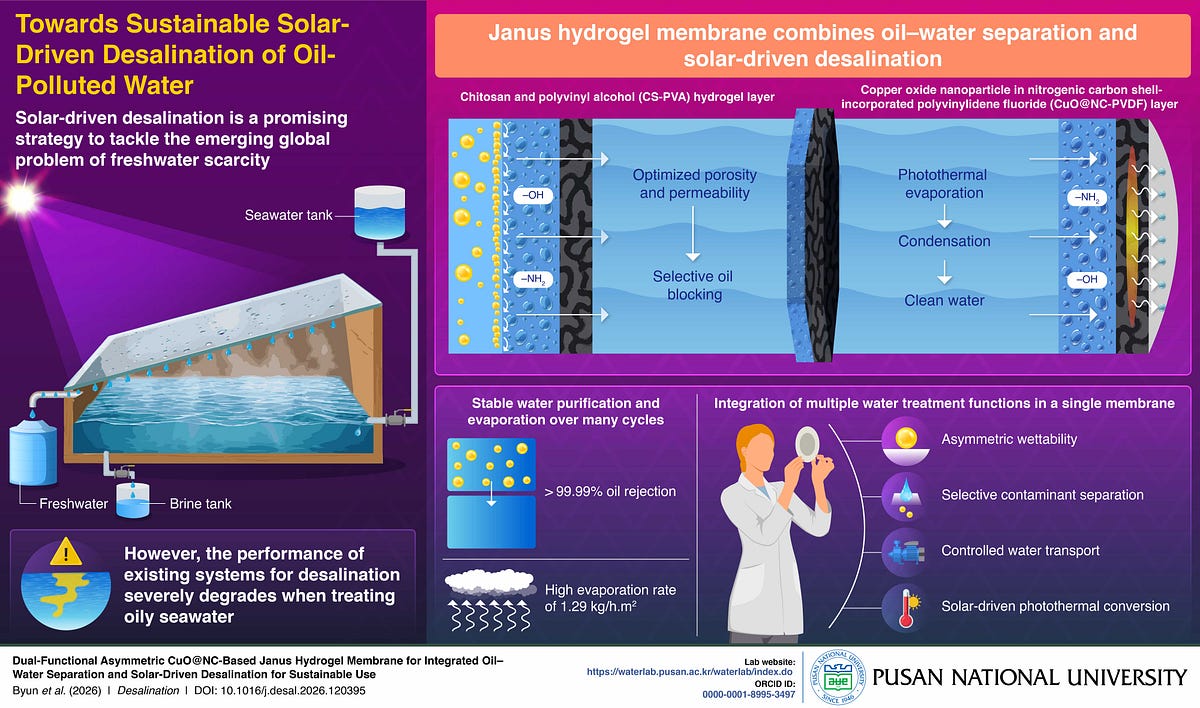
A research team at Pusan National University has built a membrane that filters oil from seawater and uses sunlight to drive evaporation at three times the rate of conventional designs. The membrane removed over 99.99% of oil during lab tests and maintained stable performance across different oil droplet sizes and repeated use, according to a study published in the journal Desalination.
Coastal waters near ports and industrial areas often contain oil that fouls the specialized membranes used in solar desalination. Most experimental platforms have been tested only on clean saltwater, so their real-world performance was unclear. This dual challenge, separating oil while maintaining heat for evaporation, has limited the adoption of solar desalination for treating industrial wastewater or seawater near shipping lanes. The new membrane integrates both functions into a single architecture.
The design uses a Janus structure, two sides with different properties. One side, made from a chitosan and polyvinyl alcohol hydrogel, attracts water and repels oil. The other side contains copper oxide nanoparticles wrapped in a carbon shell, embedded in a nanofiber layer. That side absorbs sunlight and converts it to heat, driving water evaporation at its surface. The hydrogel layer acts as a barrier, allowing water molecules through while blocking oil droplets. The nanofiber layer acts as a photothermal converter, turning sunlight into localized heat. Because each layer focuses on one task, oil rejection and heat generation do not interfere, the researchers said.
During solar desalination, the membrane achieved an evaporation rate of 1.29 kilograms of water per square meter per hour, nearly three times that of a conventional single-layer membrane. "By harnessing renewable solar energy and integrating contaminant separation with freshwater production in a single membrane platform, our technology has the potential to reduce energy consumption and operational complexity while cutting secondary waste generation," Professor Sanghyun Jeong, who led the study, said in a statement.
Water scarcity is a growing constraint for semiconductor and electronics supply chains. Apple (AAPL) has committed to replenishing 100% of the freshwater used in its corporate operations. The company's environmental reports cite supplier water use as a focus area. Coastal waters near ports and industrial areas, where many electronics suppliers operate, are often contaminated with oil, the researchers noted.
Jeong said the work demonstrates how multiple treatment functions can be combined within a single membrane architecture. The paper is scheduled for the October 15, 2026 issue of Desalination; it appeared online June 1, 2026.