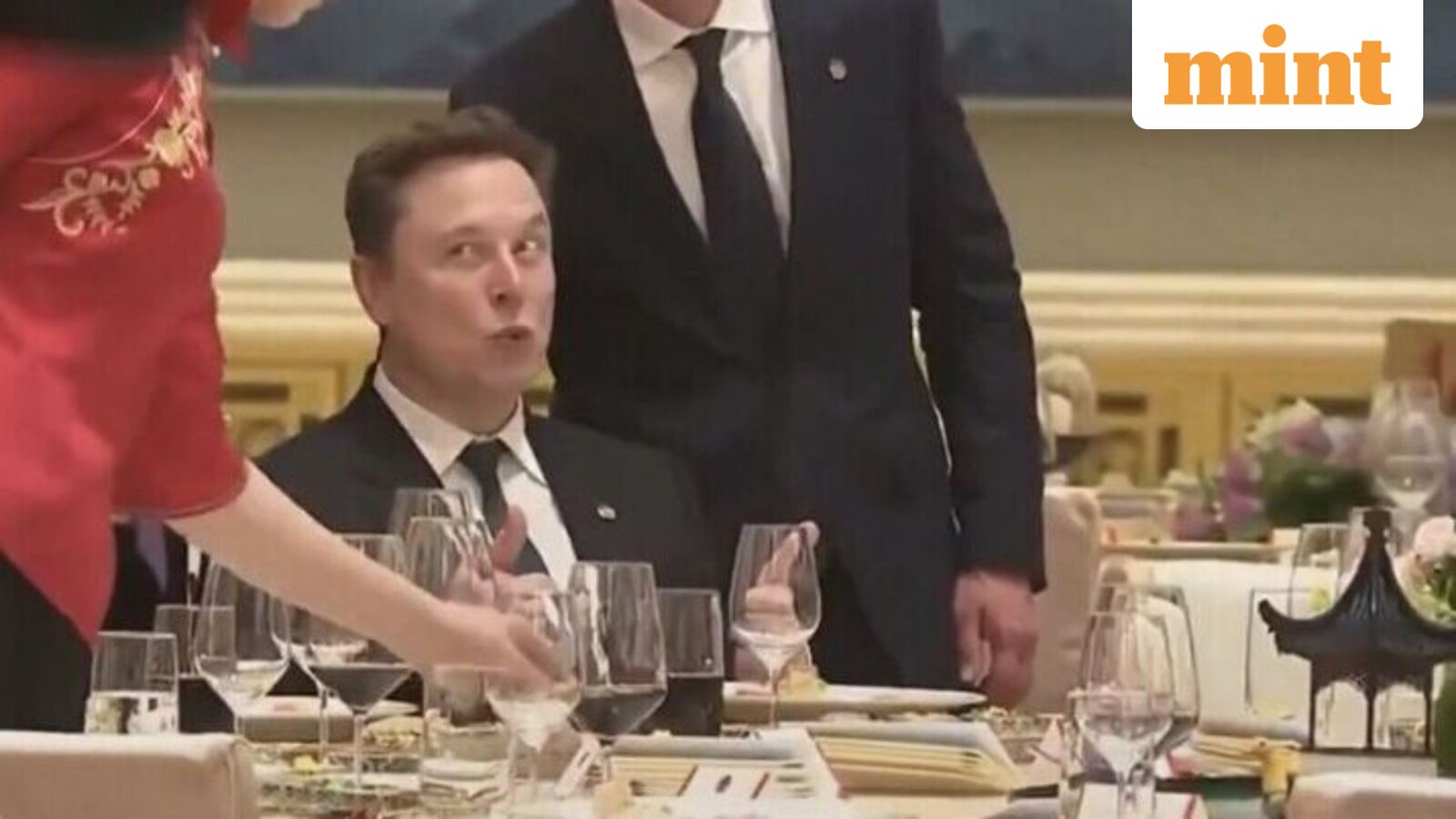
Tesla Chief Elon Musk spun and filmed a 360-degree video on red-carpeted stairs at Beijing’s Great Hall of the People, turning a high-level state banquet with President Donald Trump and Chinese President Xi Jinping into a viral moment. The theatrics dominated social media; the more consequential development, however, is the re-ignition of Tesla’s long-pending bid for Chinese regulatory approval of its Full Self Driving product.
Musk accompanied Trump and a delegation of top technology CEOs–including NVIDIA’s Jensen Huang and Apple’s Tim Cook–during the two-day state visit. Eagle-eyed social media users seized on clips of Musk making faces, taking selfies with Xiaomi CEO Lei Jun, and treating the formal ceremony like a playground. The footage spread rapidly across platforms, drawing an avalanche of memes and commentary that, for a day, turned Tesla’s chief into a global entertainment story.
The Viral Distraction: Musk’s Beijing 360 Spin
Simple Read: A Playful Diplomatic Interlude
The clip that broke through showed Musk holding his phone aloft and rotating on red-carpeted stairs to capture a panoramic view while uniformed officials and business delegates looked on. Social media erupted. One observer wrote, “Elon Musk records tourism videos with 360 spins while everyone is serious in front of the Chinese diplomats.” Another remarked, “He is enjoying on his own. Loving his China vibes.” A fourth user quipped, “Scan the whole area - Make it a Diablo boss fight in upcoming updates.”
Musk’s expressions became the center of attention when he posed for a photo with Tim Cook and a selfie with Lei Jun. A commenter stated, “Awe He is getting over stimulated. The way he is breathing but holding together because he is kind.” The easy narrative framed the episode as a disruptive billionaire amusing himself amid a staid diplomatic ritual.
Better Read: FSD Talks Behind the Smile
The entertainment value, however, obscures the real business payload. Musk’s presence alongside Trump at the highest levels of Chinese state protocol was explicitly linked in dispatches to potential growth drivers for Tesla, particularly “gaining approval to sell its Full Self Driving product” and advancing AI applications. The lighthearted optics may signal a comfort level with Chinese officials that could smooth the path for sensitive technology approvals. A regulatory wink from Beijing’s Ministry of Industry and Information Technology would be worth far more to Tesla’s valuation than any number of viral clips.
Key insight: The viral video is the color; the FSD permit is the catalyst.
The Real Catalyst: Tesla’s Full Self Driving Ambitions in China
From Hardware to High-Margin Software
Telsa has been waiting for Beijing’s green light to roll out its FSD package–a suite of advanced driver-assistance features that transforms the vehicle into an autonomous-driving machine. While the company already sells cars in China, FSD would unlock a high-margin, recurring software revenue stream. A green light would allow Tesla to layer a software subscription on top of its existing fleet, generating incremental revenue at near-zero marginal cost.
That recurring income would help decouple Tesla’s financial story from the up-and-down of quarterly delivery numbers, a shift growth-oriented investors have been pricing in sporadically. The visit’s direct link to “gaining approval to sell its Full Self Driving product” means any word from China’s MIIT about testing permits or a compliance path will be a tradable event for Tesla shares.
The Regulatory Gate: MIIT Approval
The concrete catalyst is a public notice from the Ministry of Industry and Information Technology granting Tesla authorization to test or commercially deploy FSD features on Chinese roads. Such an event would validate the software-subscription thesis and force analysts to raise long-term revenue estimates. Traders should also monitor local Chinese media; a favorable state-media profile of Tesla’s technology often precedes formal regulatory moves.
Competitive Landscape: Can Tesla Catch BYD’s ‘God’s Eye’?
BYD’s Aggressive Rollout
Local rivals are not standing still. BYD has rolled out its “God’s Eye” driver-assistance system across much of its lineup, marketing the feature as a standard inclusion rather than a premium upgrade. That strategy pressures Tesla’s ability to command a high price for FSD in China, especially in a market where price wars have already compressed vehicle margins.
Xpeng’s XNGP and Policy Backing
Xpeng continues to refine its XNGP (Xpeng Navigation Guided Pilot) platform, which enjoys strong backing from local regulators keen to promote domestic champions. In China’s regulatory sandbox, being late to the autonomous-feature race could erode Tesla’s brand premium. A first-mover advantage on certified FSD–backed by a central-government nod–would reposition Tesla from an EV pure-play to a software-led mobility company.
Geopolitical Crosscurrents: Trump, Xi, and the Taiwan Warning
Diplomatic Tailwinds vs. Risk of Tech Freeze
President Trump’s meeting with Xi Jinping included pledges to enhance economic cooperation, a backdrop that lowers the immediate risk of retaliatory tariffs or supply-chain disruption for Tesla’s Shanghai Gigafactory. Xi, however, delivered a sharp warning on Taiwan, cautioning that mishandling the issue could lead to conflict. For Tesla, the cross-currents matter. A stable U.S.-China relationship helps technology transfers; a geopolitical flare-up could delay or derail FSD approvals, making the timeline hostage to diplomatic tensions.
Risk to watch: If Musk’s viral antics are recast by state media as disrespectful, or if the Taiwan rhetoric escalates into a freeze on technology cooperation, the FSD timeline could slip into 2026 or beyond, pressuring the stock’s AI narrative.
The AI Horizon: Robo-Taxis and Optimus in China
A Valuation Layer Not Yet Priced In
Beyond FSD, the Beijing visit aligns with Tesla’s broader AI roadmap. The dispatch specifically noted future plans in AI applications like robo-taxis and humanoid robots. China is pouring billions into artificial intelligence infrastructure, and a Tesla that participates in that ecosystem–perhaps through a localized robotaxi fleet or humanoid robot manufacturing–could tap into policy-driven capital flows.
Beijing’s industrial policy now treats humanoid robotics as a strategic frontier. If Tesla’s Optimus program can find a regulatory and manufacturing foothold in China, it would add a valuation layer that isn’t in current consensus models. The trip served as a signal that Musk wants Tesla to be seen as an AI company with China-endorsed projects.
The broader AI trade remains supportive. NVIDIA shares rose 4.39% to $235.74 during the session, reflecting the market’s appetite for AI-linked growth stories. That optimism provides a tailwind for Tesla’s AI ambitions–if Beijing gives the green light, Tesla would be the next name to ride that wave with a concrete, China-specific catalyst. NVDA stock page
What Traders Must Watch: The FSD Permit Signal
Confirmation Event: MIIT Test License
The immediate catalyst is any public notice from the Ministry of Industry and Information Technology granting Tesla permission to test or commercially deploy FSD features on Chinese roads. That would validate the software-subscription thesis and likely trigger a sentiment-driven rally that could overshadow near-term delivery concerns.
Risk Scenario: State Media Backlash
If Musk’s playful demeanor is reframed by state media as a breach of diplomatic decorum, or if the Taiwan rhetoric escalates into a freeze on technology cooperation, the FSD timeline could slip into 2026 or beyond. In that scenario, the stock’s AI narrative would lose one of its most tangible near-term payoffs, pressuring the valuation multiple.
The trip leaves Tesla traders with a low-expectation baseline and a binary, high-impact trigger. Positioning around that signal, while hedging the geopolitical tail risk, is the practical framework.
Apple (AAPL) profile | stock market analysis