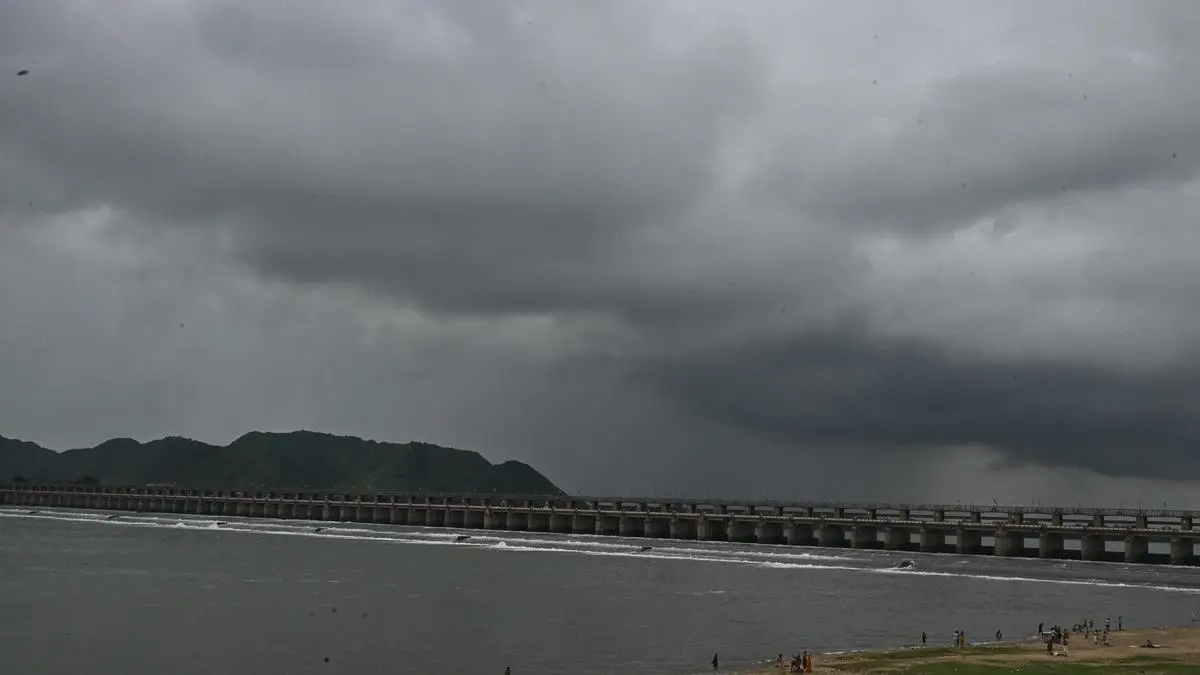
The India Meteorological Department said Tuesday that the southwest monsoon is likely to reach the Andaman Sea and Andaman and Nicobar Islands by the end of this week. A low-pressure system over the Bay of Bengal is intensifying, pulling the onset timeline forward. The statement provides the first concrete timeline for the 2026 monsoon, the seasonal engine that drives agricultural output, rural demand, and food inflation in India. Equity markets, particularly shares of agri-input, consumer, and two-wheeler companies, often rally on onset headlines. This year, the rally trigger arrives alongside a pre-existing warning: the IMD's seasonal forecast calls for below-normal rainfall of 80 cm, a 7 cm deficit against the 1971-2020 long-period average of 87 cm.
A timely onset matters. It removes the tail risk of a severely delayed start that would compress the kharif sowing window. The low-pressure area that the IMD described is intensifying toward a more marked system, and its cyclonic circulation already extends up to 4.5 km above mean sea level. The mechanism is textbook, and the Andaman arrival around the May 20 climatological normal signals that the monsoon is not stalled at its first waypoint. Equity markets can price that as a near-term positive. The harder question is whether the market has fully internalised the El Niño-linked rainfall deficit that will govern the distribution, intensity, and agricultural impact of the rains that follow.
The Low-Pressure Trigger and What an On-Time Onset Actually Resolves
The IMD's daily forecast described a system that is still deepening. The low-pressure area was positioned over the southwest Bay of Bengal at 8:30 a.m. on May 12, 2026, and the department expects it to become "more marked" within 48 hours. That intensification creates the wind and moisture convergence needed for monsoon onset over the south Bay of Bengal, Andaman Sea, and island territories.
"The low-pressure area over southwest Bay of Bengal lay over the same region at 8.30 am of today, the 12th May 2026, with the associated cyclonic circulation extending up to 4.5km above mean sea level. It is likely to become more marked during the next 48 hours."
Climatological Norm and the Sowing Calendar
The monsoon normally reaches the Andaman and Nicobar Islands around May 20 and advances to the Kerala coast by June 1. An on-time Andaman arrival preserves the standard calendar. A delay would force farmers in rain-fed regions to switch to shorter-duration crop varieties, altering the demand mix for seeds, fertilisers, and pesticides. The current timeline removes that sequencing risk for now.
What the Onset Date Does Not Confirm
The monsoon's westward advance depends on forces the IMD did not address in Tuesday's statement: the strength of the Somali jet, the formation of an off-shore trough along India's west coast, and the phase of the Madden-Julian Oscillation. A clean Andaman arrival does not guarantee a normal progression to the mainland. The multi-week gap between the island onset and the Kerala onset is a window in which the El Niño signal can strengthen, altering the monsoon's trajectory before it reaches the main kharif belt. The market's habit of treating the first onset headline as a broad buy signal for rural-exposed stocks ignores that gap.
The 80 cm Forecast and the El Niño Mechanism
The IMD had already projected seasonal rainfall of 80 cm against a long-period average of 87 cm. The May 1 monthly update flagged the transition of El Niño-Southern Oscillation (ENSO)-neutral conditions over the equatorial Pacific toward El Niño conditions, which historically suppress the Indian monsoon. Tuesday's onset announcement did not change that seasonal outlook.
The Deficit in Context
An 80 cm outcome implies a roughly 8% deficit at the all-India level. The last strong El Niño event, in 2015-16, delivered a 14% shortfall and pushed food inflation above 8%. The current forecast is less severe. A large portion of the market has priced a "manageable deficit" scenario, not a drought. The risk is that the actual rainfall undershoots the 80 cm mark, particularly if the El Niño intensifies faster than models anticipate.
Regional Divergence Is the Real Driver
The all-India number hides the spatial pattern. The northwest and central regions, home to the bulk of rain-fed kharif acreage, tend to absorb the largest deficits during El Niño events. The southern peninsula and northeast often fare better. A trader who buys a broad agri-input basket on the onset headline is betting that the rainfall distribution will be benign across the high-acreage states, a bet the IMD's own historical correlations do not support.
Sector Exposure: Mapping the 80 cm Scenario Beyond Agri Stocks
The monsoon's market impact flows through multiple channels. The naive long-agriculture trade is only one of them, and it may be the most crowded.
- Fertilisers and agrochemicals: Volume demand is the key lever. A 7 cm national deficit, if concentrated in key growing states, can cut offtake by more than the headline percentage suggests. Urea volumes are less price-sensitive because of the subsidy structure. Specialty chemical and pesticide demand correlates more tightly with pest pressure, which rises in dry spells.
- Irrigation and pipes: A weak monsoon raises the call on groundwater and canal irrigation. Companies selling drip irrigation systems, pumps, and PVC pipes may see offsetting demand if farmers invest in protective irrigation. This substitution effect is the contrarian read: the market often sells irrigation stocks on monsoon fears, missing the short-cycle capex that dry conditions can trigger.
- Consumer staples and two-wheelers: Rural demand accounts for roughly 35-40% of FMCG revenue and over half of motorcycle sales. A normal monsoon supports disposable income and credit appetite; a deficient one delays discretionary spending. The onset headline alone does not move these stocks sustainably. The critical variable is the July-August rainfall distribution, which determines kharif output and the subsequent rabi planting sentiment.
- Power producers: Hydropower generation benefits from reservoir levels. A weak monsoon, however, raises the load on thermal plants as irrigation pumps run longer. The net effect is ambiguous. Utility stocks rarely offer clean, one-direction monsoon trades. US utility Southern Company (SO) carries an Alpha Score of 43/100, a Mixed label reflecting rate and load-growth uncertainties, a reminder that regulated power names filter monsoon impacts through rate cases and grid dynamics, not just rainfall totals. For Indian utilities, the monsoon effect is similarly mediated by state-level power purchase agreements and fuel costs.
The Rate Channel: Food Inflation as a Policy Transmission Belt
A poor monsoon pushes up food prices, which feed directly into the Consumer Price Index. The Reserve Bank of India's rate path is data-dependent. A sustained food price shock would delay rate cuts, tightening financial conditions for rate-sensitive sectors such as real estate, autos, and non-bank financial companies (NBFCs). The monsoon is not just an agriculture story; it is a monetary policy transmission mechanism that can compress valuation multiples across the broad market.
Positioning and the Risk That Is Not Yet Hedged
Indian equities have traded at a premium to emerging-market peers through much of 2026, supported by domestic flows and a growth premium. The Nifty 50 forward price-to-earnings multiple sits above its five-year average. A monsoon disappointment would challenge the earnings growth assumptions embedded in that multiple, particularly for the consumption and financial sectors.
Consensus Is Priced for a Manageable Deficit, Not a Drought
Sell-side consensus has leaned toward a "normal to slightly below-normal" monsoon. The 80 cm forecast is not a shock. The risk is that the actual outcome undershoots even that tempered view. If June-September rainfall prints closer to 75 cm, the earnings downgrade cycle for rural-exposed names would accelerate. The market is pricing a scenario of manageable stress, not a drought-level shortfall.
Hedging and Flow Signals
Open interest in Nifty Bank and Nifty FMCG futures has not yet shown a defensive tilt. The put-call ratio for agri-input stocks remains in neutral territory. This suggests that monsoon risk is not being hedged aggressively ahead of the onset. A trader who wants to express a view has two practical choices: buy protection on rural-exposed indices before the first fortnight of June rainfall data, or wait for that data to provide a higher-conviction signal on spatial distribution.
Key insight: The onset date is a sentiment event, not a fundamental catalyst. The fundamental catalyst is the July rainfall distribution, which will determine whether the 80 cm seasonal forecast holds or deteriorates.
Risk to watch: A rapid intensification of the El Niño signal in the June-August Oceanic Nino Index would raise the probability of a sub-80 cm outcome. The IMD's next monthly update, due in early June, is the first chance to see if the agency revises its seasonal number.
Bottom line for traders: The monsoon onset headline will generate a short-lived bid for agri and rural stocks. Use that liquidity to reassess exposure, not to chase. The better trade is to map portfolio sensitivity to a 75 cm scenario and decide whether that risk is compensated at current valuations. For broader context on how macro catalysts flow through equity markets, see our stock market analysis. The monsoon's indirect impact on utility names, much like the mixed signals embedded in Southern Company's Alpha Score of 43, rewards a framework that separates sentiment from the fundamental distribution of rain.