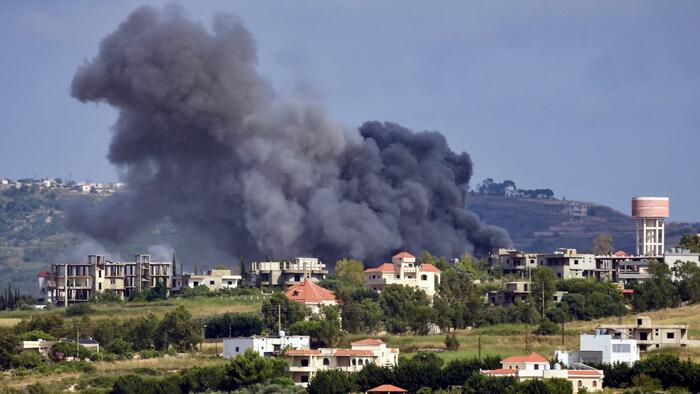
The fragile ceasefire between Israel and Hezbollah has collapsed in a surge of violence that killed at least 50 people in 24 hours, according to Lebanese officials. Israeli airstrikes pounded southern Lebanon on Saturday, hitting the districts of Nabatieh, Bint Jbeil, Sidon, and Tyre, while Hezbollah launched explosive-laden drones that seriously wounded an Israeli reservist soldier and damaged an unmanned engineering vehicle. The rapid escalation resets the geopolitical risk premium across energy, defense, and safe-haven assets, forcing traders to reassess the probability of a wider regional conflict.
Ceasefire Collapses: 50 Killed in 24 Hours as Israel Strikes Southern Lebanon
The 10-day ceasefire brokered by Washington in late April had already been fraying, but Saturday's bombardment marked a definitive return to full-fledged hostilities. Lebanon's National News Agency reported that rescue operations were still underway for bystanders trapped under rubble late Saturday. The Israeli military said it was acting to root out Hezbollah infrastructure, issuing evacuation orders for several areas. However, Lebanese media reported that at least 12 people were killed in areas where no evacuation orders had been issued, raising questions about the scope and targeting of the strikes.
Col. Avichay Adraee, an Israeli army spokesman, framed the operations as a response to Hezbollah's violations of the truce: "In light of the Hezbollah terror organization's violations of the ceasefire agreement, the IDF is forced to act against it with force and does not intend to harm you." Yet the pattern of strikes on vehicles south of Beirut, which killed four people, and the bombardment of southern villages where demolitions have been carried out, suggests an expanding operational footprint. Lebanese officials have accused Israel of attempting a "cultural genocide" by erasing the Lebanese presence in the border strip that Israeli forces now occupy as a "buffer zone."
The Drone War: Hezbollah's Precision Strikes on Israeli Forces
Hezbollah's response has been asymmetric but precise. On Saturday, the group launched multiple salvos of explosive-laden drones and rockets at Israeli forces. One drone penetrated Israeli territory near the border, seriously wounding a reservist soldier and moderately wounding two others. The seriously wounded soldier underwent surgery at Galilee Medical Center and was listed as stable in intensive care; the other two were scheduled for surgery later. A separate drone struck an unmanned engineering vehicle in southern Lebanon, causing damage but no casualties.
These attacks underscore a critical tactical shift: Hezbollah is using low-cost, hard-to-intercept drones to target Israeli military assets and personnel. The ability to inflict casualties and damage equipment despite Israel's sophisticated air defenses changes the risk calculus for any prolonged ground presence. Lebanese Parliament Speaker Nabih Berri, a Hezbollah ally and leader of the Amal Movement, warned that if Israel "maintains its occupation, whether of areas, positions, or by drawing yellow lines, it will smell the scent of resistance every day." He added: "If they insist on remaining, they will face resistance, and our history bears witness to that."
Market Read: Energy Supply Risks and Defense Spending
The naive read is that any Middle East conflict is automatically bullish for oil. The better read: this conflict is currently contained to Lebanon and Israel, with no immediate disruption to crude production or transit. Lebanon is not an oil producer, and Israel's offshore gas fields, while potentially vulnerable, have not been targeted. However, the real tail risk is Iranian involvement. Iran backs Hezbollah, and a wider regional war could threaten the Strait of Hormuz, through which roughly 20% of global oil passes. That scenario, while still low-probability, is the one that would send crude prices sharply higher.
For now, traders are likely to price a modest risk premium into Brent and WTI futures. Exchange-traded funds like the United States Oil Fund (USO) and the Energy Select Sector SPDR (XLE) could see increased volume as hedgers and speculators position for potential supply scares. The more immediate beneficiary may be defense stocks. The Israeli military's reliance on drones, counter-drone systems, and engineering vehicles highlights the demand for modern asymmetric warfare technology. The iShares U.S. Aerospace & Defense ETF (ITA) and individual contractors with exposure to missile defense and unmanned systems could attract bids. The US has already been replenishing Israel's Iron Dome interceptors, and a sustained campaign would accelerate that spending.
Safe-haven flows are the third leg of the trade. Gold, the Japanese yen, and US Treasuries tend to rally during geopolitical shocks. The CBOE Volatility Index (VIX) is likely to spike, though the magnitude depends on whether the conflict escalates further. The dollar may strengthen on flight-to-safety demand, complicating the outlook for emerging markets and commodities priced in greenbacks.
Confirmation Signals: What Sustains a Geopolitical Bid
For the energy and defense trades to gain traction beyond a knee-jerk spike, traders need confirmation that the conflict is widening or becoming protracted. Key signals include:
- Hezbollah rocket attacks reaching deeper into Israel, particularly targeting Haifa or offshore gas infrastructure.
- Israeli ground operations expanding beyond the current buffer zone, with sustained casualties.
- Direct Iranian military involvement or threats to close the Strait of Hormuz.
- A breakdown in diplomatic channels, with the US unable to broker a new ceasefire.
If these conditions materialize, oil could break above its recent range, and defense stocks could enter a sustained uptrend. Conversely, if the violence remains localized and diplomatic efforts regain traction, the risk premium will fade quickly.
Invalidation: A Return to the Ceasefire Framework
The primary risk to the geopolitical bid is a rapid de-escalation. The US has significant leverage over Israel and has already demonstrated the ability to broker a temporary halt. If Washington pressures both sides into a new ceasefire, the fear premium in oil and gold would unwind. Traders should watch for statements from the White House, the UN, or regional mediators like Qatar. A resumption of the ceasefire talks, even if fragile, would be the clearest invalidation signal for the long-volatility and long-energy trades.
Another invalidation trigger is a shift in Israeli domestic politics. If the conflict generates significant Israeli casualties or economic disruption, public pressure could force a pullback. The drone attack that wounded three soldiers, while limited, is a reminder that Hezbollah can impose costs. A major successful strike on an Israeli city would likely escalate the response, but a series of smaller, manageable attacks might push the government toward containment.
Next Flashpoint: Hezbollah's Rocket Arsenal and the Buffer Zone
The immediate catalyst for the next leg of this trade is Hezbollah's rocket and missile arsenal. The group is estimated to possess over 100,000 rockets, many with the range to hit Tel Aviv. If Hezbollah begins launching barrages at Israeli population centers, the conflict will enter a new phase, and the market impact will intensify. The buffer zone itself is a flashpoint. Israel's demolitions in southern villages and the accusation of "cultural genocide" are inflaming Lebanese public opinion, which could increase recruitment for Hezbollah and prolong the insurgency.
Traders should also monitor the northern Israeli home front. The Galilee Medical Center's treatment of wounded soldiers is a tangible reminder that the conflict is not cost-free for Israel. If casualty counts rise, the political calculus in Jerusalem could shift, either toward a more aggressive campaign to "finish the job" or toward a negotiated exit. Either outcome has market implications: escalation means higher oil and defense stocks; de-escalation means a rapid unwind of the fear trade.
The conflict's return to full-fledged war has reset the geopolitical risk matrix. For now, the smart money is watching energy and defense for a potential breakout, but only if the next flashpoints confirm a wider, longer war. The naive play is to buy oil on the headline; the better process is to wait for confirmation of a sustained risk-off move, then size positions accordingly, with a clear invalidation point if diplomacy returns.