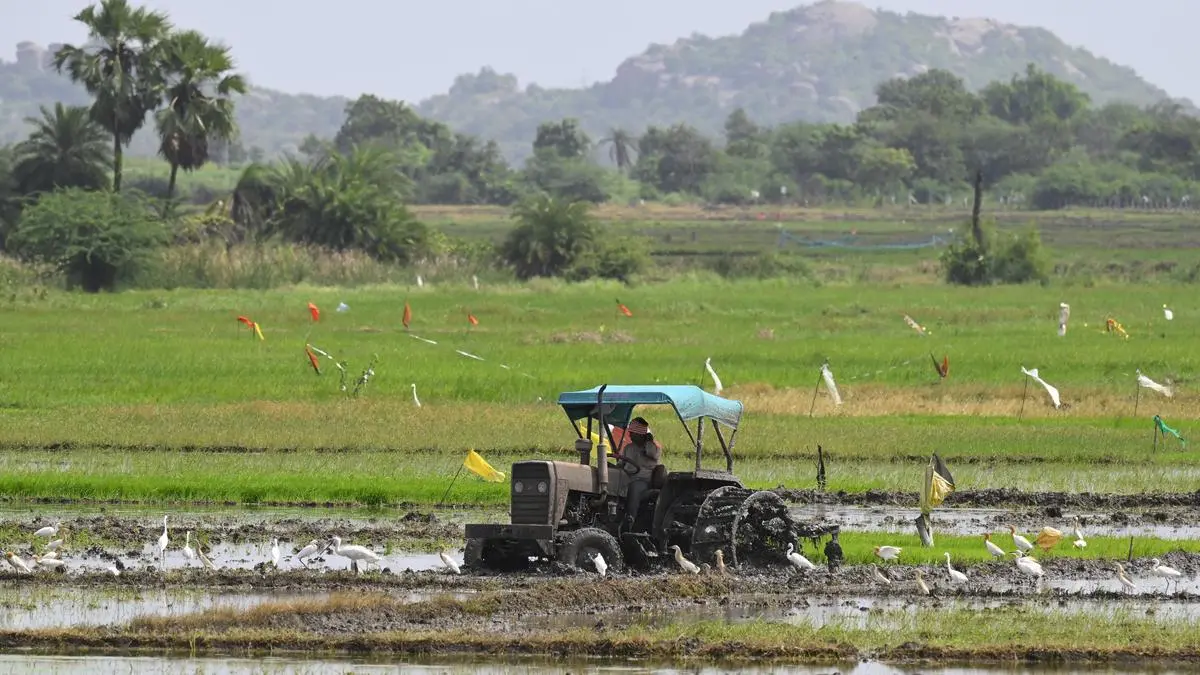
India set a foodgrain production target of 373.93 million tonnes for the 2026-27 crop year, down from the record 376.56 mt achieved in 2025-26. The reduction concentrates on rice (151 mt) and maize (52.50 mt), two crops heavily dependent on the June-September monsoon. The India Meteorological Department forecast of below-normal rainfall at 90% of the long-period average provides the backdrop. For traders tracking agri-commodity inflation and India's CPI trajectory, the target change is a concrete signal that the government is pricing in weaker monsoon yields before planting begins. This kind of macro risk event alters sector-level positioning across the stock market analysis landscape.
Why the 373.93 mt Target Flags a Kharif Crop Risk
The 0.7% decline from the record looks modest on paper. The composition tells a different story. Rice and maize are monsoon-dependent kharif (summer) crops. A weak June-September rainfall directly reduces yield potential for these two staples. By setting lower targets for rice and maize while holding wheat at 121.5 mt (mostly irrigated), the agriculture ministry implicitly acknowledges a dry-spell risk.
Key government targets for 2026-27:
- Rice: 151 mt
- Wheat: 121.5 mt
- Pulses: 28.42 mt
- Nutri-cereals: 18.08 mt
- Maize: 52.50 mt
The pulses and nutri-cereals targets are roughly flat. The cuts are concentrated where rain sensitivity is highest.
The Vulnerable District Map
Sources in the agriculture ministry review identified 240 vulnerable rainfed districts that could be majorly impacted if the IMD forecast proves correct. Among them, 157 districts have received at least 19% deficient rainfall in past El Niño years. Across the country, 577 districts are under central monitoring for contingency planning. That is roughly 80% of India's agricultural districts under some form of watch.
A senior ministry official told reporters the target cut had no link with El Niño prediction and described it as “almost at same level with the previous year’s target.” The numbers contradict that framing. The 2025-26 actual was a record. Lowering the target for 2026-27 after a below-normal monsoon forecast is a conservative planning move that embeds higher weather risk.
The Trade Policy Expert's View on Export Risk
A trade policy expert cited in the source said:
The expert recommended a cautious and calibrated export policy to manage domestic prices. India has used export restrictions on rice and wheat in recent years to contain food inflation. A repeat of those measures would keep global grain prices elevated while capping domestic price spikes.
What a Below-Normal Monsoon Changes for Food Inflation and RBI Policy
Food inflation in India has repeatedly surprised above the RBI's comfort zone. A monsoon deficit in the 90-100% of normal range historically adds 30-50 basis points to headline CPI over the following quarter, depending on spatial distribution. The current forecast carries an additional risk: IMD flagged disrupted spatial distribution, meaning some regions could get near-normal rain while others face outright drought.
Risk to watch: A rainfall deficit exceeding 10% (below 90% of normal) could push food inflation into double digits. That would force the RBI to hold rates through the second half of 2026, delaying any easing cycle. Short-end bond yields would lift, and rate-sensitive stocks would face headwinds.
Agricultural Commodities
Rice is not exchange-traded in India, but paddy prices influence the broader grain complex. Maize futures on NCDEX could see volatility as livestock feed demand competes with supply uncertainty. Soybean and palm oil prices may also respond if farmers shift acreage from rain-fed cereals.
Agri-Input Stocks
Companies selling seeds, fertilizers, and pesticides–such as Coromandel International and Rallis India–could benefit if farmers replant or increase input usage to salvage yields after a dry spell. The government's directive to distribute suitable seeds and alternative crop options may drive demand for short-duration varieties.
Consumer Staples
Nestlé India, Britannia, and Hindustan Unilever face input cost pressure from higher grain and vegetable prices. Rural demand, already under strain, would weaken further if farm incomes fall.
Bonds and Rural Banks
The 10-year Indian government bond yield would reflect rising inflation expectations. HDFC Bank and ICICI Bank with significant rural loan exposure could see provisioning increases if drought triggers farmer defaults.
Timeline and Confirmation Points
The monsoon season runs June through September. The IMD will issue weekly updates on cumulative rainfall, regional distribution, and El Niño status. The first critical milestone is the June 15 update, covering the monsoon's onset over Kerala and progress into central India.
What would confirm the risk:
- IMD's June forecast downgrading to below 90% of normal
- Deficient rainfall in more than 30% of the 240 vulnerable districts
- A sharp rise in paddy procurement prices in mandis
What would weaken the thesis:
- Normal or above-normal rainfall in July and August, washing out early deficits
- Aggressive government export restrictions keeping domestic prices capped
- Higher irrigation coverage reducing yield sensitivity to rainfall
Agriculture Minister's Directives
Union Agriculture Minister Shivraj Singh Chouhan reviewed the situation and issued a series of directives. His instructions included:
- Contingency plans activated up to the district level
- District-specific advisories on re-sowing, life-saving irrigation, short-duration crops, and alternative crops
- Water delivered to the last mile of canal systems, with regular review meeting with states
In a statement, Chouhan said: “We are preparing together and the goal is that the impact of weather challenges on the farm and the farmer should be minimal. Through advanced technology adoption, expansion of irrigation facilities and climate-resilient agricultural practices the impact can be controlled to a large extent.”
The directives signal a government preparing for a plausible dry spell. They do not sound like a government expecting business as usual.
The Next Decision Point for Traders
India's foodgrain target cut is a watchlist event, not a crisis trigger. It adjusts expectations to a below-normal monsoon. The real test comes with June-August rainfall data. If the deficit narrows to 5% or less, the target will look conservative and agri stocks may rally. If the deficit pushes past 10% with poor spatial distribution, food inflation will climb and the RBI will face pressure to hold rates through the second half of 2026.
The vulnerable district data is the closest thing to a pre-existing map of where the risk concentrates. For now, the prudent positioning is defensive: reduce exposure to rural consumption stocks, add to agri-input names that benefit from replant cycles, and monitor NCDEX maize futures for early signals. The monsoon is not lost yet–the government's planning numbers say it is not taking chances.