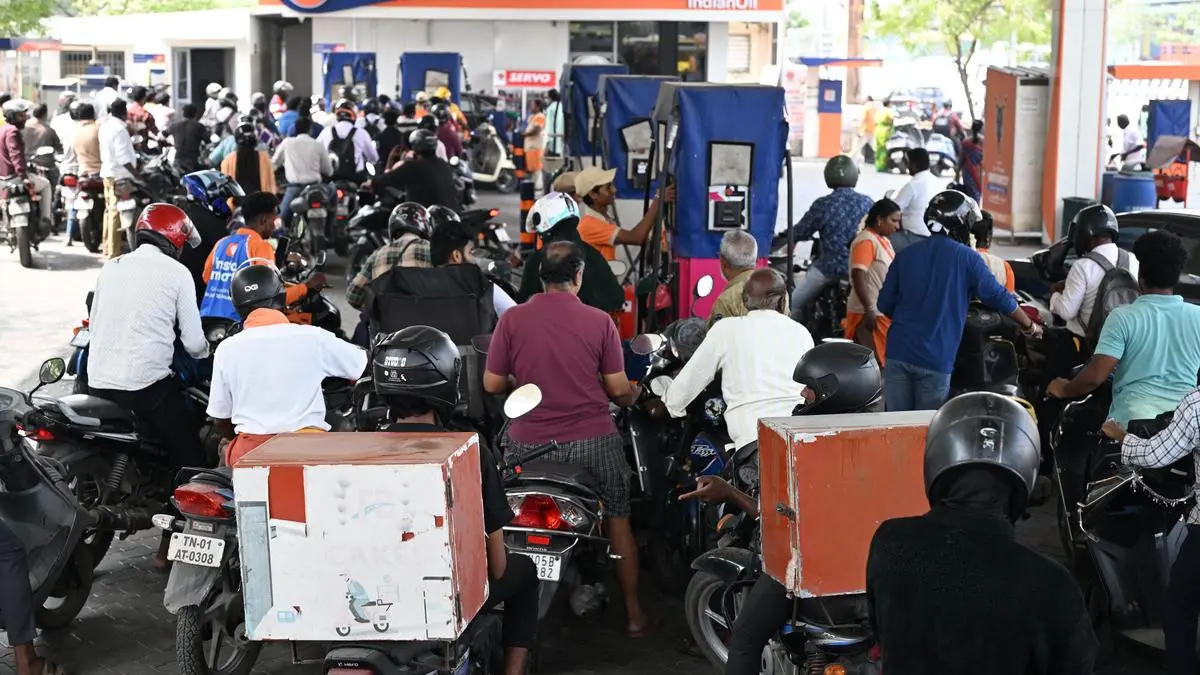
Retail fuel prices in India have risen again, the fourth increase in ten days. Petrol jumped ₹2.61 per litre and diesel rose ₹2.71 per litre on May 23, 2026. The cumulative move over the period is roughly ₹7 per litre. The central government cut excise duty by ₹10 per litre in late March. No state has followed with a matching reduction.
This pattern renews focus on state fuel taxes. Each Indian state sets its own value-added tax (VAT) or sales tax on petrol and diesel. Rates vary widely, creating a large gap in retail prices across cities. On May 25, petrol cost ₹102.12 in Delhi, ₹111.21 in Mumbai, ₹113.51 in Kolkata, and ₹107.77 in Chennai. The difference is almost entirely tax, not crude costs or refinery margins.
The fiscal mechanism: ad valorem VAT and state revenue
Most states levy ad valorem VAT on petroleum products. Revenue rises automatically when the base price increases. A higher international crude price lifts retail prices, which lifts state tax revenue without any rate change. That creates a built-in disincentive to cut taxes when crude is expensive.
Data from the Petroleum Planning and Analysis Cell (PPAC) for the first nine months of fiscal 2026 (April to December 2025) shows the scale of this revenue. Maharashtra collected ₹27,500 crore in sales tax and VAT on petroleum products. Uttar Pradesh collected ₹23,200 crore. Gujarat collected ₹21,600 crore.
Southern states are also heavy recipients. Karnataka took in ₹19,500 crore, just ahead of Tamil Nadu at ₹19,200 crore. Andhra Pradesh collected ₹12,200 crore and Telangana collected ₹12,100 crore. These figures underline the importance of petroleum consumption to state budgets.
Examining the share of petroleum taxes in each state's own tax revenue (SOTR) reveals an even starker picture. Gujarat derives 18.6 percent of its SOTR from petroleum products – the highest share among the 11 states and union territories analysed. This occurs despite Gujarat’s relatively low tax rates on petrol and diesel; high consumption from the state’s industrial base and refineries drives volume. Delhi, by contrast, derives only 6.6 percent of SOTR from petroleum, reflecting a less industrialised, consumption-led economy with a broader SGST base.
| State | Petroleum Tax Revenue (FY26, first 9 months, ₹ crore) | Share of SOTR (%) | VAT on Petrol (Effective) |
|---|
| Maharashtra | 27,500 | ~16 (est.) | >30% |
| Gujarat | 21,600 | 18.6 | Below 20% |
| Uttar Pradesh | 23,200 | ~14 (est.) | Hybrid / below 20% |
| Karnataka | 19,500 | ~15 (est.) | >30% |
| Tamil Nadu | 19,200 | ~14 (est.) | ~18% (mixed) |
Three buckets of state tax exposure
The 11 states and union territories split into three groups based on their levy on petrol and diesel.
High-tax states include Telangana, Andhra Pradesh, Rajasthan, Karnataka, Maharashtra, and Madhya Pradesh. Effective tax rates on petrol exceed 30 percent. Telangana charges 35.2 percent VAT on petrol and 27 percent on diesel. Andhra Pradesh uses a multi-layered structure: 31 percent VAT on petrol, plus an additional ₹4 per litre VAT and a ₹1 per litre road development cess. Consumers in these states face the stiffest retail price burden.
Medium-tax states are Tamil Nadu and West Bengal. Tamil Nadu applies a mixed structure: 13 percent ad valorem tax plus ₹11.52 per litre specific tax on petrol, and 11 percent ad valorem plus ₹9.62 per litre on diesel. West Bengal levies a higher rate of 25 percent, or ₹13.12 per litre, whichever is higher, plus a cess component.
Low-tax states include Uttar Pradesh, Gujarat, and Delhi. Their effective rates stay below 20 percent. Uttar Pradesh uses a hybrid formula – percentage tax or fixed per-litre levy, whichever is higher. Gujarat and Delhi continue to maintain relatively lower rates compared to southern and western states.
With retail prices rising, the high-tax states have the most room to offer relief. They also have the least fiscal incentive to do so, given that ad valorem revenues are swelling alongside crude prices.
Demand risk for crude and refined products
India imports roughly 85 percent of its crude requirements. It is one of the world’s largest consumers of refined products. Higher retail prices directly affect demand for gasoline and gasoil (diesel). Diesel alone accounts for roughly 40 percent of total petroleum product consumption, driven by trucking, agriculture, and industry.
When retail prices rise faster than inflation, end-users adjust. Truckers shorten routes or consolidate loads. Industrial buyers defer non-essential fuel purchases. Farmers switch to alternative fuels where possible. These micro-level adjustments aggregate into lower year-on-year demand growth.
The risk for global crude oil markets is twofold. First, slower Indian demand growth removes a key support from International Energy Agency forecasts. Second, state tax inertia makes the demand response stickier than a simple pass-through. Even if international crude prices correct, high VAT rates keep retail prices elevated, delaying any rebound in consumption. This is not a short-term noise event; it is a structural ceiling on Indian demand elasticity.
What would reduce the risk
- A coordinated state-level VAT cut by high-tax states, especially Telangana, Andhra Pradesh, Karnataka, and Maharashtra. A reduction of even 2–3 percentage points would knock ₹5–₹7 off the retail price.
- A second central excise reduction. The government still has room after the ₹10 cut in March. Another ₹5 cut would pressure states to follow.
- A sharp drop in international crude prices. Lower landed costs reduce the ad valorem tax burden automatically and could trigger rate recalibration from budget-surplus states.
What would make it worse
- Continued retail price hikes without offsetting tax relief. If both centre and states hold, retail prices could push above ₹115 per litre in Mumbai and ₹110 per litre in Delhi – levels that historically triggered demand destruction.
- A crude supply disruption that pushes Brent above $85 per barrel. The ad valorem mechanism would amplify state revenues further, reducing any political urgency to cut taxes.
- High-tax states raising rates to plug budget gaps. Telangana and Andhra Pradesh face high fiscal deficits; petroleum taxes are an easy target. A rate increase would compound consumer pain and deepen the demand drag.
The trader's decision framework
For anyone trading crude oil, gasoil, or Indian refining equities, the key variable is not just OPEC+ supply or U.S. inventories. It is whether India’s state governments treat fuel taxes as a relief valve or a revenue pipe. The PPAC data shows revenue is structurally important: even low-tax Gujarat gets 18.6 percent of its own tax revenue from petroleum. That argues for inertia.
Watchlist: Indian state budget announcements for July 2026, when new fiscal year tax proposals take effect. Any state that voluntarily cuts VAT will be a leading indicator of broader relief. Any state that holds or raises rates confirms the fiscal priority is revenue, not demand support.
The naive view is that fuel prices follow crude. The practical view is that they follow state treasuries first. For a read-through on utility fuel-cost pass-through, Southern Company (SO) carries an Alpha Score of 47/100 (Mixed) – a reminder that state-level regulatory inertia is not unique to India. For commodities analysis and country-level demand tracking, the crude oil profile provides further context.
Multiple hikes in ten days have made the state tax question impossible to ignore. The better market read treats this as a fiscal policy event with second-order effects on global demand, not a simple crude pass-through.