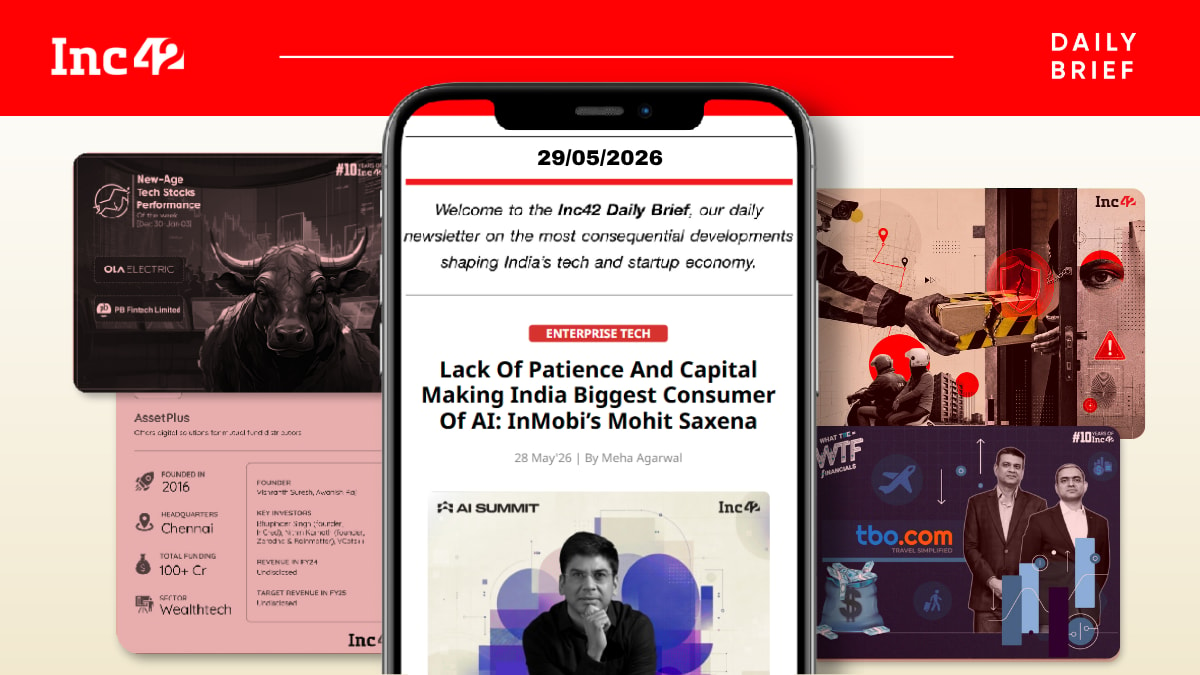
Bengaluru hosted the Inc42 AI Summit 2026 this week. The opening sessions immediately cut through the optimism. India is racing toward a $126 Bn AI market by 2030. The country remains constrained by capital, talent and infrastructure gaps.
The $126 Bn AI Ceiling: Capital Depth and Chip Access
Mohit Saxena of InMobi set the tone by arguing that India is still far behind the US and China. The country lacks the same depth of capital, chip access and long-term ecosystem patience. His point was direct: India remains a consumer of global technology rather than a builder of core infrastructure. The gap is not about talent or ambition. It is about the willingness to fund projects that may not return capital for a decade.
The Distribution Moat
Rahul Chari of PhonePe pushed the conversation in a different direction. He argued that lower entry barriers due to AI make distribution and data more valuable than ever. In his view, the next few years will see engineers evolve from coders into architects who think about systems, hardware and design. The implication is clear: India may not win the chip race. It can win the application and distribution race if it plays to its strengths.
Key insight: The summit's central tension was between Saxena's infrastructure pessimism and Chari's distribution optimism. Both can be true simultaneously. The market will eventually price which one dominates.
AI Workforce: Code Compression at Rapido and S45
The summit put the spotlight on how AI is reshaping startup structures in real time. Rapido, the ride-hailing giant, revealed that two-thirds of its code is now AI-generated. This compresses software production cycles to a single week. That is a structural shift in how startups allocate engineering resources.
S45, a fintech platform, went further. The company only hires humans when AI cannot do the job. That is not a future scenario. It is the current hiring policy.
Voice, Code and Growth
Zepto and ElevenLabs pointed to two sides of the AI shift. Zepto is using the technology to accelerate experimentation on the operator side. ElevenLabs is helping brands convert voice and intent into reduced friction and improved resolution on the consumer side.
Risk to watch: The compression of software cycles is a double-edged sword. Faster production means faster iteration. It also means faster commoditisation. The moat shifts from code to data and distribution, exactly as Chari argued.
Investor Filter: Beyond AI Buzzwords
The funding conversation at the summit was revealing. Archana Jahagirdar of Rukam Capital and Ashwin Raguraman of Bharat Innovation Fund said that investors are increasingly looking past AI buzzwords. They are asking tougher questions about adoption, margins, compute costs and real customer usage.
This is a shift from the 2023-2024 period, when any startup with "AI" in its pitch deck could raise capital. The new filter is operational: does the AI actually reduce cost, increase revenue, or improve retention? If the answer is unclear, the cheque does not come.
Practical rule: The funding environment is rewarding startups that can show unit economics, not just user growth. AI is a tool, not a business model.
CLUIX: Portable Water Testing for Remote India
Safe drinking water remains hard to verify in India's remote areas. Testing is often slow, costly and dependent on lab access. CLUIX is tackling this gap with portable hardware that can test water quality on the spot and send results into a real-time monitoring system.
Founded in 2023, CLUIX sits at the intersection of water infrastructure, diagnostics and environmental monitoring. The startup's flagship digital water quality analyser can test drinking water across more than 12 key parameters, including pH, turbidity, nitrate, fluoride and residual chlorine.
Designed for Remote Use
The device delivers lab-grade accuracy in the field while geo-tagging every reading and pushing data to a central dashboard for real-time oversight. It works without internet connectivity and can last 10 to 15 days on a single charge. This makes it suitable for last-mile deployments.
The platform also supports testing for arsenic and microbiological contaminants through its software-led system. This widens its utility in high-risk water zones.
Eye on Global Markets
CLUIX claims to be already running pilots across multiple Indian states. The startup is now expanding to Europe, Africa and Southeast Asia. The homegrown water purifier and testing market is projected to reach $7.72 Bn by 2032.
What this means: CLUIX is betting that hardware-led verification will become a regulatory and consumer requirement, not just a niche. The question is whether the startup can scale manufacturing and distribution before larger players enter the space.
Travel Tech: Rebuilding the Ecosystem
India's travel tech ecosystem is being rebuilt by startups. From AI-powered travel solutions to electric mobility, the next generation of new-age tech companies is changing how Indians experience travel. The summit highlighted that the shift is not just about booking platforms. It is about infrastructure, energy and personalisation.
The Inc42 AI Summit 2026 confirmed that India's AI story is real. It is also uneven. The capital gap is the binding constraint. Startups that solve distribution, data or hardware verification problems have a clearer path to funding than those chasing foundation models. The next 12 months will separate the AI-enabled businesses from the AI-wrapped ones.
For broader context on how structural shifts affect public markets, see our stock market analysis.