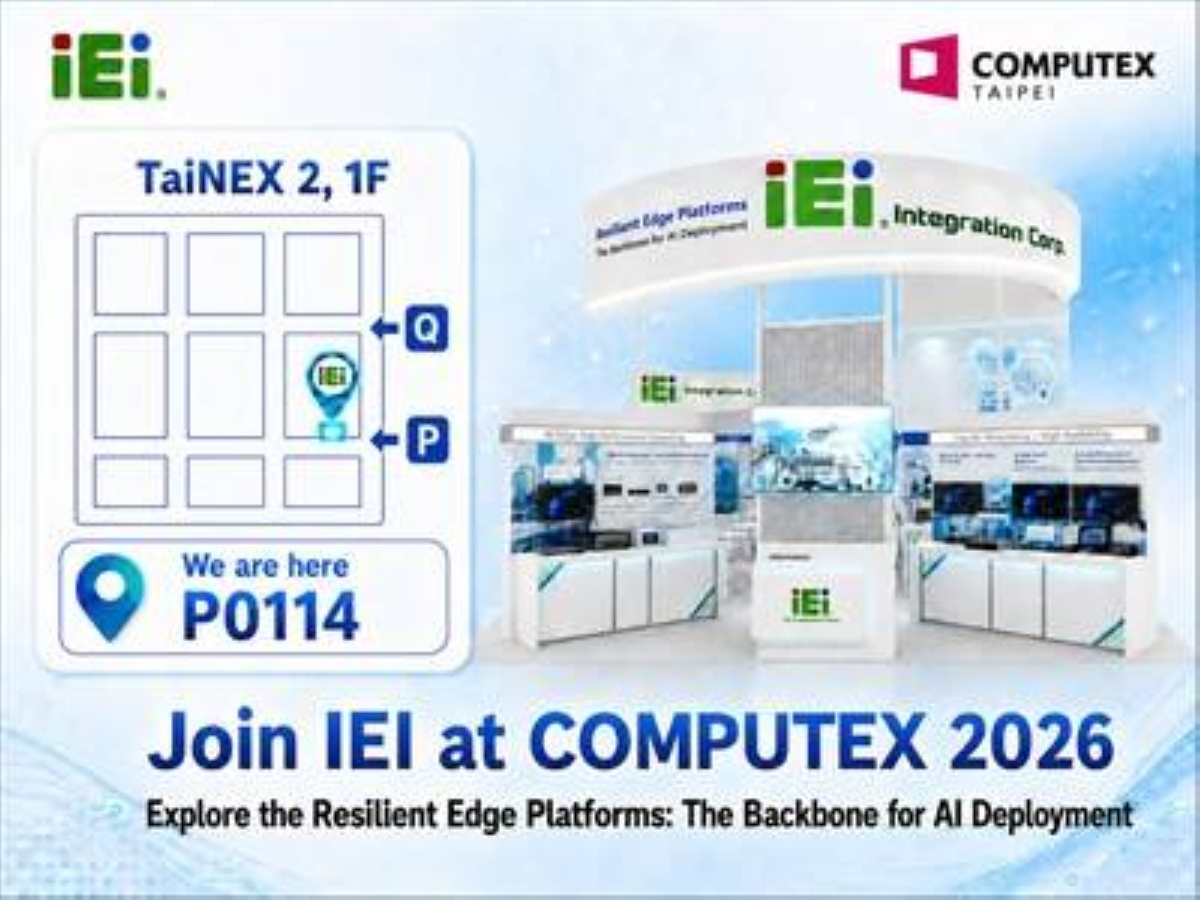
IEI Integration Corp. announced its COMPUTEX 2026 lineup today under the theme “Resilient Edge AI Platforms: The Backbone for AI Deployment.” The company is staking its showcase on a claim that many industrial AI hardware vendors make but few prove: that computing, control, cyber resilience, and extreme durability can live inside a single edge device.
IEI’s Convergence Test at COMPUTEX
The naive read is that IEI is simply another exhibitor with ruggedized boxes. The better read starts with the engineering reality inside a factory. Nearly every shop floor today separates AI inference hardware from safety control systems. A robot slows down when a dedicated AI PC fails to detect a worker in time, and safety controllers from established PLC vendors run on separate hardware that cannot easily share data. IEI is betting that this separation is a cost and latency problem, not a safety requirement.
YT Lee, VP of IEI, laid out the direction: “AI is moving from demonstration to edge deployment. Customers need secure platforms consolidating computing, control, networking, and management.” The company built its COMPUTEX presence around four pillars – computing performance, control precision, cyber resilience, and extreme durability – claiming a single platform can address all four without adding dedicated appliances.
TANK-XM813: Safety and Intrusion on One Device
The marquee demonstration lives at the Intel Pavilion (Booth A0618), not IEI’s own booth, signaling co-development. The TANK-XM813 consolidates two functions that typically require separate hardware: mobile cobot management and AI-based intrusion detection. Powered by Intel OpenVINO, the system analyzes camera feeds to identify personnel. When a worker enters a dangerous zone, the box triggers an emergency stop through an internal software-defined network (SDN).
IEI targets the semiconductor wafer transport segment, where a single TANK-XM813 replaces the usual multi-machine setup. The mechanism is straightforward: inference and control run on the same hardened computer, eliminating the network round-trip that can delay a safety stop by milliseconds. For investors, the key question is not whether the technology works inside a booth. It is whether factory operators – especially those running semiconductor fabrication lines – will trust one edge device to handle both compute and safety-critical control.
Confirmation Signal: A Customer Order for Consolidated Edge
A single trade-show demo does not validate a thesis. The confirmation signal would be a purchasing commitment from a large industrial operator – ideally a semiconductor wafer fab or an automotive assembly plant – that references the TANK-XM813 or a similar IEI platform by name. The invalidation risk is that cyber resilience and control precision remain separate purchase decisions inside large factories. IEI could win the compute slot while customers buy separate safety controllers from vendors such as Siemens or Rockwell Automation, whose products carry decades of certification history.
The Next Decision Point
COMPUTEX runs during the first week of June 2026. Anecdotal feedback from buyers and partners will shape the near-term narrative. IEI’s pitch – a single ruggedized box that consolidates AI inference, real-time control, and security management – directly challenges the current factory architecture of separate nodes. Stock market analysis of IEI as an edge-computing name hinges on whether this convergence logic gains traction beyond a press release. Without order flow or a named customer, the showcase remains an invitation to watch, not to buy.
Whether IEI Integration Corp.’s COMPUTEX lineup translates into revenue growth depends on how fast factory operators trust a single edge box to handle both compute and control under real-world safety margins.