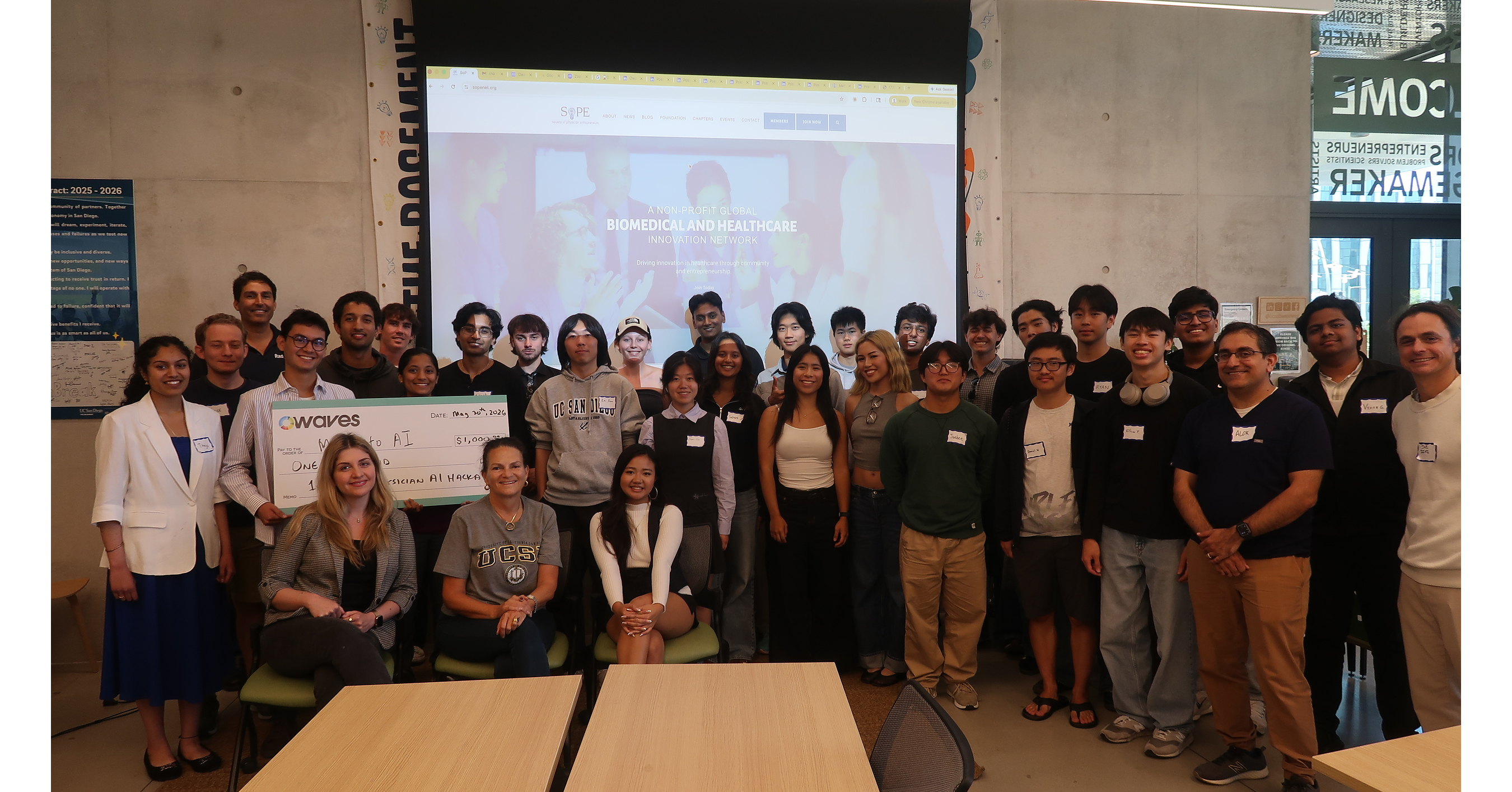
The San Diego chapter of the Society of Physician Entrepreneurs (SoPE) held its first annual Physician AI Hackathon at the University of California, San Diego on May 30. Seven teams, each pairing at least one practicing clinician with engineers and students, built working clinical software prototypes in under two hours. The event, sponsored by Owaves and organized around the theme "Idea to App in Two Hours," awarded first place to Manifesto AI, a perioperative coordination tool, and second place to GutGuide, a patient-education app.
For most of medicine's history, the clinicians who best understood a problem at the bedside could not build the software to address it. That work required dedicated engineering teams, budgets, and months of development. AI-assisted tools have collapsed that timeline. Paired with engineers and AI-fluent students, the physicians at UC San Diego moved from clinical insight to functioning prototype before noon.
The Two-Hour Pipeline That Changes the Timeline
How the Event Signals a Structural Shift
The hackathon marked the chapter's revitalization after a pandemic-era hiatus. It was hosted by Royan Kamyar, M.D., MBA, who leads the chapter and is founder and CEO of Owaves. "> The people who best understood a clinical problem were rarely the people who could build the solution," Kamyar said. "What we saw at UC San Diego is that the distance between a clinical insight and working software has collapsed to hours and minutes."
That collapse is the central mechanism for investors tracking AAPL and the broader health tech ecosystem. When clinicians can prototype a solution in a single morning, the pipeline of new health applications accelerates. The speed of innovation directly affects the value of platforms that distribute and host those applications.
Why the Surgeon Now Ships Code
The format reflects a capability that is only now possible. Bedirhan Keskin, M.D. , gold winner of Anthropic's Claude Code hackathon, delivered a keynote. Michał Nedoszytko, M.D., Ph.D. , who placed among the top three of roughly 13,000 participants in the same competition and now works on clinical AI at Abridge, mentored the winning team. Both physicians have shipped award-winning software. Their presence at the hackathon shows that the skill set is becoming part of clinical training, not a separate engineering track.
Joseph Diaz, M.D. , an associate clinical professor of general internal medicine at UC San Diego Health who competed on the second-place GutGuide team, said: "> We are entering an era where physicians can move beyond simply adopting technology to creating it. With AI, clinicians can now translate ideas born from everyday patient care into working prototypes in hours."
Where the Clinical Bottleneck Broke
The Mechanics of Rapid Prototyping
The hackathon paired physicians with engineering students from the Engineering Innovators and Entrepreneurs Club (EIEC) at UC San Diego. Justin James, co-president of EIEC, said: "> When engineering students and clinicians collaborate, we bridge the gap between technical capability and real-world medical needs."
The key constraint that broke is the feedback loop between problem discovery and solution design. Traditionally, a clinician identifies a gap, submits a request to an IT department, waits months for a build, then tests and iterates. AI-assisted coding now allows the clinician to work alongside a developer in real time, testing hypotheses as they type. The result is a prototype that embeds clinical nuance from the first commit.
Winning Projects as Leading Indicators
Manifesto AI is inspired by Atul Gawande's The Checklist Manifesto and surfaces what makes a given patient different without adding new documentation. GutGuide uses AI only to explain results in plain language and never to diagnose. These two projects represent the axes of opportunity: workflow integration into existing electronic health records (Epic) and patient-facing self-care tools.
The Apple Ecosystem Read
Why a Hackathon in San Diego Matters for AAPL
Owaves, the sponsor and creator of BodyClock AI™, has attracted 1.3 million organic downloads, earned the #1 Health & Fitness ranking on iPad in more than 135 countries, and logged over 620 million activities – generating one of the world's richest behavioral-rhythm datasets. The company's clinical validation partners include UC San Diego's Center for Circadian Biology and Medicine and Scripps Research Digital Trials Center.
Those numbers tell a straightforward story for Apple (AAPL) . The iPad is the primary distribution channel for this physician-founded health platform. As more clinician-built apps emerge from events like this hackathon, Apple's health stack – HealthKit, ResearchKit, CareKit – becomes more valuable. Each new app that lives on an Apple device adds data richness, user engagement, and App Store revenue. The hackathon demonstrates a pipeline of developer talent that is now equipped to build for that ecosystem.
The Connection Between Prototype Speed and Platform Stickiness
The faster a clinician can turn an idea into a prototype, the shorter the feedback loop between user need and product improvement. That speed reduces the likelihood that a developer will switch platforms mid-build. For Apple, the presence of a thriving, clinician-led developer community on iOS strengthens the network effects that competitors like Android Health Connect or Google Cloud Healthcare API must match.
Lily Poursoltan, a Ph.D. candidate at UC San Diego's Rady School of Management and a research data scientist at UC San Diego Health, judged the projects. She said: "> What stood out most was the energy in the room: clinicians brought real-world insight, engineers translated ideas into action, and AI experts helped teams turn ambitious ideas into meaningful prototypes."
Market Read: The Demand Signal
What the Hackathon Tells Us About Future Healthcare IT Spend
The event was presented in partnership with AIMed and UC San Diego's Office of Innovation and Commercialization. That institutional backing signals that health systems see value in this rapid-prototyping model. When a major academic medical center supports a two-hour build cycle, the procurement and deployment cycles that follow may also compress.
- Traditional timeline: 3–6 months from problem identification to pilot.
- AI-assisted timeline: Under 2 hours to first prototype, then iterative refinement over weeks.
If even a fraction of these prototypes reach clinical deployment, the total addressable market for healthcare application platforms expands faster than consensus models assume. Epic, mentioned explicitly as the target for Manifesto AI, is the dominant EHR vendor. Any tool that layers on top of Epic without adding documentation burden addresses a known pain point.
Risk to Watch: Regulatory Hurdles
Neither winning project was cleared by the FDA. GutGuide explicitly avoids diagnosing, staying within general wellness guidance. Manifesto AI is a read-only layer on Epic, likely not subject to the same scrutiny as a clinical decision support tool.
What Would Confirm or Weaken the Thesis
Confirmation signals
- Commercial adoption: One or more hackathon projects secure partnerships with health systems or VC funding within 12 months.
- Apple engagement: Apple highlights physician-built apps in a keynote or App Store editorial, signaling strategic support.
- Repeat event scaling: SoPE holds a larger hackathon in 2027 with more health systems and payer participants.
- Regulatory clarity: FDA issues clear guidance for non-diagnostic physician-generated tools, reducing uncertainty.
Weakening signals
- Projects stall: No team moves beyond prototype stage; institutional inertia blocks deployment.
- Platform fragmentation: Developers shift to Android or web because of Apple's App Store fees or restrictions on health data usage.
- Regulatory backlash: New state or federal laws require physician-authored software to pass the same approval process as medical devices, killing the speed advantage.
The Investor Decision Point for AAPL
For holders of AAPL, the hackathon is a leading indicator of developer momentum in healthcare. Apple does not need to build clinical software itself – it needs a steady stream of third-party apps that keep users on iOS and drive App Store services revenue. The Owaves data already shows that health apps can achieve massive scale on iPad: 1.3 million downloads and a #1 ranking in 135 countries suggest the platform works.
The next catalyst to track is whether Apple invests in education or grants to support similar events. The company's Health team has expanded partnerships with academic medical centers. If Apple sponsors a hackathon like SoPE's, that would confirm that it sees the same shift.
This article is for informational purposes only and does not constitute investment advice.