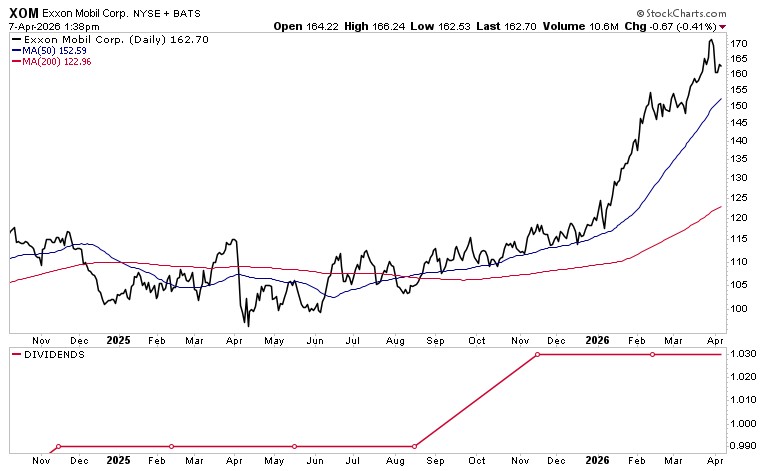
ExxonMobil Corp (NYSE:XOM) hit a record high of $176.41 on March 30, then settled to $162.70 as of this writing. The catalyst was a fourth-quarter earnings beat driven by record production and a shareholder return plan that includes $20 billion in buybacks for 2026.
Q4 2025: Earnings Beat on Record Production
ExxonMobil reported fourth-quarter earnings of $6.5 billion, or $1.53 per share. Excluding identified items, earnings were $7.3 billion, or $1.71 per share, topping the Wall Street consensus of $1.70 per share. Full-year 2025 earnings reached $28.8 billion ($6.70 per share), with cash flow from operations of $52.0 billion.
The production number that made the quarter possible: 4.7 million barrels of oil equivalent per day, the highest in more than 40 years. That volume offset lower oil prices in 2025, a dynamic that matters for the forward thesis.
Permian and Guyana Drive the Volume Story
Two assets powered the production record. The Permian Basin delivered 1.6 million barrels of oil equivalent per day, an annual record. Guyana contributed 700,000 gross barrels per day, also a record. Those numbers were boosted by the $59.5 billion acquisition of Pioneer Natural Resources (NYSE:PXD) in 2023, which added 18 billion barrels of oil equivalent to Exxon’s Permian inventory.
ExxonMobil is shifting its portfolio mix toward liquids, which carry higher cash margins than gas. The company’s total proved reserves stood at 19.9 billion barrels of oil equivalent at end-2024, 69% liquids. That mix improvement is a structural margin driver, not a one-time event.
For traders tracking the crude oil profile, the production growth from these two basins means Exxon’s earnings are becoming less sensitive to short-term price swings – though not immune.
Cash Flow and Shareholder Returns: $20B Buyback in 2026
ExxonMobil distributed $9.5 billion to shareholders in the fourth quarter: $4.4 billion in dividends and $5.1 billion in share repurchases. For full-year 2025, the totals were $17.2 billion in dividends and $20.0 billion in buybacks.
The company plans to buy back $20 billion of its shares in 2026 and maintain the same pace in 2027. That level of repurchase, combined with a dividend that has increased for 43 consecutive years at a compound annual growth rate of about 6%, creates a total return engine that has delivered 204% over the last decade with dividends reinvested.
The current quarterly dividend of $1.03 per share ($4.12 annualized) yields 2.56% – more than double the S&P 500’s 1.24% yield, which is the lowest in 50 years.
2030 Plan: $25B Earnings Growth Target
In December 2025, ExxonMobil announced an updated 2030 business plan targeting $25 billion in earnings growth and $35 billion in cash flow growth compared with 2024. Both figures are $5 billion higher than the previous plan. The company projects earnings growth of 13% per year through 2030, with double-digit cash flow growth and even higher per-share growth as buybacks reduce the share count.
Practical rule: The 2030 plan is the valuation anchor. If Exxon delivers on those targets, the current price-to-earnings multiple on 2025 earnings of about 24x (based on $6.70 EPS and $162.70 stock price) compresses quickly as earnings compound. If execution slips or oil prices fall, the multiple becomes a risk.
Valuation After the Record High: Alpha Score 53
ExxonMobil carries an Alpha Score of 53/100 (Mixed) on AlphaScala’s proprietary system. That score reflects the tension between strong fundamentals and a stock that has already re-rated to a record high. The XOM stock page shows the full breakdown.
Key insight: The record high of $176.41 was a momentum event tied to the earnings beat and buyback announcement. The pullback to $162.70 suggests the market is pricing in execution risk on the 2030 plan and the possibility of lower oil prices. Total returns over 10 years (204% with dividends) are impressive, though past performance does not guarantee the next decade’s returns.
What Could Weaken the Thesis
Three risks stand out for the post-print setup:
- Oil price sensitivity: Record production in 2025 overcame lower prices. A sustained drop below $60 per barrel would pressure earnings even at 4.7 million boe/d.
- Execution on the 2030 plan: The $25 billion earnings growth target assumes continued production gains from Permian and Guyana, plus margin expansion from the liquids mix. Any operational setback in those basins would delay the timeline.
- Long-term demand shift: The global push toward zero emissions creates regulatory and reputational headwinds. ExxonMobil has responded with emissions reduction targets. The structural shift in energy demand remains a multi-decade overhang.
For now, the earnings beat and buyback plan provide a floor. The next catalyst will be the first-quarter 2026 production update and any change in the oil price outlook. Traders watching the PXD stock page should note that the Pioneer acquisition is fully integrated, and the Permian production trajectory is the single most important metric to track.