Enterprise AI Study: Workers Adopted AI, Companies Didn't Adapt
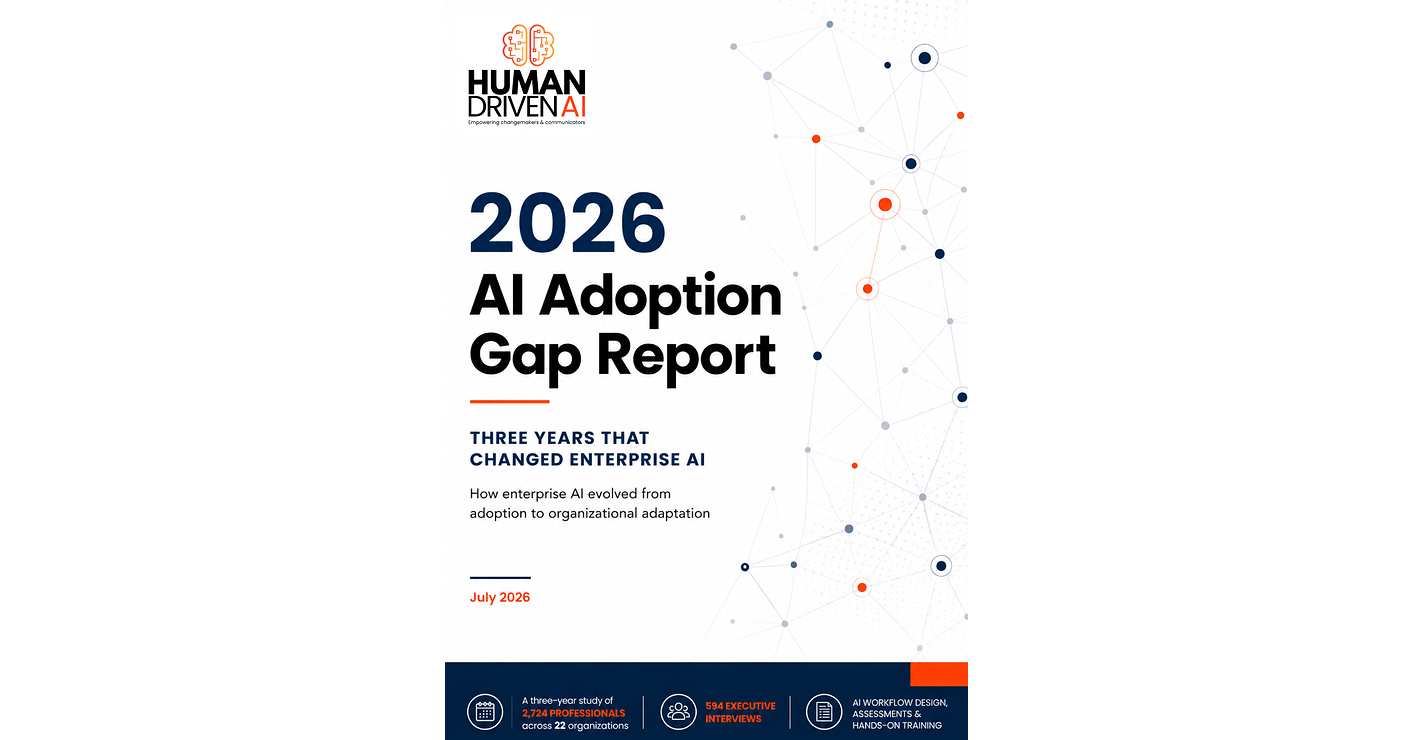
A three-year study of 2,724 professionals finds employees already use AI at work. The bottleneck is organizational redesign, not technology adoption. Companies that redesign roles will lead.
Alpha Score of 57 reflects moderate overall profile with strong momentum, poor value, strong quality. Based on 3 of 4 signals – score is capped at 90 until remaining data ingests.
A three-year study tracking how enterprise AI moved from curiosity to routine work found that employees already changed. Organizations had not.
Human Driven AI's 2026 AI Adoption Gap Report followed 2,724 professionals, conducted 594 executive interviews, and worked hands-on with 22 organizations between 2023 and 2026. The company started with a simpler question – how employees were adopting AI. What it found was that adoption was not the problem. The bottleneck was organizational redesign.
"Because we weren't just surveying people, we were working alongside them, we had a front-row seat to one of the fastest workplace transformations in modern history," said Jennifer Jones-Mitchell, founder and CEO of Human Driven AI. "That allowed us to observe not just what organizations were doing, but how their thinking evolved over time."
The research captured how the questions leaders asked shifted each year. In 2023 the conversation centered on whether employees should use AI. By 2024 it moved to which tools to adopt. By 2025 and 2026 the discussion had left technology behind entirely and turned to how work itself must change.
The report's central finding is simple: organizations are not struggling to get employees to adopt AI. They are struggling to adapt to a workforce that already has. That mismatch, the researchers said, is now the primary barrier to capturing value from AI investments.
For companies like Apple (AAPL) and other technology firms pouring capital into AI, the implication is that the next competitive advantage will come from redesigning workflows and roles, not from deploying more powerful models. The report documented that organizations succeeding with AI are not eliminating people. They are redefining what people do.
"The answer was never to resist AI," Jones-Mitchell said. "It's to help employees learn to work alongside it. It comes down to this. The companies that pull ahead won't simply have better AI. They will build better organizations around how humans and AI work together."
The report is available for download from Human Driven AI's website.
Drafted by a large language model from the source reporting linked above, then screened by automated publishing checks. It is not read by a journalist before publication. Some articles cite our Alpha Score. Verify prices and figures against the original source. Educational coverage, not personalized advice.