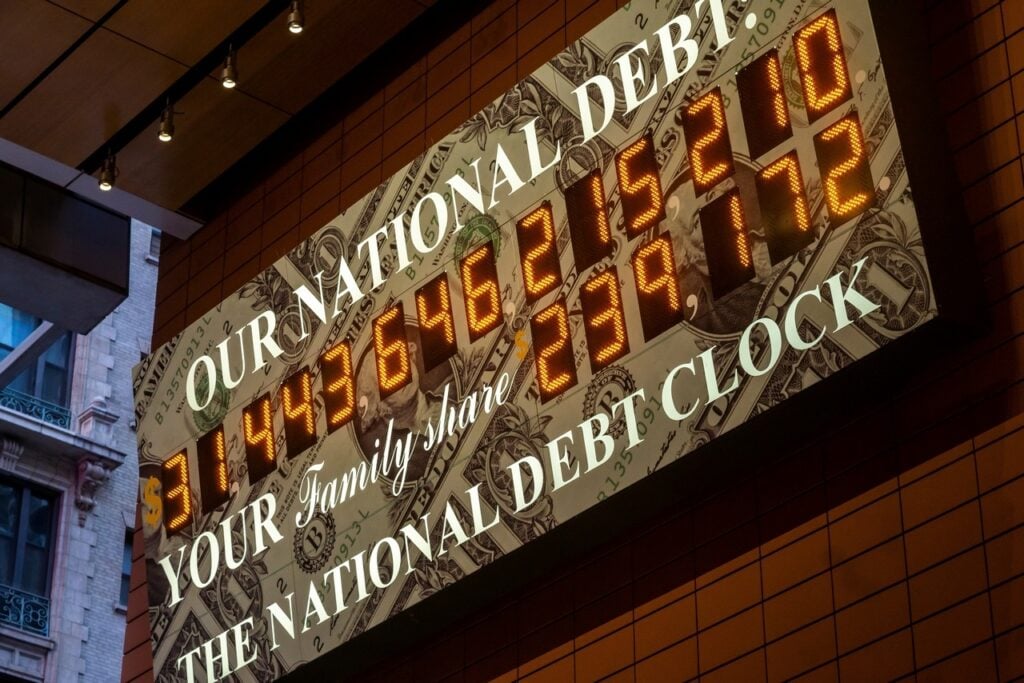
The United States has reached a structural milestone that is increasingly dominating investor discourse: national debt has officially surpassed 100% of gross domestic product. As of the end of March, the debt-to-GDP ratio reached 100.2%, a level not observed since the immediate aftermath of World War II. With total national debt now exceeding $39 trillion and projections placing it on a trajectory toward $40 trillion by the November elections, the mechanics of fiscal sustainability have moved from academic theory to the center of portfolio construction.
The Mechanism of Devaluation
Market participants are increasingly debating whether currency devaluation is an accidental byproduct of policy or an intentional tool for debt management. The naive interpretation of the current debt load focuses on the raw dollar amount, viewing $40 trillion as a static hurdle to be cleared through spending cuts or tax increases. However, a more sophisticated read suggests that the market is already pricing in a long-term erosion of purchasing power. If the government cannot inflate away the debt through traditional growth, the alternative is a quiet, persistent devaluation where the nominal value of the debt remains, but the real value of the currency used to repay it declines.
This mechanism explains why assets like equities and real estate have seen consistent nominal appreciation. The market is not necessarily signaling a surge in productivity or intrinsic value; it is signaling a repricing of assets against a weakening denominator. For the individual investor, this creates a paradox: holding cash or fixed-income instruments that do not outpace the rate of currency debasement results in a guaranteed loss of real wealth. This reality is driving a shift in sentiment, where investors are moving away from the assumption that the dollar is a stable store of value and toward strategies that prioritize hard assets or inflation-hedged instruments.
Managing Interest Obligations
While the headline debt figure is alarming, the more immediate operational risk is the cost of servicing that debt. A segment of the market argues that the U.S. does not require a total reduction of the $40 trillion burden, but rather a sustainable management of interest payments. This perspective relies on the assumption that as long as the economy grows at a rate that allows for the servicing of interest, the absolute level of debt is secondary.
However, this setup is highly sensitive to interest rate volatility. If rates remain elevated, the portion of the federal budget dedicated to interest payments will continue to crowd out other fiscal priorities, potentially forcing the Federal Reserve into a position where it must choose between maintaining price stability or facilitating government borrowing. Investors should monitor the relationship between Treasury yields and GDP growth; if the cost of debt service begins to consistently outpace economic expansion, the probability of forced monetary intervention increases significantly.
Portfolio Construction in a Devaluation Cycle
For those navigating this environment, the traditional 60/40 portfolio is facing significant scrutiny. When both stocks and bonds are priced in a currency that is losing value, the diversification benefit of the portfolio is diminished. This has led to a rise in interest for alternative asset classes that offer a hedge against systemic currency risk. Platforms such as Masterworks, which provides fractional access to blue-chip art, or Arrived Homes, which facilitates fractional real estate ownership, are gaining traction as investors seek to move capital into assets that are not directly tethered to the fluctuations of the fiat currency system.
Welltower Inc. (WELL) remains a relevant case study in this environment, as the firm operates within the real estate sector where asset values are often used as a hedge against inflation. With an Alpha Score of 52/100, the stock reflects a mixed sentiment, balancing the inherent value of its healthcare-focused real estate portfolio against the broader pressures of interest rate sensitivity and capital costs. Investors looking at WELL stock page should consider how the firm's balance sheet management interacts with the broader macro environment of rising debt and potential currency debasement.
The Catalyst Path
What would confirm the thesis of accelerating devaluation? The primary indicator is not a single inflation print, but the long-term trend in real interest rates. If real rates remain negative for an extended period, it confirms that the system is relying on financial repression to manage the debt burden. Conversely, a move toward austerity—characterized by significant spending cuts or tax reforms—would weaken the devaluation thesis, though such measures remain politically difficult to implement.
Investors should also watch the behavior of the Treasury market. If demand for long-term debt weakens, forcing the central bank to step in as a buyer of last resort, the market will likely interpret this as a signal that the debt is no longer sustainable through private market demand. This would likely trigger a flight into non-correlated assets and a further repricing of the dollar. In this environment, the most effective strategy is not to predict the exact timing of a fiscal crisis, but to ensure that the portfolio is not overly exposed to the singular risk of currency debasement. Diversification across real estate, fixed-income alternatives, and productive assets remains the most practical defense against a macro environment where the debt-to-GDP ratio has become a permanent feature of the economic landscape. For those seeking to refine their approach, utilizing professional guidance to map these risks to personal retirement and tax strategies is becoming a standard, rather than optional, component of wealth management.