China's experiment with data intellectual property registration has moved from policy paper to working infrastructure. By April 2026, the China National Intellectual Property Administration (CNIPA) pilot program had issued more than 48,000 Data IP certificates across 17 provinces and municipalities, supporting over RMB 15 billion in financing and licensing transactions, according to CNIPA figures.
The framework traces back to the "Data Twenty Measures" policy document published in 2022. Rather than assigning exclusive ownership of raw data, that document separated data-related rights into three categories: the right to hold data resources, the right to process and use data, and the right to commercialize data products. CNIPA launched its regional Data IP pilot in November 2022, working through provincial IP administrations that each set up their own registration systems under central guidance.
Courts have started giving these certificates real legal weight. Two appellate decisions show the pattern. In the DataTang case (DataTang (Beijing) Technology v. Yinmu (Shanghai) Technology), the defendant reproduced about 200 hours of the plaintiff's registered 1,505-hour speech corpus on its website. The Beijing Intellectual Property Court treated the Data IP certificate as prima facie evidence of lawful provenance and legitimate control over the processed dataset. The court grounded liability in the general clause of the Anti-Unfair Competition Law, not in any dedicated data property right, and awarded RMB 100,000 in damages.
The Taobao-Taoshu dispute followed similar logic. The defendant had systematically extracted and commercialized proprietary business analytics data from Alibaba's Business Advisor platform. The Nanjing Intermediate People's Court used the Data IP certificate as evidence of lawful source and legitimate holding, then awarded the full RMB 30 million claimed, including punitive damages under trade secret law and unfair competition doctrines.
These decisions show a courts that is willing to protect data interests but cautious about creating new property rights without explicit statutory authorization. The certificate reduces a plaintiff's burden of proving lawful acquisition, processing, and control. Substantive protection still comes from existing doctrines, primarily the Anti-Unfair Competition Law and trade secret law.
Zhejiang Province: The Most Active Pilot
Zhejiang has been the most aggressive pilot region. By April 2026 the province had received over 80,000 Data IP registration applications and issued more than 31,000 certificates, recording over RMB 14.5 billion in transactions, licensing, and financing linked to registered Data IP, according to the Zhejiang Intellectual Property Research and Service Center.
Zhejiang evaluates applications against four substantive criteria. The data must be lawfully collected, compliant with the Data Security Law, the Cybersecurity Law, and the Personal Information Protection Law. It must be algorithmically processed -- cleaned, anonymized, or computationally transformed, not merely aggregated. It must show practical value for decision-making, market analysis, or R&D. And it must reflect intellectual effort in the creative organization or curation of data.
These criteria resemble copyright law's originality requirement in their emphasis on intellectual input and value-added processing. The lawful collection requirement ties back to China's broader data governance framework.
Survey Data: Who Registers and Why
The most granular evidence comes from two surveys conducted by the Zhejiang Provincial Research Center for Data IP at Zhejiang University and the Zhejiang Intellectual Property Research and Service Center. The 2025 survey covered 1,049 valid respondents from the January-November 2025 cohort, with a 93.2% response rate. A 2024 survey covered 823 respondents from the May 2023-April 2024 cohort. Both used stratified random samples across 20 industry categories and 11 prefecture-level administrative divisions.
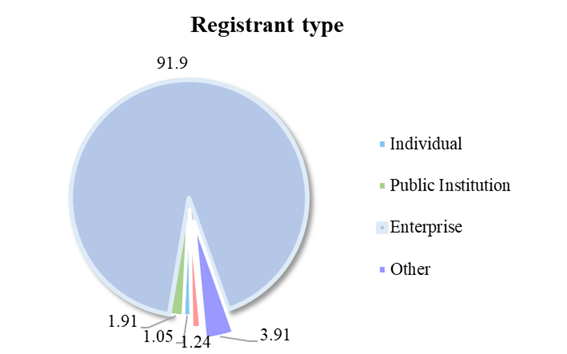
Enterprises dominate registration, accounting for 91.9% of all registrants in 2025. Among enterprise registrants, non-state-owned companies make up 91.7%, state-owned enterprises 6.95%. Foreign-invested and Hong Kong, Macao, and Taiwan-invested enterprises participate only marginally. The survey's authors attribute this to the registration requirements, which generally presuppose identifiable commercial application scenarios and practical value. Foreign-related enterprises may also face additional concerns over cross-border data regulation and compliance review.
Most registrations came from three sectors: software and information technology services, wholesale and retail, and manufacturing. Agriculture, scientific research, health and social work, transportation, construction, finance, education, and culture and entertainment each contributed much smaller shares.
The top three motivations for registration were developing data products or product standards, strengthening corporate reputation, and preventing imitation or misappropriation. These are market-oriented motives but not primarily about immediate commercialization. They point to registration as a tool for formalizing data products, signaling credibility to external stakeholders, and creating defensive protection.
On valuation, the 2025 survey asked registrants what price they would accept to sell their Data IP on the day they obtained the certificate. More than half reported valuations below RMB 100,000, with the largest single group in the RMB 50,000-100,000 range. Nearly four-fifths were below RMB 500,000. A smaller upper tail included valuations above RMB 5 million and even above RMB 30 million. This suggests a long-tail structure: most registered data IP is modestly valued, while a limited number of certificates carry substantial commercial potential.
Average annual sales revenue from data IP-related products and services was RMB 4.54 million per registered certificate in 2024. Extrapolating to the 11,713 registered data IP in Zhejiang yields an estimated total revenue of RMB 53.19 billion, with a 95% confidence interval from RMB 41.37 billion to RMB 65.01 billion. The survey authors caution that this revenue cannot be attributed solely to registered data IP, since technology, labor, customer relationships, and market channels also contribute.
Of the 1,049 respondents in the 2025 survey, 171 had engaged in some form of commercialization or transaction activity involving Data IP. The dominant form was self-development of products or services, followed by balance-sheet recognition as a data asset, entrepreneurial activity, licensing, credit-enhanced financing, and combined transfer-and-licensing arrangements. Cross-border circulation, securitization, and trust structures remained marginal. Data IP is still used mainly internally, as an input to a firm's own products rather than as a freely traded asset.
The Second System: NDA Data Property Rights Registration
A separate institutional framework has emerged under the National Data Administration (NDA), established in October 2023 within the National Development and Reform Commission. The NDA has a broader remit than CNIPA, coordinating data integration, sharing, development, utilization, and the Digital China strategy.
In April 2026 the NDA released the Guidelines for Data Property Right Registration (Trial), bringing the three-types separation framework into operation at the national level. The Guidelines allow separate registration of the right to hold data resources, the right to process and use data, and the right to commercialize data products, recognizing these rights may belong to different parties. Registration authorities are nominated by provincial governments and approved at the national level. The national registration platform is designed to support a "register once, use nationwide" model, reducing fragmentation across regional pilots.
Regional pilots under the NDA framework are running in Xiamen, Fujian, and Hangzhou, Zhejiang. By February 2026 Xiamen had issued 83 data property rights registration certificates, attracted more than 30 professional service providers for compliance certification and asset valuation, and supported the listing and trading of nearly 200 data products with a combined transaction value of more than RMB 10 million. In Hangzhou the data exchange had issued more than 300 certificates by April 2026, covering manufacturing, healthcare, financial services, transportation, and embodied intelligence.
A third initiative, led by the Ministry of Finance, focuses on treating data as an asset for financial reporting purposes. In 2025 the MoF launched a pilot program for whole-process management of data assets involving several central ministries, major state-owned enterprises, and 16 provincial and municipal governments. The pilot covers compiling inventories of data assets, establishing data asset registration systems, improving mechanisms for authorized data operation, refining revenue-sharing mechanisms, and standardizing transaction and circulation procedures. A Data IP certificate or a data rights registration record may help support the recognition of data assets by providing evidence of provenance and a basis for valuation.
Where the System Stands
China's Data IP experiment is no longer just a policy slogan. The combination of growing registration numbers, emerging litigation outcomes, survey evidence, and sustained institutional investment shows a system being used in practice with real legal and commercial consequences. Courts have treated Data IP certificates as prima facie evidence of lawful data provenance and legitimate control over data products.
This progress also reveals the limits of the current framework. Enforcement still relies on the Anti-Unfair Competition Law. That approach lets courts protect data-related interests without creating a new property right. As data transactions become more frequent and rights arrangements more complex, that provisional route may prove insufficient. The relationship between CNIPA's Data IP registration system and the NDA's data rights framework has not been fully clarified. Data asset recognition depends on valuation methods that are still developing. If transaction markets remain thin, reliance on registered or self-reported values could create risks of inflated or unstable balance-sheet treatment.
Whether the infrastructure can evolve into a more active data market depends on whether different registration systems become interoperable, whether valuation standards become more reliable, and whether a professional ecosystem of brokers, certifiers, valuators, transaction platforms, and legal service providers develops sufficient credibility. The market analysis implications for foreign companies operating in China's data economy are that Data IP registration now carries evidentiary value in litigation. The small foreign-investor share in registration suggests cross-border data regulation remains a barrier.
The Zhejiang survey captures where the system currently sits. Firms register data IP mainly to support data product development, establish product standards, enhance reputation, and protect commercially valuable datasets. Direct market transactions such as licensing, transfer, and financing are present but still limited. Commercialization is dominated by internal use. At this stage Data IP registration functions less as a mechanism for creating a liquid market in standalone data assets and more as institutional infrastructure that helps firms identify, document, govern, and legitimize data resources already connected to business operations.