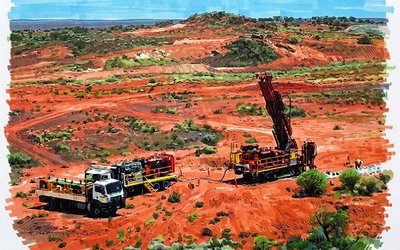
Caprice Resources (ASX: CRS) has shifted the narrative at its Island Gold project following the discovery of a high-grade intercept measuring 22 meters at 66.2 g/t gold. This result, which includes a bonanza-grade interval of 8 meters at 181 g/t gold from 42 meters downhole, marks the highest-grade intersection recorded at the site to date. By identifying this mineralization 120 meters west of the established Vadrians lode, the company has effectively expanded the project's geological footprint and altered the technical outlook for its upcoming maiden Mineral Resource Estimate (MRE).
Geological Implications of the New Zone
The discovery is notable not just for its grade, but for its structural context. The mineralization is hosted within a weathered shear zone, suggesting a geological style distinct from the banded iron formation (BIF) hosts previously identified at the Vadrians lode. This distinction implies that the project may possess multiple, varied mineralized systems, which increases the potential scale of the resource. With three diamond drill holes currently awaiting assay results to test depth continuity, the immediate focus is on confirming whether this shear zone maintains its grade profile at depth.
For investors, the primary mechanism to watch is the transition from anomalous air-core hits to confirmed, high-grade RC intercepts. The company has already identified multiple anomalous trends, including Trig Gully and Ironclad Extended, which are now prioritized for follow-up testing. The success of this 50,000-meter drilling program is the primary catalyst for the MRE, as the company seeks to prove that these isolated high-grade hits represent a cohesive, mineable deposit rather than localized pockets.
Balance Sheet and Divestment Mechanics
Beyond the drill bit, Caprice has executed a strategic pivot to streamline its capital allocation. The divestment of a 75% interest in the West Arunta (Chobe) project to Corella Resources for a consideration of up to $2.89 million provides a necessary liquidity injection. With $2.70 million in cash expected at completion, the company’s balance sheet is projected to reach $16.5 million. This liquidity is critical for sustaining the aggressive 50,000-meter drilling program without the immediate need for dilutive equity raises.
However, the structure of the West Arunta deal introduces specific long-term variables. While Caprice retains a 15-25% interest and is free-carried to a Decision to Mine, the potential conversion of this interest into a buy-backable Net Smelter Return (NSR) royalty could cap the upside if the project proves highly prospective. Investors should monitor the progress of Corella Resources' $5 million capital raise at $0.012 per share, as the completion of the Chobe acquisition remains contingent on this funding and subsequent regulatory approvals.
Risk and Execution Framework
Market participants should distinguish between the immediate excitement of bonanza grades and the operational reality of resource definition. The primary risk remains the conversion rate of these high-grade intercepts into a formal resource. If the upcoming RC drilling fails to demonstrate continuity between the new shear zone and the Vadrians lode, the valuation premium currently being priced into the exploration potential may contract.
Conversely, if the diamond drilling confirms depth continuity, the project’s profile will shift from a speculative exploration play to a more defined asset. The company’s current Alpha Score of 66/100 reflects a moderate sentiment, balancing the high-grade discovery against the inherent risks of junior mining development. For those tracking the broader sector, this development serves as a reminder of how asset divestment can be used to fund core exploration, a strategy that is increasingly common in the current stock market analysis environment. As the company moves toward its maiden MRE, the ability to maintain consistent grade delivery across the 50,000-meter program will be the ultimate test of the project's economic viability.