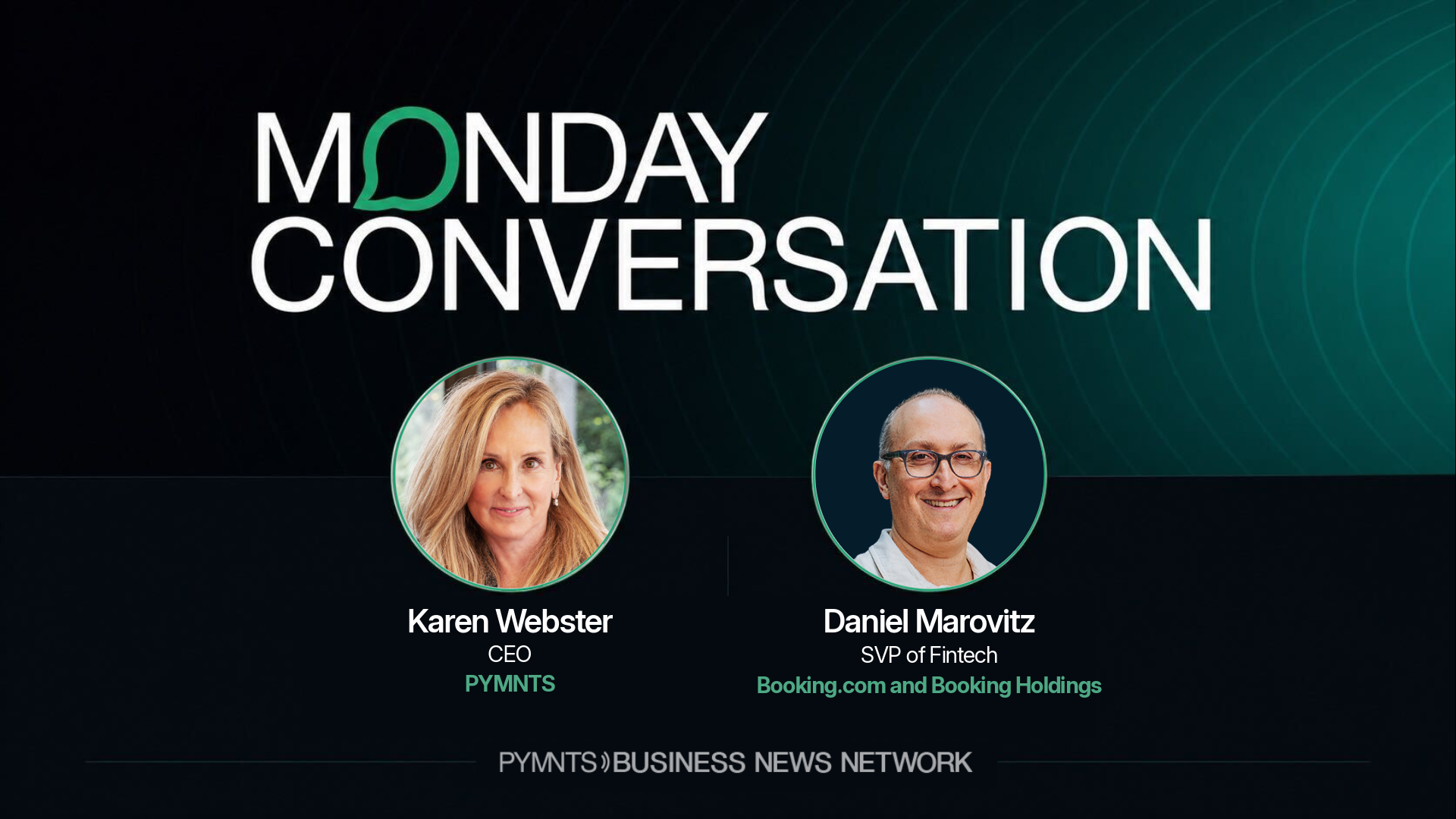
Daniel Marovitz, SVP of Fintech at Booking Holdings, has watched AI adoption hit consumers faster than any prior technology cycle. "In the course of any technology adoption curve, not mobile phones, not personal computers, not the original adoption of the internet, original adoption of eCommerce, we've never seen consumer adoption like this," he told PYMNTS CEO Karen Webster. "It is absolutely breathtaking."
Breathtaking adoption gets attention. Marovitz is clear that adoption alone does not build a moat. Execution does.
Travel platforms have historically operated two layers. The front door is the search box, the app, the website. The operating layer is everything the consumer never sees: payments, currencies, supplier relationships, fraud controls, compliance, refunds and service. AI is collapsing the distance between them.
The consumer-facing assistant that plans a wedding trip to Rome can take in dates, weather, flights, hotel preferences and things to do. It can narrow options, surface a payment choice and prepare the purchase. At the same time, other AI agents are moving inside the platform, contacting hotel partners, filling supplier-information gaps and routing payments. Both sides are headed toward the same transaction.
Marovitz says direct traffic has been a "hard fought battle" for Booking. The company has spent years increasing the share of customers who arrive through its own website or app. That direct relationship remains a critical priority.
The LLM is not the first platform to sit between a traveler and the transaction. Google, Facebook and TikTok already do. "Is some of the traffic that would've come from Google or gone through Facebook or gone through TikTok gonna go through an LLM front door? I think for sure," Marovitz said.
That answer sounds like a channel shift. He agreed it is more than that. Search sends the traveler to a list. Conversational AI can hold the context, reduce the list and move the traveler toward a decision. The front door starts to absorb the funnel.
An LLM can propose a trip in seconds. Completing one is another matter. Marovitz pointed to OpenAI's earlier experiment with direct commercial integrations, including Booking, which was later discontinued. The lesson was the distance between answering an eCommerce question and operating the machinery behind the answer.
A travel transaction can cross currencies and borders, involve local payment methods, onboard suppliers, screen for fraud and sanctions, process refunds and create customer-service obligations that last for months. Marovitz called travel payments "absolutely demonically complicated."
AI does not make that complexity go away. It makes the complexity disappear from view.
The traveler may experience one clean conversation. Underneath it, the platform still has to supply the inventory, payments, supplier relationships, compliance and service that turn a recommendation into a completed trip. The interface may move. The execution layer becomes embedded.
Webster asked whether that was Booking's moat and why its front door remains valuable in an agentic world. Marovitz did not hedge: "100%."
Traditional travel platforms were built to deliver abundance. Ask for a four-star hotel in Greenwich Village and the platform can return dozens of properties that meet the brief. Useful. Decisive is another matter. The traveler still has to sort, compare and choose.
AI changes the value proposition. The win is not a longer list with better ranking. It is a shorter path from intent to selection. "The magic is mostly derived from respecting time," Marovitz said. "At some point, when we get to a place where rather than searching through that, you're selecting, because we give you three that we're very, very sure you're going to like."
Getting from dozens to three takes more than keywords. Marovitz used sarcasm in hotel reviews as an example. Older machine-learning systems could classify a complaint as praise because the words looked positive. Modern language models can recognize what the reviewer actually meant.
The same reasoning can follow the traveler into payments. A larger purchase might trigger demand for buy now, pay later. A traveler with both euro- and dollar-denominated cards might be shown the more economical option. Discovery, selection and payment stop behaving like separate steps.
The AI story moves beyond the traveler's screen into the platform itself. Booking is testing voice AI agents that contact hotel partners about unpaid commissions, find the right person to speak with and navigate changes in staffing or contact information. Similar technology is being tested in supplier onboarding, where incomplete information would otherwise require manual follow-up.
Marovitz said AI can let customer service teams spend their time on situations that actually require human judgment, including safety issues and unusual disruptions. Not a head-count discussion, he was quick to point out. A way to allocate humans to the roles where they can be of most value.
AI is also embedded in payment routing. Booking can look at issuer location, transaction currency, purchase size and acquiring bank to choose the route most likely to produce an authorization. At Booking's scale, a small lift in approvals matters. The system can also see what an operator may not, including an acquirer whose authorization performance deteriorates at particular times.
Consumer AI understands the trip. Embedded AI helps the platform assemble, pay for and support it. What the traveler experiences as a single conversation is powered by agents working on both sides of the transaction.
Agent-initiated transactions come with a double edge. A completed sale and a potential source of liability. Marovitz expects truly autonomous purchasing agents to emerge gradually. The complication begins when the agent acts on a broad instruction instead of a fixed order. It might decide that a $1,000 concert ticket is a sufficiently good deal and buy it. Existing payment systems generally assume that a person authorized the purchase. Agentic commerce breaks that assumption.
"I didn't do it, it was my agent," he said describing the potential customer-service dilemma.
Autonomy will likely arrive with a hand on the brake. Webster expects consumers to let an agent find the transaction, then ask for final approval before it commits the funds. "Consumers want to delegate autonomy and authority, only to a point," she said. Marovitz agreed: "Human in a loop will be big."
That human handoff is where the consumer assistant becomes an economic actor, and where intent has to become authority. The platform that manages that boundary also manages the authorization, the dispute and the accountability that follow.
The prompt, the recommendation, the selection, the payment and the operations behind them are converging. A general-purpose AI may frame the trip. A travel platform may narrow the choices and supply the inventory. AI may surface the payment option, route the authorization, follow up with the supplier and prepare customer service for whatever happens next.
To the consumer, that can feel like one continuous interaction. Underneath, the platform is still doing the hard work. The prompt may win the first interaction. The winner will be decided by who can turn the consumer's intent into an authorized payment, a supplier commitment and service that still works months later.