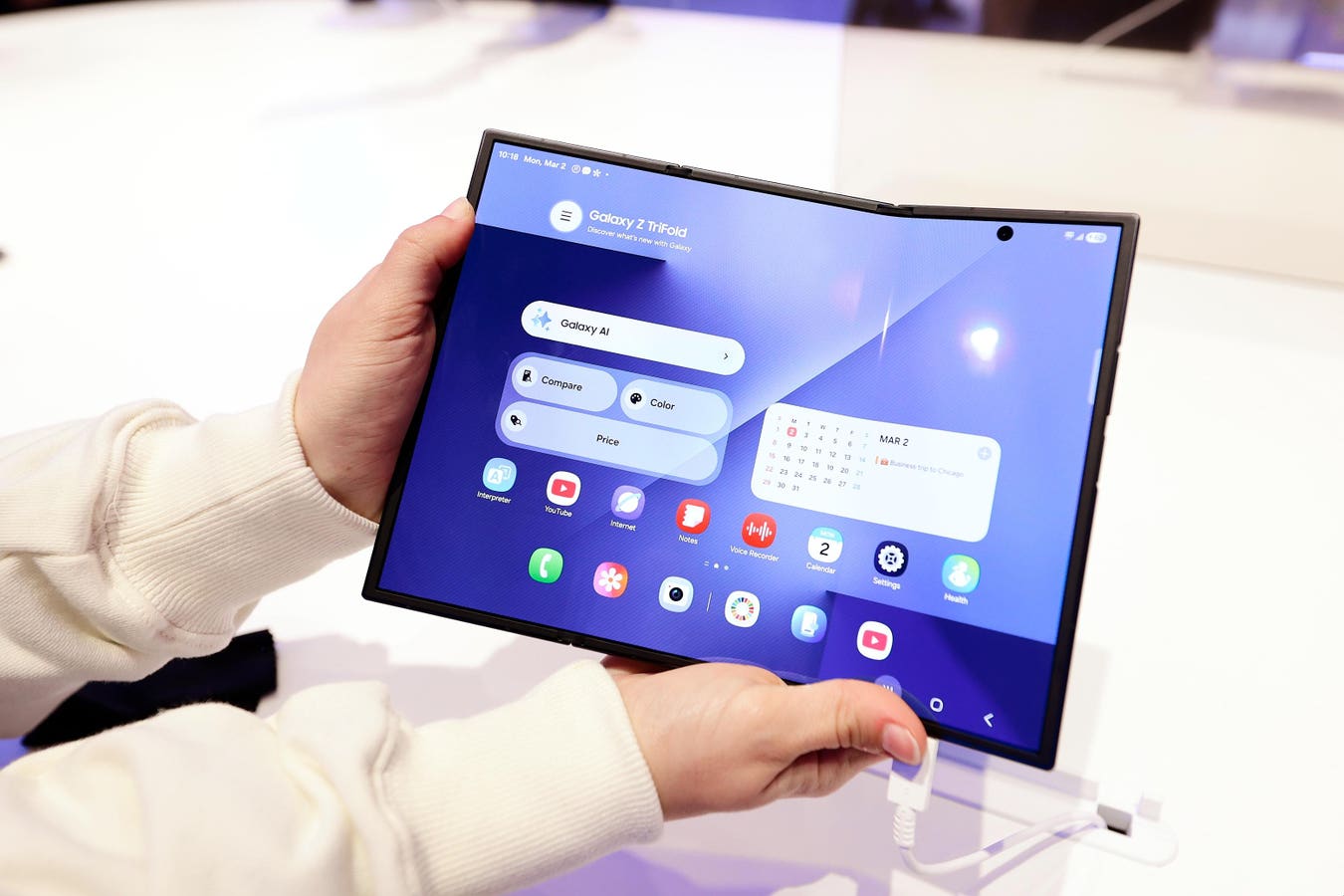
Samsung and Google are betting that a free software upgrade will tilt foldable phone buyers away from Apple. The Galaxy Z Fold 8 and Google Pixel 11 will ship with Android 17 and its new Gemini Intelligence suite this summer, just as Apple prepares to launch its first iPhone Fold. The implication for Apple investors is straightforward: the user experience gap between the devices may widen before the first iPhone Fold ships, and that could compress market-share expectations.
The Agentic AI Feature Gap
Android 17's Gemini Intelligence introduces what Google calls “agentic” AI – the ability to complete multi-step tasks with minimal user input. A user can tell the phone to find a class syllabus in Gmail, add the required books to a shopping cart, and finalize the checkout. The AI can also book gym sessions, build a grocery delivery order from notes, or dig through Google Photos to find a passport photo for a flight booking.
A second feature, Create My Widget, lets users generate a custom home-screen widget by describing what they want – a countdown timer, a weekly meal suggestion, a live package tracker. For a foldable phone, which already emphasizes side-by-side multitasking, the combination of deep customization and agentic automation is a natural fit. The AI can handle a background task while the user runs two other apps on the large screen.
What This Means for the Foldable Battle
The practical advantage is clear. Foldable phones appeal to power users who want to get more done on a single device. Gemini Intelligence turns that into a hands-off automation layer. Samsung and Google are essentially offering a free AI upgrade that adds functionality no current iPhone Fold (nonexistent yet) can match. The marketing will almost certainly frame the Android experience as more capable, using Apple's inexperience with foldable UI as a foil.
Apple faces a strategic crossroad. WWDC kicks off on June 8th and will detail iOS 27. According to Bloomberg's Mark Gurman, Apple will let users choose third-party AI models for image and text generation. That is a meaningful step. It is not the same as giving an AI deep cross-app access to execute tasks. Gemini Intelligence needs to see all apps – Gmail, Photos, Calendar, Notes – to work seamlessly. Apple has historically prioritized privacy over that level of access.
The source notes that Apple settled a $250m lawsuit over promised Siri features that never arrived. That history raises execution risk. If iOS 27 offers only a curated, privacy-restricted AI toolset while Android 17 delivers a fully agentic experience, foldable buyers may split along trust lines. Some users will prefer the privacy-first approach; others will want the convenience of a “seeing” AI that books a flight using their passport photo from Photos.
The Price of Invasiveness
Google's own examples – Gemini pulling personal data from across apps – highlight the trade-off. The AI needs to be “all-seeing” on the device to function fully. Not every consumer will be comfortable with that. If Apple can articulate a compelling privacy alternative without sacrificing too much utility, the iPhone Fold could attract the cohort that finds Gemini's access level unnerving. The risk is that Apple's AI feels underpowered at launch, pushing power users toward the Galaxy Z Fold 8.
Why the Foldable Form Factor Amplifies This
Samsung has shipped five generations of Galaxy Z Fold devices. Google has two Pixel Fold iterations. Both companies have iterated on hinge durability, software splits, and app continuity. Every first-generation foldable the source tested had teething pains. Apple is entering a form factor it has never built at scale. That inexperience is a tangible risk – early reviews of the iPhone Fold could highlight UI quirks that Samsung solved years ago.
Samsung and Google clearly believe people will happily let AI book flights, hotels and restaurants with minimal oversight, pulling personal information from across your apps to fill in complex forms. Google even gave the example of Gemini digging through Google Photos to find a passport photo for a flight booking.
That is genuinely useful. It also raises privacy concerns. Gemini needs to be all-seeing on your Android phone to work seamlessly, and not everyone will be comfortable with that. If they are not, maybe Apple will tempt them over with a less invasive AI toolset.
Assets and Exposure
Apple (AAPL) is the most directly exposed U.S.-listed stock. The iPhone Fold is expected to launch in late 2025, with assembly ramp starting mid-year. A disappointing AI strategy at WWDC on June 8 would likely weigh on AAPL sentiment in the foldable narrative, though the broader iPhone cycle still dominates earnings. Supply chain names – Qorvo (QRVO), Skyworks (SWKS), Cirrus Logic (CRUS) – could also see sentiment shifts if iPhone Fold volume expectations adjust.
Samsung (KRX: 005930) and Google (GOOGL) are not directly traded by many AlphaScala readers. The competitive read-through matters for anyone long Apple or short Android hardware plays.
What Reduces the Risk
- WWDC reveals a deeply integrated agentic AI – If iOS 27 includes multi-step automation comparable to Gemini, the differentiation narrows, and the iPhone Fold competes on hardware polish and ecosystem.
- Consumer backlash against Gemini privacy – If early adopters report discomfort with the AI's access level, Apple's privacy stance becomes a stronger selling point.
- Apple delays the iPhone Fold – A slip into 2026 would give Android another full product cycle to lock in foldable buyers.
- Samsung or Google stumble on Android 17 execution – AI accuracy issues or botched automation could erode confidence in the feature set.
What Makes It Worse
- Apple's AI feels underpowered at launch – If iOS 27 offers only third-party model selection without deep automation, the iPhone Fold will launch with a clear capability shortfall.
- iPhone Fold hardware or software glitches – First-gen issues could amplify the AI contrast, especially if Samsung's marketing highlights Apple's inexperience.
- Samsung and Google execute flawlessly on Android 17 – Seamless Gemini integration would cement the AI gap for the entire 2025 cycle.
The single biggest binary event before launch is WWDC on June 8. If Apple shows a credible agentic AI path – even if it launches later in the year – the threat diminishes. A second catalyst is the first independent reviews of the Galaxy Z Fold 8 running Android 17. If reviewers report that Gemini Intelligence is buggy or overhyped, the perceived AI gap shrinks.
The Execution Risk on Both Sides
Both Apple and Google have incentives to execute. Samsung and Google clearly believe users will hand off sensitive personal tasks to a phone AI. That belief may prove correct. It may also hit a trust wall. Apple's approach is safer. It risks looking conservative. For traders, the foldable AI narrative is a new variable in an already competitive premium smartphone market.
Practical rule: The AI feature set on foldables is a new battleground. The first mover with a seamless agentic experience may capture the power-user segment. Watch WWDC for Apple's real AI depth, not just its privacy messaging.
For a broader view of how product cycles affect stock valuations, see our stock market analysis and the Apple (AAPL) profile for historical iPhone launch patterns.