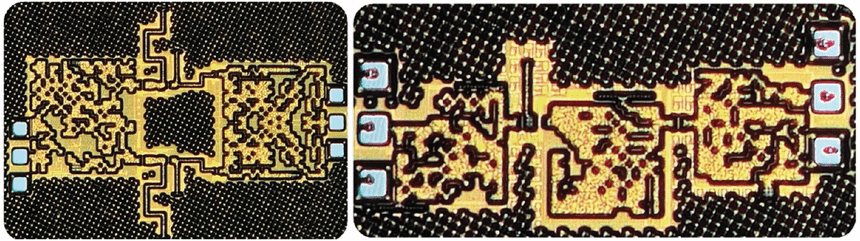
A radio-frequency chip designed by an AI looks like a QR code. It has no symmetry, no repeating blocks, nothing a trained engineer can follow. The signal loss is lower than anything a human team has produced. The chip is tested, verified, and in production. The engineers who commissioned it can prove it performs. They cannot point to a section of the layout and explain why that particular arrangement of metal makes it better.
The gap between knowing it works and understanding why is not a curiosity. It is the same gap opening up across hardware, structural engineering, and AI-to-AI communication. For companies like Apple that design custom chips, this shift matters. The logic that once made chip design a traceable apprenticeship is being replaced by results that are opaque.
Traditionally, chip design used symmetry and straight lines because those are what a human mind can hold and debug. Symmetry is a limit of working memory, not a requirement of electromagnetics. Researchers stripped away every human template and let a reinforcement-learning algorithm design the chip from scratch. The AI placed tiny pieces of metal on a grid. A physics simulation scored each placement. Good placement, reward. Bad placement, penalty. After millions of iterations in hours, the AI converged on layouts no human would have tried – because no human would have thought to try them. The result is not neat. It is closer to visual noise. It outperforms decades of human-refined design because the AI was never constrained by what a person could follow on a schematic.
Two structural reasons explain why this happens. The design space is too large to see. A human can intuit two or three spatial dimensions. The space an RF chip algorithm explores has thousands of independent variables. The system does not need to see the whole space to search it efficiently. Humans do, and structurally cannot. Separately, the function a trained neural network computes is too deep to write down. No single layer is mysterious – multiply, add, squash, repeat. Compose that a few hundred times, and the resulting function has no closed form. No equation a person can simplify. Billions of parameters get tuned, each playing a role closer to a synapse than a line of code.
The same pattern appears in other domains. Aircraft brackets designed by AI look like bone – skeletal, porous, asymmetric. Airbus used the approach to cut bracket weight by nearly 60% without compromising strength. Nobody designed it to look organic. Nature had solved the same optimization problem, and the algorithm rediscovered it independently. In communication between AI agents, a framework called Interlat lets one agent pass its raw hidden state directly to another, skipping text compression. The result is communication compressed by roughly 24x, with agents retaining multiple possible ideas at once instead of committing to a single linear thought.
Three different domains. Same move: remove the requirement that a human be able to follow along, and performance jumps.
For most of engineering history, trust was built on tracing the logic. If a bridge held weight, an engineer could show the load calculations for every truss. That assumption is breaking down. The teams building the QR-code chip, the bone-shaped bracket, and the telepathic agent pair cannot walk through the logic the way an engineer once could. The discipline has pivoted from checking the reasoning to checking only the result. Run the simulation. Run the stress test. If the output holds up, ship it – regardless of whether anyone can explain the path that got there.
We have gone from being the architects of these systems to being their auditors. A model simple enough for a person to trace end-to-end is too simple to search a space with thousands of dimensions. The readable version is not a rough draft of the powerful one. It is a weaker model. Illegibility is not a side effect anyone is trying to patch out. In every case, it is the actual mechanism producing the gain. The chip got better because it was not constrained to be readable.
That leaves a question none of this answers. Once verifying the result is all we have left, how much verification is enough before we call something trustworthy? The chip is already in production.