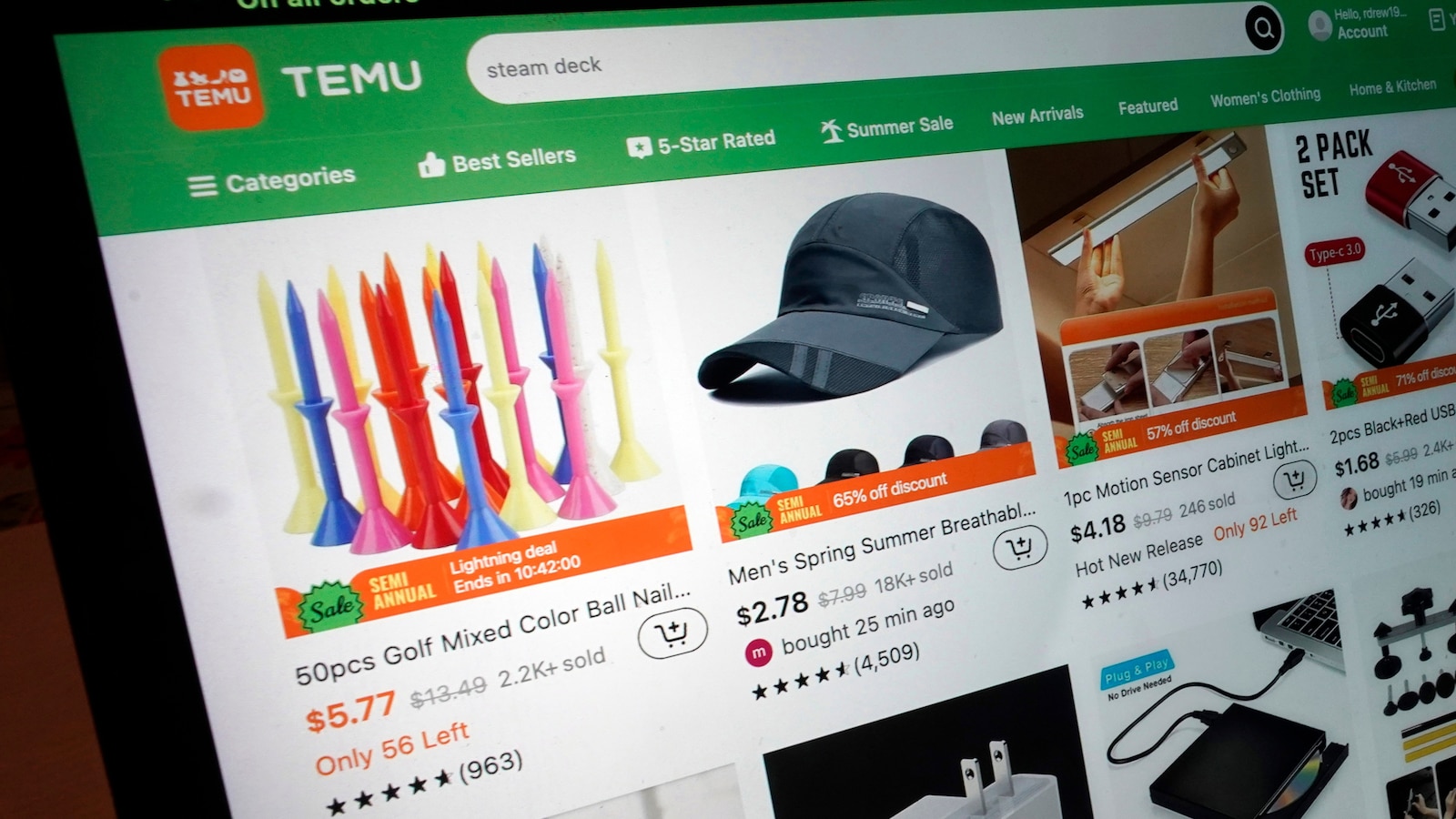
European Union regulators fined Temu €200 million ($232 million) on Thursday after an investigation found the Chinese online retailer failed to protect consumers from illegal products, including toxic baby toys and unsafe electronics. The penalty, issued under the Digital Services Act (DSA), targets Temu's parent company PDD Holdings Inc. (PDD) and introduces a hard regulatory deadline: Temu must submit an action plan by the end of August or face additional daily, weekly, or monthly fines.
The fine follows preliminary findings last year that Temu exposed its 92 million EU users to a high risk of non-compliant goods. The European Commission conducted a “mystery shopping exercise” that turned up multiple electronic device chargers that failed basic safety tests and a “very high percentage” of baby toys that either contained chemicals above safety limits or had detachable parts posing a suffocation risk.
The DSA Penalty and Temu's Risk Assessment Failure
The European Commission said Temu failed to identify, analyze, and assess the systemic risks of illegal goods on its platform – a breach it considers particularly serious under the DSA. Risk assessments under the law are “not box‐ticking exercises,” European Commission Executive Vice-President Henna Virkunnen said.
Temu said it disagreed with the decision and called the fine “disproportionate.” The company argued the penalty relates to the commission’s first DSA evaluation in 2024 and “does not reflect the current state of our systems.” It added that it has since taken further steps to strengthen risk assessment, platform governance, and user protection.
The DSA Mechanism and Maximum Penalty
The DSA requires online platforms to proactively assess and mitigate risks from illegal content and goods. Failure to do so can trigger fines of up to 6% of global annual turnover. The €200 million penalty is a single shot. The commission can impose additional recurring fines if Temu does not comply with the order.
PDD Holdings' EU Exposure and the Fine's Scale
Temu is the international fast‑commerce arm of PDD Holdings, which also owns the Chinese e‑commerce site Pinduoduo. The EU represents a large and growing user base for Temu – 92 million monthly active users – making it one of the platform’s most important markets outside China.
Revenue and Margin Risk
PDD does not break out Temu’s EU revenue separately. Analysts estimate the region accounts for a meaningful share of the company’s international segment. A forced compliance overhaul could raise operating costs. Potential market access restrictions would hit top‑line growth. The fine itself is manageable relative to PDD’s cash pile – the company held $34 billion in cash and equivalents as of the last filing – so the regulatory trajectory matters more than the one‑time penalty.
AlphaScala's proprietary model assigns PDD an Alpha Score of 52/100, reflecting a mixed risk‑reward profile as regulatory headwinds compound. The stock page for PDD shows the score has been under pressure since the preliminary DSA findings last year.
August Action Plan Deadline and Escalation Triggers
The commission has given Temu until the end of August to submit an “action plan” that addresses the risk‑assessment failures. That deadline is the next concrete catalyst for PDD stock.
- August deadline: Temu must deliver a credible plan showing how it will identify, analyze, and mitigate risks from illegal products. The commission will evaluate the plan and could accept it, demand revisions, or impose further penalties.
- Potential daily fines: If Temu fails to comply by the deadline, the commission can levy recurring fines that compound the financial hit and increase pressure on PDD management.
- Broader DSA enforcement: The Temu case is the first major DSA penalty against a Chinese e‑commerce platform. Other platforms like Shein and AliExpress face similar scrutiny. Temu’s fine sets a precedent for the level of enforcement.
What Would Reduce the Risk
- Temu submits a detailed, evidence‑based risk assessment that the commission accepts.
- The company demonstrates concrete improvements in product safety screening, such as third‑party testing for electronics and toys.
- PDD management signals that the fine and compliance costs are one‑time events with no material impact on international growth plans.
What Would Make It Worse
- The commission rejects Temu’s action plan and imposes daily fines, escalating the financial burden.
- Mystery shopping follow‑ups reveal continued non‑compliance, leading to a broader investigation or market access restrictions.
- Reputational damage spurs EU consumers to shift to competitors, reducing Temu’s user base and revenue growth.
Sector Read‑Through for China E‑Commerce Stocks
PDD stock is the primary affected asset. The stock has already priced in some regulatory risk. The size of the fine and the August deadline introduce a new layer of uncertainty. Other Chinese e‑commerce stocks with EU exposure – JD.com, Alibaba (BABA) – could see sympathy moves if investors re‑evaluate the regulatory landscape for Chinese platforms in Europe.
DSA Enforcement Signal
The fine reinforces the DSA’s teeth. European regulators are signaling that they will enforce the rulebook aggressively, especially on product safety. For investors in cross‑border e‑commerce, the cost of compliance is rising. Platforms that rely on low‑cost, high‑volume Chinese sellers face the most exposure.
For broader stock market analysis, the Temu case is a reminder that regulatory risk in the EU is not theoretical. Companies with large European user bases should be evaluated on their compliance infrastructure, not just their growth metrics.
The €200 million fine is a signal, not a fatal blow. PDD has the balance sheet to absorb it. The real question is whether Temu can satisfy the commission’s demands by August. If it does, the stock may recover as the overhang lifts. If it does not, the penalty structure escalates, and the EU could become a contested market rather than a growth driver.
Investors should watch for the action plan submission and the commission’s response. Any indication that Temu is struggling to meet the DSA’s risk‑assessment standards would confirm the risk is larger than a one‑time fine. A swift and accepted plan would weaken the bear case and allow the market to refocus on PDD’s core e‑commerce economics.